










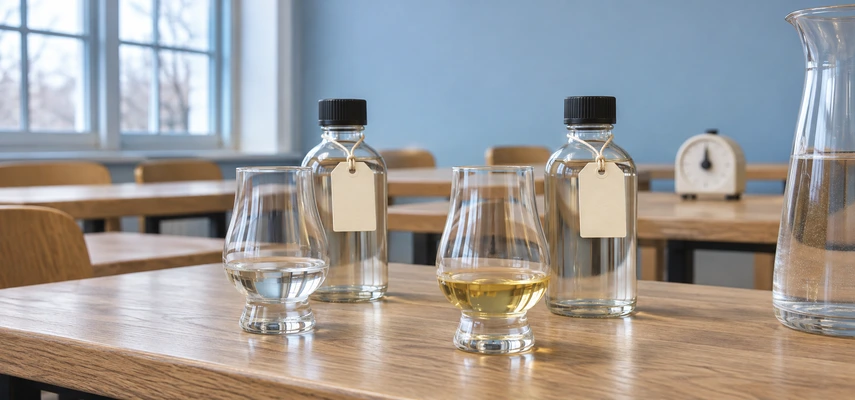

Blind tasting is a test of observation and reasoning, not a contest to recognize a favorite bottle. A correct category guess with a thin note leaves much of the work unfinished. A careful description can remain valuable even when the final identification is uncertain, because it records the evidence rather than merely announcing a result.
The Issue 3 examination specification limits the practical sample range. This article covers every listed category and style through original hypothetical examples, then shows how to organize a two-sample exercise. The teaching keys illustrate plausible interpretations; they cannot replace actual samples, sensory practice or feedback from a trained educator.
Know the eligible range before building a practice flight
The Scotch group includes Single Malt and Blended Scotch Whisky; the American group includes Bourbon and rye whiskey. Grape spirits include Cognac and Armagnac. Sugar cane spirits may be made from molasses or cane juice, while the agave group includes Tequila and Mezcal. Gin covers juniper-forward and contemporary styles.
That list is a practical training boundary, not a claim that other spirits are unimportant. Vodka and the additional global categories remain relevant elsewhere in the qualification, but they should not quietly be substituted for the named tasting-examination range. Plan practice so less familiar eligible groups receive attention alongside the ones you already enjoy.
Keep the samples genuinely blind during the exercise
Ask another person to select appropriate examples and keep the identity key separate. Use neutral bottles and consistent glasses so a familiar label or package does not supply the answer. Ensure each glass corresponds to the correct sample code, then preserve that relationship throughout the notes and eventual reveal.
Do not inspect sample identities halfway through a timed attempt. The reveal can influence the descriptors you expect to find and make the result look more certain than it was. Keep the original note intact afterward, adding corrections and educator comments separately. That record is far more useful for diagnosing recurring mistakes.
Describe each spirit before narrowing its identity
Work through appearance, aromas, palate and the developing finish using your current course tasting reference. Record intensity and characteristics separately, and write texture as a sequence. A clear observation of gentle entry, fuller middle and firm warmth communicates more than an unqualified claim that the sample is smooth.
Use familiar language that fits the actual experience. If you notice dried fruit and spice, record them without immediately naming a protected origin. A bread-like aroma can suggest a cereal-related profile, but it is not a laboratory identification of the mash bill. The note should retain that distinction between sensation and explanation.
Identity needs several observations to work together
A useful identification combines compatible clues and considers conflicts. Juniper, citrus and a botanical palate can support a gin interpretation. Cooked vegetal notes, pepper and an appropriate texture can support an agave-spirit interpretation. None of these groups requires every example to show an identical set of aromas.
Write the strongest alternative when practicing. If an amber, fruit-and-oak sample could fit more than one matured category, identify which additional observation would help you distinguish them. This trains comparison rather than a collection of supposed single-clue rules. It also makes an uncertain conclusion more honest and more open to useful feedback.
Scotch practice needs more than smoke recognition
Single Malt Scotch can show a wide range of cereal, fruit, smoke and maturation influences. A smoky sample does not represent every Single Malt, and a relatively light one does not become a blend simply because it lacks peat. The legal category concerns production, while blind identification draws a reasoned inference from the sensory pattern.
Blended Scotch combines malt and grain whiskies, but the blend need not make each component individually identifiable to the taster. Compare overall cereal, fruit, oak and texture relationships. A coherent lighter profile can be a useful training contrast, provided you remember that a hypothetical note demonstrates one possible example rather than the entire category.
Bourbon and rye overlap as well as differ
Corn-led and rye-led production relationships can help organize knowledge, while new charred-oak maturation supplies shared flavor possibilities. Vanilla, caramel and spice do not belong exclusively to one of the two categories. A learner who assigns every spicy sample to rye may overlook the influence of oak and the variation among Bourbons.
Practice with contrasted examples, then revisit them without labels. Ask whether the observed grain and spice profile, sweetness impression and structure collectively support one interpretation. Keep the answer at the requested category level. Claiming a particular distillery from one cinnamon note adds a much weaker inference than the assessment requires.
Cognac and Armagnac require attention to the whole profile
Both grape-spirit categories can show fruit, floral and matured characteristics. Distillation and maturation choices provide useful theoretical comparisons, but a floral aroma does not prove Cognac and a robust texture does not prove Armagnac. Overlapping profiles are part of the exercise rather than an error in the categories themselves.
Compare the clarity of fruit, the relationship of wood and spice, the texture progression and the finish. A Cognac production account can explain how the category is made, but it cannot authenticate a fictional tasting note as a real bottle. Use production knowledge to interpret observations, keeping the uncertainty of blind inference visible.
Cane-spirit practice should distinguish material from maturation
Molasses and cane-juice routes offer different starting materials, while fermentation, still operation and post-distillation choices broaden the range further. A grass-like note can be useful in a juice-based comparison, but a dark appearance does not identify molasses. An aged juice spirit and a pale filtered molasses rum already disrupt that shortcut.
Mount Gay’s producer account illustrates how fermentation and different still routes can supply components within a molasses-based tradition. The practical implication is to observe the sample’s whole profile. Do not assume every molasses rum is heavy, or every cane-juice spirit unaged, because one training example happened to fit that pattern.
Tequila and Mezcal need more than a smoke decision
Cooked agave, vegetal, pepper, fruit and earthy associations can appear in different combinations. Smoke may be helpful where present, but it is not a universal identity test. Different cooking and distillation choices can produce substantial variation, so a convincing identification should include supporting observations beyond one familiar descriptor.
Remember that wood treatment can add another layer. An aged sample’s vanilla or spice should not erase the possibility of an agave base. Likewise, a clear sample is not necessarily neutral. Compare the underlying aromatic and tactile profile with the relevant production possibilities, then state the category supported by the strongest evidence.
Gin practice should include two botanical balances
A juniper-forward example makes that defining botanical particularly prominent. A contemporary style can give more attention to other botanicals while retaining the necessary gin identity. Neither style is automatically higher quality. Compare the clarity of the profile and its relationship with alcohol and texture rather than rewarding whichever recipe matches your preference.
For a contemporary example, citrus or floral character may be especially noticeable, but do not assume the spirit has no juniper. A tasting note should identify what is present and how the elements work together. The practice aim is to distinguish styles within the eligible range, not to turn contemporary into a synonym for any flavored spirit.
Run a thirty-minute two-sample drill
Set a timer for 30 minutes and assign approximately fifteen minutes to each sample. Within each allocation, complete description, identity and supported quality reasoning. The official framework offers 25 marks per sample: appearance 2, nose 5, palate 10 and conclusions 8. TFE examples do not claim a confidential official marking key for particular bottles.
On separate blank paper, write Sample A and Sample B, leaving space for your descriptive record and your argued decisions. At the finish, check both notes for omissions and unsupported claims. Do not spend nearly the whole session on one fascinating sample while leaving the other with only a category guess.
Review quality independently of a correct identity
A correct answer does not guarantee a well-supported quality assessment. Return to balance and expressiveness using the actual note. Were aromas defined? Did texture develop coherently? Did the finish retain flavor, or only heat? The conclusion should draw on those observations even if the category decision needs correction.
After the reveal, discuss three things separately: descriptive accuracy, identity reasoning and the quality argument. An educator can help identify where the error occurred. You might have observed accurately but applied an overconfident rule, or recognized the category while failing to describe the sample’s most important tactile limitation.
Choose practice pairs deliberately: similar-looking spirits can test aromatic discrimination, while different strengths can test whether you confuse heat with flavor. Record that training objective before selection so the eventual feedback addresses the skill you intended to improve.
What to remember
Cover the entire eligible range, keep the exercise blind and preserve the original record. Describe before identifying, consider alternatives and support quality from the same evidence. The worked examples below are training illustrations rather than unique sensory fingerprints. Use them to organize real practice, and seek trained feedback to calibrate both observations and conclusions.
Tasting practice: original TFE exercises
These hypothetical training examples and qualitative reviews are independently authored. They are not official samples, worksheets or marking keys.
Tasting task 1: Single Malt Scotch Whisky
Task: Treat this as a fictional training note. Identify the broad type and specific category, support a quality conclusion and name a plausible alternative. The heading is the teaching key, not proof of unique identification from words alone.
Illustrative observations: Fictional sample: medium gold, clean; medium-plus apple, malt biscuit, heather and light smoke. Dry, with defined cereal and fruit; a rounded entry grows firmer and gently drying. A medium-plus finish retains fruit and a quiet smoky note.
Reasoning and review: Teaching identity: Scotch whisky, Single Malt Scotch Whisky. Good is a defensible illustrative level: defined character and generally integrated warmth, with moderate development. A blended Scotch remains a plausible alternative; smoke alone cannot settle the distinction.
Common error: Assuming every Single Malt must be heavily peated or every smoky sample comes from one island.
Tasting task 2: Blended Scotch Whisky
Task: Treat this as a fictional training note. Identify the broad type and specific category, support a quality conclusion and name a plausible alternative. The heading is the teaching key, not proof of unique identification from words alone.
Illustrative observations: Fictional sample: pale gold and clean, with medium orchard fruit, light cereal, vanilla and a faint smoky edge. Dry palate; a light entry becomes rounded, then gently warm. Flavor is coherent but relatively simple, with a medium finish.
Reasoning and review: Teaching identity: Scotch whisky, Blended Scotch Whisky. Good can be supported by a coherent profile and proportionate texture, while acknowledging limited development. A lighter Single Malt could resemble this pattern; the example does not make a sensory proof of blending.
Common error: Treating a lighter profile as evidence of inferior quality or uniquely revealing a grain-whisky percentage.
Tasting task 3: Bourbon
Task: Treat this as a fictional training note. Identify the broad type and specific category, support a quality conclusion and name a plausible alternative. The heading is the teaching key, not proof of unique identification from words alone.
Illustrative observations: Fictional sample: medium amber, clean and pronounced vanilla, caramel, toasted corn and oak spice. Dry palate with strong flavor; a rounded mouth-coating middle leads to firm integrated warmth. Sweetcorn-like and woody notes persist into a developing spice finish.
Reasoning and review: Teaching identity: American whiskey, Bourbon. Very good is illustrated by defined aromas, coherent substantial texture and continuing development. Rye whiskey is a relevant alternative because charred-oak and spice notes overlap; the corn-related observation helps but is not conclusive alone.
Common error: Using vanilla as unique proof of Bourbon or calling a sweet-smelling nose a measured sugar content.
Tasting task 4: Rye whiskey
Task: Treat this as a fictional training note. Identify the broad type and specific category, support a quality conclusion and name a plausible alternative. The heading is the teaching key, not proof of unique identification from words alone.
Illustrative observations: Fictional sample: medium amber and clean, with medium-plus rye-bread, citrus-zest, pepper and vanilla impressions. Dry, firm and linear initially, broadening through the middle with controlled warmth. The medium-plus finish retains pepper, grain and a drier woody edge.
Reasoning and review: Teaching identity: American whiskey, rye whiskey. Good is supported by a clear grain-and-spice profile and generally integrated structure; the final dryness limits the positive argument. Bourbon remains plausible and must be weighed against the whole pattern.
Common error: Assuming any pepper or cinnamon note establishes the statutory rye grain percentage.
Tasting task 5: Cognac
Task: Treat this as a fictional training note. Identify the broad type and specific category, support a quality conclusion and name a plausible alternative. The heading is the teaching key, not proof of unique identification from words alone.
Illustrative observations: Fictional sample: medium amber, clean and medium-plus dried apricot, blossom, vanilla and toasted nuts. Dry, with clearly expressed fruit and spice. The soft entry broadens into a rounded, gently warming palate; a long finish develops from fruit to nut and subtle wood.
Reasoning and review: Teaching identity: grape spirit, Cognac. Very good follows from definition, coherent texture and sustained development. Armagnac is a credible alternative; floral character alone does not prove the origin or distillation route.
Common error: Guessing a cru or exact age category from one floral note or an amber color.
Tasting task 6: Armagnac
Task: Treat this as a fictional training note. Identify the broad type and specific category, support a quality conclusion and name a plausible alternative. The heading is the teaching key, not proof of unique identification from words alone.
Illustrative observations: Fictional sample: medium amber and clean, with medium-plus plum, dried fig, spice and earthy notes. Dry palate; an initially firm feel becomes fuller, with substantial but proportionate warmth. Fruit remains through a medium-plus finish, followed by a slightly drying wood note.
Reasoning and review: Teaching identity: grape spirit, Armagnac. Good reflects clear character and generally successful structure, tempered by the drier final impression. Cognac remains a possible alternative; this robust profile is one example rather than a universal Armagnac requirement.
Common error: Treating robustness as a compulsory category trait or proof of lower quality.
Tasting task 7: Sugar cane spirit made from molasses
Task: Treat this as a fictional training note. Identify the broad type and specific category, support a quality conclusion and name a plausible alternative. The heading is the teaching key, not proof of unique identification from words alone.
Illustrative observations: Fictional sample: medium gold and clean, with pronounced banana, ripe pineapple, molasses-like and baking-spice impressions. Dry, full-flavored and rounded; an oily middle supports increasing but integrated warmth. A long finish develops from tropical fruit to spice.
Reasoning and review: Teaching identity: sugar cane spirit, made from molasses. Very good is supported by defined, developing aromas and a coherent full texture. An aged cane-juice spirit is an alternative to consider; color alone cannot identify the raw material.
Common error: Assuming pineapple was added or equating every molasses rum with one heavy national style.
Tasting task 8: Sugar cane spirit made from sugar cane juice
Task: Treat this as a fictional training note. Identify the broad type and specific category, support a quality conclusion and name a plausible alternative. The heading is the teaching key, not proof of unique identification from words alone.
Illustrative observations: Fictional sample: water-white and colorless, clean; pronounced fresh grass, stalk, citrus and floral notes. Dry and strongly flavored, with a light entry developing a rounded middle and firm warmth. A medium-plus finish retains herbaceous and citrus character.
Reasoning and review: Teaching identity: sugar cane spirit, made from sugar cane juice. Good is illustrated by clearly defined material-related character and generally proportionate texture, with moderate development. A light molasses rum remains an alternative rather than being excluded by appearance.
Common error: Making unaged appearance a universal requirement of the cane-juice route.
Tasting task 9: Tequila
Task: Treat this as a fictional training note. Identify the broad type and specific category, support a quality conclusion and name a plausible alternative. The heading is the teaching key, not proof of unique identification from words alone.
Illustrative observations: Fictional sample: water-white and colorless, clean; medium-plus cooked agave, bell pepper, citrus and peppercorn. Dry palate with clear vegetal and citrus flavors; a rounded middle moves into firm but controlled warmth. The medium-plus finish remains herbal and peppery.
Reasoning and review: Teaching identity: agave spirit, Tequila. Good follows from definition and a coherent tactile sequence, while the finish shows moderate complexity. Mezcal is a relevant alternative because a lack of obvious smoke does not exclude it.
Common error: Claiming every clear Tequila is legally additive-free or that a smoke-free sample cannot be Mezcal.
Tasting task 10: Mezcal
Task: Treat this as a fictional training note. Identify the broad type and specific category, support a quality conclusion and name a plausible alternative. The heading is the teaching key, not proof of unique identification from words alone.
Illustrative observations: Fictional sample: water-white and colorless, clean; pronounced cooked agave, roasted vegetable, smoke, citrus and earthy notes. Dry and expressive; an oily middle supports firm warmth. A long finish moves from roasted vegetal character to smoke and quieter herbal flavor.
Reasoning and review: Teaching identity: agave spirit, Mezcal. Very good is supported by distinct, developing character and the integration of substantial texture. A smoky Tequila or another agave tradition can be a theoretical alternative; eligible exam range and the whole pattern guide the final decision.
Common error: Letting smoke replace description of agave character, texture and quality evidence.
Tasting task 11: Gin: juniper-forward style
Task: Treat this as a fictional training note. Identify the broad type and specific category, support a quality conclusion and name a plausible alternative. The heading is the teaching key, not proof of unique identification from words alone.
Illustrative observations: Fictional sample: water-white and colorless, clean; pronounced juniper, citrus peel and coriander-like spice. Dry with pronounced botanical flavor; a light entry becomes rounded, with proportionate warmth. A medium-plus finish retains clearly defined juniper and citrus.
Reasoning and review: Teaching identity: gin, juniper-forward style. Good is supported by clear definition and balance, while development remains relatively direct. A contemporary gin is less persuasive here because juniper is the strongest recorded feature; style is still judged from the whole note.
Common error: Awarding the highest quality solely because juniper is intense or assuming every botanical was processed identically.
Tasting task 12: Gin: contemporary style
Task: Treat this as a fictional training note. Identify the broad type and specific category, support a quality conclusion and name a plausible alternative. The heading is the teaching key, not proof of unique identification from words alone.
Illustrative observations: Fictional sample: water-white and colorless, clean; medium-plus floral, citrus and juniper notes with gentle spice. Dry and clearly flavored; a soft entry develops a fuller middle and restrained warmth. A medium-plus finish moves through citrus, flowers and a quieter juniper note.
Reasoning and review: Teaching identity: gin, contemporary style. Very good is a plausible illustration where the defined botanical development and coherent texture support it. A juniper-forward style remains the closest comparison, but the recorded balance gives other botanicals more prominence.
Common error: Describing contemporary gin as necessarily juniper-free or automatically better than a traditional profile.
Tasting task 13: Blank two-sample simulation
Task: Ask an educator or capable practice partner to choose two eligible spirits and keep the key hidden. Allow30minutes total,15per sample. On fresh paper create your own space for observations and conclusions; do not read the worked examples while the timer runs.
Illustrative observations: Sample A: record what you see, smell, taste and feel, including the developing finish. Sample B: complete a separate record. Leave no descriptive dimension blank, and distinguish intensity from character and warmth from flavor.
Reasoning and review: For each sample identify broad type and specific category, state a quality level and justify it from your note. Review against the official section totals2/5/10/8 only with an appropriate assessor; this drill supplies no invented official bottle-specific score. After the reveal, preserve the first notes and record feedback separately.
Common error: Spending all the time on one sample, identifying a brand instead of category, or replacing the original note after seeing the answer.
Knowledge check: 10 original practice questions
Independent TFE questions, not official WSET examination items. Choose one answer per question; explanations follow separately.
1. What is the full official practical timing?
2. What does a correct identity guarantee about the quality answer?
3. What should a blind-tasting note establish before a category guess?
4. Which Scotch categories are in the stated tasting range?
5. Which grape-spirit pair is eligible?
6. Why is dark color insufficient to identify molasses rum?
7. What should follow the identity reveal?
8. What does contemporary gin mean in this training comparison?
9. Why can smoke alone not uniquely identify Mezcal?
10. Which American categories are listed?
Answers and explanations
- B — Two samples in 30 minutes. Practice should preserve the separate two-sample thirty-minute framework. Mapping: Unit 2.
- C — Nothing; quality still needs supporting evidence. Identification and quality reasoning are separate tasks drawing on the observation record. Mapping: Unit 2.
- B — A complete descriptive record. Observation should lead the identity decision rather than being adjusted to fit an early guess. Mapping: Unit 2.
- A — Single Malt and Blended Scotch Whisky. The practical range names these two Scotch categories specifically. Mapping: Unit 2.
- C — Cognac and Armagnac. These two categories are specifically named for practical sample selection. Mapping: Unit 2.
- D — Maturation and other treatments can also affect color. Appearance does not uniquely establish the sugar-bearing starting material. Mapping: Unit 2.
- D — Separate review of description, identification and quality reasoning. This separation helps determine whether the problem was sensory accuracy or interpretation. Mapping: Unit 2.
- C — Other botanicals receive more prominence within a gin identity. The style distinction concerns the botanical balance rather than abandoning gin identity. Mapping: Unit 2.
- D — Smoke can overlap with other production routes and vary within categories. A complete pattern and appropriate category comparison are stronger than one descriptor. Mapping: Unit 2.
- A — Bourbon and rye whiskey. The tasting range is narrower than the full American whiskey theory discussion. Mapping: Unit 2.
Continue exploring this series
12. Single Malt Scotch Whisky Explained: Production, Distillation, and Quality
13. Grain and Blended Scotch Whisky Explained: Production Choices, Laws, and Style
14. Bourbon Explained: Mash Bills, Distillation, New Oak, and Quality
15. Rye and Tennessee Whiskey Explained: Production Rules and Flavor Differences
17. Cognac Explained: Grapes, Double Distillation, Oak, and Quality
19. Armagnac Explained: Grapes, Column Distillation, and Regional Styles
22. Caribbean Rum Explained: Distillation, Regional Traditions, and Quality
24. Tequila Explained: Agave, Production Choices, and Legal Categories
25. Mezcal Explained: Agave Varieties, Traditional Methods, and Quality
27. Gin Explained: Juniper, Botanicals, Distillation, and Quality
46. The WSET Level 3 Systematic Approach to Tasting Spirits Explained
47. How to Assess Spirits Quality: Balance, Complexity, and Evidence
49. How to Answer WSET Level 3 Spirits Written Questions: Structure, Reasoning, and Marks
50. WSET Level 3 Spirits Exam: Complete Revision Guide and Practice Examinations












