Maintenance teams are responsible for keeping equipment running, reducing downtime, controlling costs, and maximizing asset performance. The key to achieving all these goals is to work smarter and not harder.
If you currently rely on spreadsheets for manual coordination or a basic maintenance software tool, you may face many inefficiencies that can be easily solved by upgrading to a better maintenance software solution. The best manufacturing maintenance software helps organizations streamline maintenance workflows, gain greater visibility, and make data-driven decisions. In the article below, we will look at the signs that you need better maintenance software and what this upgrade brings to your organization.
Key Indicators It Is Time for a System Switch
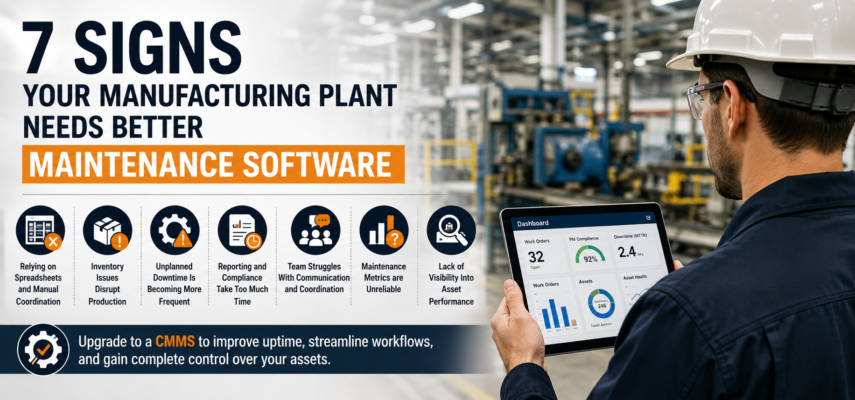
Here are seven key indicators that it is time to switch from your existing maintenance system:
1. You Are Still Relying on Spreadsheets and Manual Coordination
Organizations rely on spreadsheets because they are familiar and inexpensive. Moreover, manual coordination is simple and requires no training. However, as assets, facilities, and maintenance activities grow, spreadsheets become difficult to manage and lead to inefficiencies. Stakeholders have to deal with missing or outdated information, duplicate data entries, a lack of version control, and time-consuming reporting.
2. Inventory Issues Disrupt Production Flow
Poor inventory management leads to two costly situations: running out of critical spare parts or carrying excessive inventory. Without the right inventory software, tracking spare parts usage, monitoring inventory levels, and maintaining accurate inventory records is a major task.
Manufacturing facilities face delays because although spare parts appear to be available in records, they are missing on the factory floor. On the other hand, excessive inventory leads to significant financial losses.
3. Unplanned Downtime Is Becoming More Frequent
Unexpected equipment failure leads to disruption in the production process, delays in deliveries, and an increase in operational costs. If your team spends more time reacting to breakdowns rather than preventing them, you need an upgrade.
Frequent reactive maintenance is a strong indication that your maintenance software is not supporting proactive preventive maintenance strategies.
4. Reporting and Compliance Take Too Much Time
Maintenance managers are often responsible for demonstrating maintenance performance, regulatory compliance, and operational reliability. However, generating reports manually can consume significant time and resources. When critical asset information is stored in employees’ heads rather than digitally recorded, the maintenance process becomes vulnerable to inefficiencies. When your team spends hours compiling data from multiple sources, rather than relying on a centralized platform, it’s time to switch to a more efficient process.
5. Your Maintenance Team Struggles With Communication and Coordination
In a growing organization, maintenance teams often become distributed across multiple shifts, facilities, or locations. Without a centralized system, communication gaps can create confusion and inefficiencies.
In a competitive industry such as manufacturing, teams need a shared platform where technicians, supervisors, and managers can access the same information. Additionally, mobile capabilities are essential for improving accessibility.
6. Maintenance Metrics are Unreliable
For effective maintenance operations, managers rely on key performance indicators. KPIs such as Mean Time to Repair (MTTR), PM Completion Rate, and Mean Time Between Failures (MTBF) are some of the important indicators that determine the current health of assets.
When you operate with an outdated system, these metrics become unreliable. An outdated system forces leaders to depend on guesswork when making decisions.
7. You Lack Visibility Into Asset Performance
Do you know which assets are costing the most to maintain? Which equipment experiences the most downtime? Which machines are nearing the end of their useful life?
If these questions are difficult to answer, your current maintenance software may not be providing you with the insights you need.
Upgrading to a Computerized Maintenance Management System
The CMMS market is a fast-growing global software market. If you are facing several inefficiencies in your maintenance operation, upgrading to a CMMS is important.
1. Improves Data Accuracy and Reporting
A CMMS captures maintenance activities, creating a reliable source of data for performance tracking. Organizations can generate accurate KPIs and make informed decisions based on real-time information rather than incomplete records.
2. Reduce Equipment Downtime
By automating the scheduling of preventive maintenance, a CMMS helps identify potential issues before they become costly failures.
This proactive approach reduces unplanned downtime and improves equipment reliability. In addition, it also helps organizations remain compliant with strict industry regulations.
3. Increase Maintenance Efficiency
A centralized CMMS simplifies work order creation, assignment, and tracking. Technicians can access maintenance information quickly, while managers gain better visibility into ongoing tasks, improving productivity across the maintenance team.
4. Gain Better Control Over Assets and Inventory
A modern CMMS provides complete visibility into asset histories, maintenance costs, and spare parts inventory. This allows organizations to optimize inventory levels, extend asset lifecycles, and control maintenance spending more effectively.
Conclusion
If the signs mentioned above are familiar, you need to upgrade your maintenance software. A CMMS is a tool that streamlines maintenance operations, improves asset reliability, and supports long-term business growth. Recognizing the signs early can help your organization transition before these inefficiencies start impacting your productivity.