










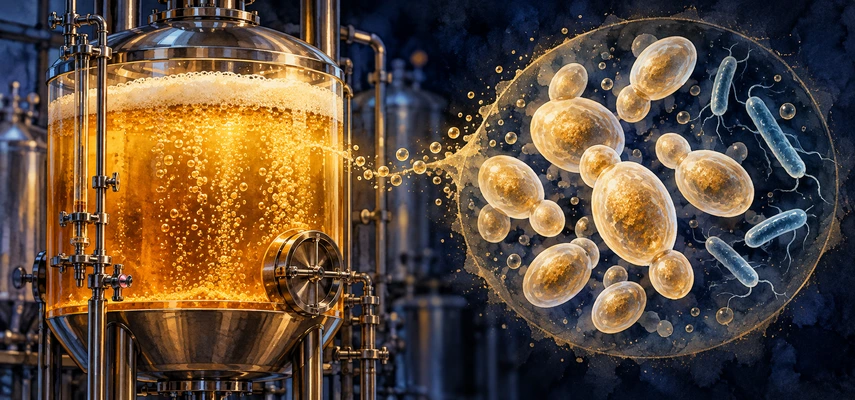

Yeast has an unusually productive way of eating dinner. Give suitable brewing yeast a supply of fermentable sugar and it can produce alcohol, carbon dioxide and aroma compounds. The brewer controls the setting, but microorganisms perform a transformation that equipment alone cannot accomplish.
Beer yeast and bacteria explain why fermentation is more than the moment a liquid becomes alcoholic. They also help explain differences between ale and lager, why some beers smell fruity or spicy, and how acidity can be a deliberate feature rather than a failure.
Yeast works on sugar, not whole grain
Yeast is a microorganism, specifically a fungus. Brewing yeast uses fermentable sugars obtained from the wort, the sugary liquid prepared earlier in brewing. It doesn’t take an intact barley kernel and turn the whole thing directly into a glass of beer. Grain preparation and mashing make useful materials available first.
During alcoholic fermentation, yeast converts sugars into alcohol and carbon dioxide. It also produces smaller quantities of substances that influence aroma and flavor. These contributions matter even if the finished beer is filtered and the yeast itself is no longer visibly present. Removing the worker doesn’t undo the work.
The American Homebrewers Association ingredient guide describes yeast’s fermentation role and the sensory differences strains can produce. For Level 1, the important chain is sugar consumption followed by alcohol, carbon dioxide and characteristic aromas. Cell biology terminology should support that explanation rather than bury it.
Alcohol and gas are related products
Alcohol contributes to beer strength and can affect the sensory impression. Carbon dioxide can contribute to carbonation if retained or dissolved in the beer. However, producing gas during fermentation and setting the final carbonation level are not identical tasks. Some gas escapes; a brewer can also carbonate later.
This distinction helps make sense of a fermentation vessel that releases bubbles while the final beer still needs a finishing carbonation step. Seeing gas emerge tells us something about activity, but it doesn’t prove that the packaged beer will have the intended fizz. Production and packaging choices still matter.
Nor does every bit of grain material become alcohol. Wort contains a mixture of substances, and different yeasts can use different sugars to different extents. The finished beer retains material that contributes to flavor and texture. Fermentation changes a mixture; it doesn’t replace the entire mixture with ethanol.
Ale yeast: a family of possibilities
Ale yeast commonly refers to strains of Saccharomyces cerevisiae used in brewing. Compared with typical lager practice, ale fermentation generally occurs at warmer temperatures. The exact conditions depend on the strain and intended beer, so avoid treating one temperature as the definition of all ale production.
Some ale yeasts produce conspicuous fruit-like or spicy characteristics. These can help distinguish beers such as Weissbier, dubbel, tripel or saison. Other ale strains are comparatively restrained. The word ale therefore doesn’t mean that every example must taste of banana, nor that all ale styles share one aroma.
Ale is also not a color or strength category. A pale, modest-strength ale and a dark, strong ale can both belong to the broad fermentation family. To understand a beer, combine yeast choice with grain, hops and process. One category name cannot do the work of the entire recipe.
Lager yeast: comparatively quiet fermentation character
Lager yeast commonly refers to Saccharomyces pastorianus. In familiar lager production it generally works at cooler fermentation temperatures than typical ale yeast, followed by cold storage or maturation. That is a broad conceptual comparison, not an instruction to apply the same conditions to every strain.
Many lagers have relatively restrained fruit-like fermentation aromas, allowing malt and hops to be especially clear in the sensory balance. Restrained doesn’t mean flavorless. Bread-like malt, herbal hops and bitterness can all be expressive without a large fruity yeast signature competing for attention.
The Cicerone brewing introduction contrasts ale and lager fermentation character while recognizing different sensory contributions. A useful description is comparatively clean or restrained in fermentation character. It is less useful to say lager has no flavor, which confuses the quiet contribution of one ingredient with the character of the whole beer.
Temperature influences behavior, but isn’t the whole identity
Microorganisms respond to their surroundings. A brewer’s temperature management can influence fermentation performance and the mix of resulting aroma compounds. Yet temperature alone doesn’t turn one organism into another. Heating lager yeast doesn’t make it genetically become ale yeast.
This is why the neat beginner comparison needs two parts: the type of yeast and the usual production approach. Both matter. Likewise, top-fermenting and bottom-fermenting are traditional labels that can help orient a learner, but visible location alone isn’t a complete modern explanation of every fermentation.
For revision, focus on the useful contrast instead of chasing exceptions immediately. Ale yeast often brings more noticeable fruity or spicy character; lager yeast often leaves malt and hops more prominent. Keep the words often and generally. They preserve accuracy without making the basic comparison harder to remember.
Other yeasts can contribute different characters
Brewers also use other yeasts. Brettanomyces is an important example associated with some traditional or specialist beers. Its activity can create distinctive aromas and change a beer over time. It is yeast, not a bacterium, even though discussions of sour beer often mention it alongside bacteria.
That distinction matters because the phrase wild fermentation can otherwise become a bucket into which every unfamiliar microorganism is dropped. Different organisms do different things. A brewer may use a combination deliberately, but their biological categories and contributions do not become identical because they share a vessel.
At this level, recognizing the existence and purpose of other yeasts is more useful than memorizing a long species list. The key is to understand that ordinary ale and lager yeast are not the only tools available, and that deliberate use differs from unwanted contamination.
Bacteria are not simply bad yeast
Bacteria are different microorganisms from yeast. Some used in brewing, including lactic-acid bacteria such as Lactobacillus and Pediococcus, can contribute acidity. This is especially relevant to deliberately sour styles. Acidity is not the same sensory dimension as hop bitterness, even when both make a beer feel less sweet.
The same broad kind of microbial activity may be desirable in one beer and undesirable in another. A brewer making a sour style may welcome a controlled contribution that would be out of place in a beer intended to taste clean and non-sour. Intention, style and control are part of the judgment.
Therefore “contains bacterial influence” doesn’t automatically mean spoiled, and “sour” doesn’t automatically mean unsafe or faulty. Equally, those facts do not excuse unexpected deterioration in a beer. A later faults chapter examines unwanted infection; here the priority is to separate deliberate production from an accident.
Cultured fermentation starts with a selected population
In cultured fermentation, the brewer adds a prepared culture of yeast, bacteria or both. Selecting the organisms helps the brewer pursue a predictable type of fermentation and sensory result. Controlled doesn’t mean that nature has been removed; it means the starting population and conditions are deliberately managed.
A sour beer can be produced this way. A brewer may add selected bacteria to create acidity rather than relying on organisms arriving from the environment. This is the essential reason that all sour beers cannot be called spontaneously fermented. Sour describes a sensory feature; spontaneous describes an approach to initiating fermentation.
Consider two hypothetical beers with similar tartness. One could begin with a selected culture, while another could follow a spontaneous tradition. Tasting the acidity alone doesn’t reveal which method was used. Production information is needed before making that claim.
Spontaneous fermentation uses environmental inoculation
Spontaneous fermentation begins through microorganisms encountered from the environment rather than a conventional deliberate addition of a selected starter culture. The Lindemans account of traditional lambic production provides a useful context. The brewery surroundings, equipment and subsequent maturation can all contribute to a complex microbial setting.
Spontaneous doesn’t mean unskilled or completely unmanaged. Brewers still make choices about wort, exposure, vessels, time and blending. The difference concerns the source and management of inoculation, not the absence of craftsmanship. Nor should spontaneous be treated as a guarantee of one precise aroma profile.
Geuze will make more sense when this foundation is in place, but the style itself belongs in the sour-beer chapter. For now, connect the approach with its cause and resist assigning it to every tart beer on the shelf.
A useful revision exercise is to label three different statements: what organism is present, how it arrived, and what sensory effect it produced. Similar-tasting beers need not share all three answers.
One-page revision summary
Yeast consumes fermentable sugar and creates alcohol, carbon dioxide and aroma compounds. Ale and lager differ in yeast identity and customary fermentation approach, with broad differences in aroma emphasis. Other yeasts can contribute additional characters. Bacteria can deliberately create acidity in appropriate beers.
Cultured fermentation uses selected added organisms; spontaneous fermentation draws its initial inoculation from the environment. Sourness alone cannot tell the two apart. The official specification requires these ingredient and approach distinctions, so revise them as causes and effects rather than disconnected names.
Knowledge check: 10 original practice questions
Independent TFE questions, not official WSET examination items. Choose one answer per question; explanations follow separately.
1. What does yeast consume during alcoholic fermentation?
- Whole intact hop cones only
- Fermentable sugars
- Carbon dioxide as its sole fuel
- Glass particles from bottles
2. Which products are central to alcoholic fermentation?
- Alcohol and carbon dioxide
- Starch and oxygen only
- Glass and crown caps
- Water minerals and grain husks
3. Which statement about ale yeast is best?
- Every ale tastes exactly like banana
- Ale yeast always makes dark beer
- Ale means beer without fermentation
- Some strains create noticeable fruity or spicy aromas
4. How does typical lager practice compare with typical ale practice?
- It never uses yeast
- It always produces stronger beer
- It generally uses cooler fermentation conditions
- It requires every beer to be pale
5. What is Brettanomyces?
- A hop variety
- A type of yeast
- A lactic-acid bacterium
- A malt roasting method
6. What can selected lactic-acid bacteria contribute?
- Acidity
- Malt starch before mashing
- A bottle seal
- Proof that every beer is faulty
7. Which process uses a prepared selected population?
- Only spontaneous fermentation
- Milling
- Kilning
- Cultured fermentation
8. Why does sourness not prove spontaneous fermentation?
- All sourness comes from hops
- Spontaneous fermentation never involves microorganisms
- Selected bacteria can also be added deliberately
- Lager yeast is always spontaneously collected
9. Does fermentation gas production guarantee final carbonation?
- Yes, all fermented beers have identical fizz
- No, gas retention and finishing choices also matter
- Yes, packaging cannot affect gas
- No, fermentation produces no carbon dioxide
10. What is sound when judging bacterial activity in beer?
- Consider the intended style and whether the result is controlled
- Treat every bacterial contribution as spoilage
- Assume sourness identifies the exact organism
- Ignore unexpected sourness in every style
Answers and explanations
1. B — Fermentable sugars. Yeast works on suitable sugars in wort; earlier processing makes those sugars available. Mapping: LO1.
2. A — Alcohol and carbon dioxide. Yeast converts sugar into alcohol and carbon dioxide while also producing aroma compounds. Mapping: LO1.
3. D — Some strains create noticeable fruity or spicy aromas. Ale strains vary; fruit or spice can be prominent but neither color nor one aroma defines all ales. Mapping: LO1.
4. C — It generally uses cooler fermentation conditions. The broad comparison concerns yeast type and usual temperature management, not color or strength. Mapping: LO1.
5. B — A type of yeast. Brettanomyces is yeast even when discussed alongside bacteria in specialist beer production. Mapping: LO1.
6. A — Acidity. Bacteria may be used deliberately for acidity in suitable styles; the contribution is not automatically a fault. Mapping: LO1.
7. D — Cultured fermentation. Cultured fermentation involves adding selected yeast, bacteria or both to pursue an intended result. Mapping: LO1.
8. C — Selected bacteria can also be added deliberately. Sourness is a sensory property, whereas spontaneous fermentation describes an inoculation approach. Mapping: LO1.
9. B — No, gas retention and finishing choices also matter. Producing carbon dioxide and retaining or dissolving it in finished beer are distinct process considerations. Mapping: LO1.
10. A — Consider the intended style and whether the result is controlled. A contribution can be desirable in a sour style and unwanted in another beer; context is essential. Mapping: LO1.












