











A beer called bitter may seem gentle beside a modern IPA. A beer called alt, or old, may arrive fresh and beautifully clear. Bitter and altbier reward looking past the names: they describe brewing traditions and balances, not instructions to make the drink extreme or stale.
The Level 2 range includes ordinary bitter, best bitter, strong bitter or extra special bitter, and altbier. The first three form a useful British strength-and-intensity comparison. The fourth connects German ale fermentation, cold conditioning and firm bitterness with a developed malt profile.
Bitter is a family name with a practical context
British bitter combines pale-ale malt character, hop bitterness and often fruity yeast expression in a drinkable balance. Color can range through gold, amber and copper, with caramel or toast varying by recipe. A name containing bitter does not require the highest bitterness in the entire beer world.
The important comparison is the relationship among malt, hops, fermentation and strength. A low-strength example can have a firm bitter finish because its body and residual sweetness are modest. A stronger example can carry more bitterness while seeming rounder because there is more malt around it.
Traditional British hops offer earthy, floral, spicy or related aromatic possibilities. Early additions can establish the bitter balance without the intense modern-fruit aroma associated with some American styles. Hop-driven does not mean malt and fruity esters must disappear.
Ordinary bitter: low strength, complete flavor
Ordinary bitter typically appears clear pale amber to copper, with a modest white or off-white head. Aroma can combine light bread or biscuit, gentle fruit and restrained earthy or floral hops. Some recipes show light caramel, but it should not overwhelm the beer.
The palate has noticeable bitterness, a relatively dry finish and a light to medium-light body. Carbonation is often low in cask presentation, while packaged versions can differ. Alcohol is low and unobtrusive. The intended experience is a flavorful, balanced small-strength ale rather than a watered-down strong beer.
Pale ale malt with suitable small specialty or sugar contributions supports the profile, and British ale fermentation can add fruit. Compared with best bitter, the ordinary category is generally lighter in strength and malt substance. Ordinary is a style distinction, not a judgment that the brewer used ordinary care.
Best bitter: a fuller middle comparison
Best bitter commonly appears clear amber to copper with white-to-off-white foam. Bread, biscuit or light toast can be more evident than in the lower-strength comparison, with optional caramel or toffee and mild-to-moderate fruity fermentation character. Hop aroma ranges from quiet to noticeable.
Bitterness remains central, supported by enough malt to make a flavorful whole. Body is medium-light to medium, carbonation low in typical cask service, and alcohol modest rather than warming. The finish should remain dry enough for refreshment instead of becoming sticky.
The recipe usually develops the same broad British ingredient and yeast tradition at somewhat greater starting strength. Compared with ordinary bitter, best has more substance; compared with strong bitter, it is generally less powerful. The word best should not become an invented guarantee that every product is objectively better than one labeled ordinary.
Strong bitter and extra special bitter
Strong bitter ranges from light amber to deep copper, usually clear with a modest off-white head. It can show fuller bread, biscuit, toast, nut or caramel character, along with fruity esters and more noticeable traditional-hop expression.
Bitterness is medium to medium-high, while body can range from medium-light to medium-full. Carbonation is low to moderate in cask form and can be higher in bottles. Alcohol is greater than in the lower-strength bitter categories, with at most a gentle warmth in stronger examples. A dry finish remains compatible with substantial malt aroma.
Higher starting extract and appropriate fermentation create the increase in strength and sensory material. The term extra special bitter, often abbreviated ESB, is used in the syllabus comparison, but commercial and regional usage needs context. Do not assume every example worldwide exactly matches the famous producer-specific beer that helped make the initials recognizable.
Altbier: a different regional ale solution
Altbier is strongly associated with Düsseldorf. Appearance is generally clear amber to copper or bronze, with a creamy off-white head. Malt can suggest baked bread, toasted crust or nuts, while traditional hop expression is often quietly spicy, floral or peppery rather than overtly tropical.
The palate combines rich grain character with firm bitterness and a medium-dry to dry finish. Body is medium, carbonation moderate to moderately high, and alcohol normally remains unobtrusive. The result can feel smooth and clean without losing either malt substance or bitter definition.
German base malts and carefully chosen darker contributions support the color and toast, while traditional hops such as Spalt provide a useful reference. A clean, attenuative ale culture and cold conditioning explain the production identity. Alt refers to the older top-fermenting tradition, not a requirement for prolonged bottle ageing or stale character.
Compared with Kölsch, altbier is darker, richer in developed grain and generally more firmly bitter. Compared with Vienna lager, it has a different fermentation identity and typically a drier, more bitter balance. Appearance alone cannot establish which route the brewer used.
Cold conditioning does not change yeast identity
Altbier is especially useful for separating fermentation from maturation. A brewery can use an ale culture and later apply cold conditioning to clarify and refine the presentation. That later temperature phase does not turn the original culture into lager yeast.
The same principle appeared with Kölsch, but the sensory destination differs. One combines a pale delicate profile with crispness; the other combines developed malt with a firm bitter finish. A shared processing idea does not force two regional beers into the same style.
For examination reasoning, name the organism and the stage. Cold service, cold storage and lager fermentation are three different facts. If a proposed answer treats any one as proof of all the others, check it carefully.
Cask context changes the presentation
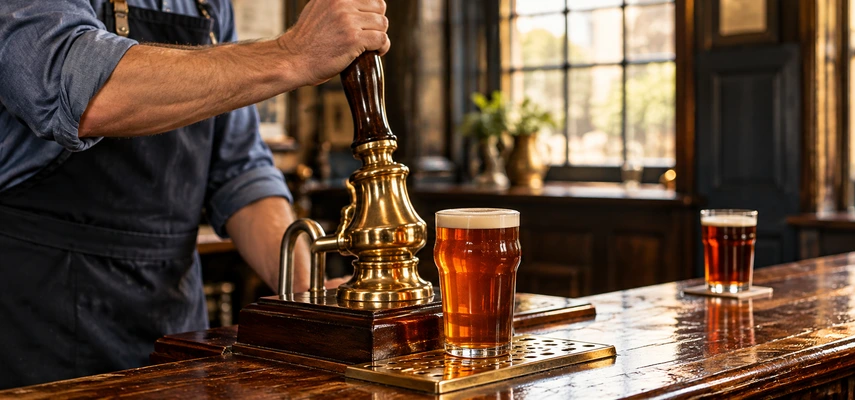
Traditional British bitter is closely linked with cask-conditioned service, in which appropriate live yeast and fermentable material support further conditioning. CAMRA’s cask explanation connects that route with cellar handling and a relatively gentle gas presentation.
Low carbonation is not the same as no condition, and cellar service is not permission to serve damaged or excessively warm beer. The appropriate presentation should support aroma, texture and refreshment. Bottled or keg versions can have different gas levels, so packaging context matters during comparison.
Altbier has its own traditional service context, including small straight-sided glasses and regional draught practices. Do not assume every vessel called a cask in one country uses exactly the same British conditioning and dispensing arrangement. A shared container word is not sufficient process evidence.
Strength and bitterness do not rise in lockstep
Across the bitter family, stronger versions commonly offer more malt and flavor material. But perceived bitterness depends on the surrounding sweetness, body and fermentation result as well as the hop-derived compounds. A lighter beer can seem very crisp with a smaller absolute bitter contribution.
Consequently, best bitter is not necessarily halfway between every ordinary and strong sample in every sensory dimension. The category map supplies useful typical relationships while recipes and regional practice produce overlap. Avoid turning a teaching comparison into a numerical law the syllabus never supplied.
The same caution applies to altbier. A particularly assertive famous example should not define every member of the style. The balance needs to preserve the characteristic grain and bitterness together rather than maximize one feature at the expense of the other.
Build a useful written comparison
Make four columns and record appearance, grain character, hop aroma, bitterness, sweetness, body, carbonation and alcohol. Add a row for yeast and conditioning. The British trio should reveal increasing typical substance, while the German example should reveal a different regional fermentation-and-malt balance.
Then test the label words. Ordinary does not mean poor; best does not guarantee superiority; strong is relative to this family; old does not mean stale. Explaining those four limits is a compact way to check whether names have replaced understanding.
The activity works entirely with reliable written descriptions, so no drinking is required. An optional tasting for legally eligible readers should compare similar serving conditions and record packaging context rather than assuming every difference comes from recipe alone.
A family comparison is not a dilution recipe
Imagine increasing a bitter’s starting extract while leaving fermentation and hop decisions unexamined. More potential alcohol and residual material can change the balance, so the brewer may need to reconsider hopping and yeast performance as well. A successful stronger version is therefore not simply the same tasting note with a larger strength number attached.
Conversely, designing a lower-strength bitter requires enough grain, fermentation and hop expression to make its lighter body feel complete. Reducing alcohol does not require removing every aromatic feature. This explains why a well-made ordinary bitter can be both delicate and satisfying without borrowing the mass of a strong ale.
One-page revision summary
Ordinary, best and strong bitter form a related British family with different typical strength and malt substance, supported by hop bitterness and often fruity yeast expression. Cask presentation can be part of the story but does not define every package identically.
Altbier links developed German malt, traditional hops, ale fermentation and cold conditioning in a clear, dry, firmly bitter profile. Understand the regional and production relationships before interpreting the name literally, and the styles become much easier to compare.
Continue your beer studies
Explore the related lessons on hops explained alongside beer yeast alongside beer fermentation to extend the ingredient, process or sensory reasoning in this article.
Knowledge check: 10 original practice questions
Independent TFE questions, not official WSET examination items. Choose one answer per question; explanations follow separately.
1. What does ordinary mean in ordinary bitter?
- A guarantee of poor ingredients
- A lower-strength family category rather than a quality insult
- Mandatory stale character
- No hop bitterness
2. How does best bitter generally compare with ordinary bitter?
- Always identical in strength
- Always darker than stout
- More strength and malt substance
- Mandatory tropical dry hopping
3. Which statement about strong bitter is accurate?
- It can retain a dry finish despite greater malt and alcohol
- It must be sweeter than every beer
- It contains no fruity esters
- It must exceed every imperial stout in strength
4. What does alt principally refer to in altbier?
- Mandatory cellar ageing for years
- A requirement for staling
- Mandatory lager yeast
- An older top-fermenting brewing tradition
5. Which city is strongly associated with altbier?
- Düsseldorf
- Only Dublin
- Only Pilsen
- Only San Diego
6. What production combination helps explain altbier?
- Only spontaneous fruit fermentation
- Ale fermentation with cold conditioning
- No fermentation followed by carbonation
- Mandatory whisky barrel ageing
7. Which comparison usually separates altbier from Kölsch?
- Altbier is always alcohol-free
- Kölsch must be smoky
- Altbier is darker, richer in developed malt and more firmly bitter
- Both must have identical grain character
8. Why should low cask carbonation not be equated with faulty flatness?
- All gas is a fault
- Cask beer contains no yeast
- Carbonation cannot affect texture
- Gentle natural condition can be the intended presentation
9. Which interpretation of ESB is most careful?
- Its producer and regional context matter alongside syllabus usage
- It is one identical global recipe
- It always guarantees the highest quality
- It means extra smoky barley
10. Why can a lighter bitter seem very bitter despite a smaller hop contribution?
- Alcohol is the only source of bitterness
- Perception depends on malt, residual material and balance
- Pale color creates bitter molecules
- Lower strength always means zero sweetness
Answers and explanations
1. B — A lower-strength family category rather than a quality insult. Ordinary bitter is generally the lighter-strength comparison. The category name does not judge the brewer’s care or the beer’s quality. Mapping: LO3 AC1.
2. C — More strength and malt substance. Best bitter commonly provides a fuller middle-strength comparison while retaining the family’s drinkable bitter balance. Mapping: LO3 AC1.
3. A — It can retain a dry finish despite greater malt and alcohol. Greater starting extract can support more alcohol and flavor while fermentation and bitterness still produce a dry, drinkable finish. Mapping: LO3 AC1/AC3.
4. D — An older top-fermenting brewing tradition. Alt refers to the older ale-fermentation tradition associated with the regional style, not a requirement for stale or extensively aged beer. Mapping: LO3 AC1.
5. A — Düsseldorf. Düsseldorf is the key regional association for altbier. Geography supports context, while the actual sensory and production profile remains important. Mapping: LO3 AC1.
6. B — Ale fermentation with cold conditioning. An appropriate ale culture and later cold conditioning support altbier’s smooth clean presentation. Cold conditioning does not change yeast identity. Mapping: LO3 AC3.
7. C — Altbier is darker, richer in developed malt and more firmly bitter. The styles share regional ale traditions and conditioning ideas but pursue distinct malt and bitter balances. Mapping: LO3 AC1/AC2.
8. D — Gentle natural condition can be the intended presentation. Cask beer can be properly conditioned at a lower gas level than many bottled or keg beers. Evaluate the intended presentation and actual condition. Mapping: LO3 AC3/LO4 AC2.
9. A — Its producer and regional context matter alongside syllabus usage. The initials have producer-specific and broader regional uses. They should not erase the variety within the strong-bitter territory. Mapping: LO3 AC1.
10. B — Perception depends on malt, residual material and balance. Bitterness is perceived within the beer’s overall balance. A leaner palate can expose it more than a richer malt background would. Mapping: LO3 AC1/AC3.












