










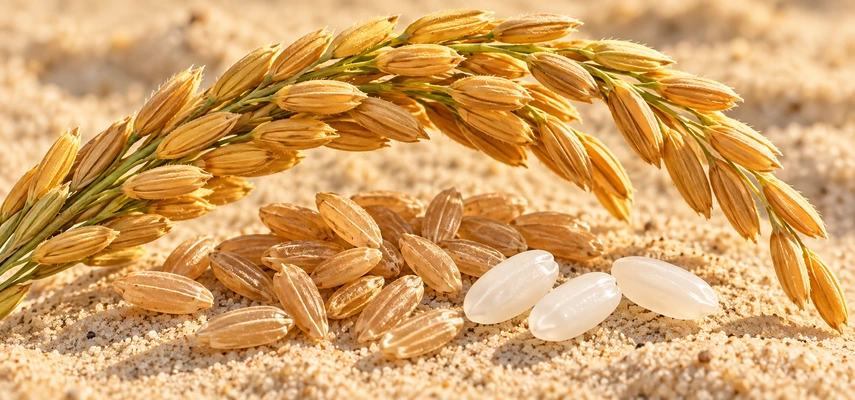

A brewer looks at rice and sees questions a cook might never ask. Will the grains survive substantial polishing? How predictably will they absorb water? Will mould grow where it is needed? Sake rice matters because it is a workable raw material, not because its name automatically writes the finished tasting note.
In this second lesson, the grain stays largely intact. We will examine what grows in the field and what is inside the kernel. The next article handles the deliberate processing decisions: polishing, washing, soaking and steaming. Separating those subjects makes it easier to tell an ingredient characteristic from something a brewer changes afterward.
Sake rice belongs to a familiar family
The official Level 2 specification identifies Japonica, short-grained, non-sticky rice in its required range. Japonica is a broad rice group. Short-grained describes the relatively compact grain shape. Non-sticky here means non-glutinous, rather than a promise that cooked rice will never cling together.
That last distinction is useful. Japanese table rice can become pleasantly cohesive when cooked without belonging to the glutinous, or sticky-rice, category. Don’t let the everyday meaning of sticky replace the technical distinction. Brewing rice is not necessarily the same material used for sticky-rice sweets, even if both can look compact and white.
The other essential distinction is purpose. Table rice is grown primarily for eating. Sake-specific rice is selected for characteristics useful in brewing. Both can be used to make sake. A bottle made with table rice has not automatically failed an ingredient quality test; its success depends on how the material fits the brewer’s aims.
What makes a grain useful to a brewery?
Large grains give a brewer more material to work with during polishing. A suitable internal structure can help water enter and enzymes later reach the starch. Relatively low protein can be useful where the desired style emphasizes delicate aroma and a restrained savory impression. These are connected advantages, not a single magic property.
Consider a hypothetical choice between a rice that is convenient for an ambitious polishing program and one that breaks more readily under the same treatment. Even before fermentation, the brewery faces different practical possibilities. The first grain may offer an advantage for that particular plan. It does not follow that the second is incapable of producing an enjoyable sake by another route.
The NRIB and JSS guide describes large grains, white cores and useful brewing behavior as important sake-rice characteristics. Actual lots vary with cultivar, growing conditions and handling. Brewers therefore assess the rice they receive, rather than relying solely on the attractive variety name printed on its paperwork.
A grain has an outside, an embryo and a food store
Start at the outside. The husk is the protective casing around the grain. Removing it gives brown rice, which still carries its bran layers and germ. Husk removal is not the same operation as the extensive polishing used to prepare brewing rice. The starting points are different.
Bran forms outer layers rich in components other than starch, including nutrients and lipids. The germ is the embryo from which a new plant could develop. It too has a different composition from the main starchy interior. Picture a seed equipped both with a future plant and with resources to support it; it is not a uniform little packet of white flour.
The endosperm is the substantial food-storage tissue. Starch dominates this interior, although proteins and other components are present as well. A brewer wants access to this starch because it can eventually become fermentable sugar. However, the grain has to be prepared and enzyme activity has to do its work before yeast can make use of that potential.
This anatomy explains why location matters. Removing outer material changes the balance of components left in the grain. It does not simply make a miniature version with exactly the same composition. The physical structure gives the brewer a way to influence the material available to later stages.
Shinpaku: a white center with a practical role
Shinpaku means the opaque white core associated with many sake-rice grains. Its appearance reflects the arrangement of starch granules and small spaces within the tissue. It is not a pocket of sugar waiting to dissolve, and it is not the germ. Confusing those three ideas would make the rest of brewing much harder to explain.
The core’s structure can help make rice suitable for kōji cultivation and digestion during brewing. Mould growth and enzyme access depend on physical conditions as well as on what the grain contains chemically. Imagine working through a material with small internal passages rather than a completely solid, inaccessible block. The comparison is imperfect, but it explains why architecture matters.
A larger or more visible shinpaku is not a universal score for better rice. Its position, shape and relationship to grain strength matter too. A useful grain must survive the preparation that the brewery plans to apply. A desirable feature in one production plan can become a practical complication in another.
Starch and proteins lead to different consequences
Starch is the main potential source of the sugars from which yeast makes alcohol. Its accessibility affects the course of brewing. Merely containing starch is insufficient: water absorption, steaming, kōji enzymes and mash conditions determine how effectively the brewery can use it. Those later operations work on a material with properties established partly in the field.
Proteins are not simply dirt that a brewer must remove. Kōji enzymes can break proteins into smaller components, including peptides and amino acids. Those can contribute to fermentation nutrition and to flavor, including savory impressions. Richness is welcome in some styles, while excessive or poorly balanced character may be unwelcome in others.
Therefore, keep the intended style in view. Saying lower protein is always better skips the brewer’s objective. A plan for delicate, fragrant sake may call for different material and processing from a plan for a fuller, savory expression. Rice contributes possibilities and constraints; it does not act alone.
Three required varieties, three useful reference points
Yamada-nishiki is a prominent sake-specific variety associated with large grains and suitability for demanding polishing. Its reputation makes it a helpful example of rice selected for brewing performance. Hakutsuru’s account of its rice sourcing describes why large, resilient Yamada Nishiki grains are valuable to the producer. A reputation is evidence of usefulness, not a guarantee of identical flavor in every bottle.
Gohyakuman-goku is another prescribed sake-rice variety. Learn it as a distinct cultivar rather than as an alternative spelling for Yamada-nishiki. Grain behavior and the brewery’s handling of it matter more than assigning it one compulsory aroma. Different polishing, kōji and fermentation choices can alter what the same variety ultimately helps produce.
Miyama-nishiki is the third required name. Again, its identity belongs at the ingredient stage of the chain. Don’t turn a rice label into a finished-style classification. A variety name does not certify junmai status, establish a polishing ratio, or prove that a sake will be dry. Those statements require different evidence.
There are useful concrete differences behind those names. The JSS production account associates Gohyakuman-goku with lighter-flavored sake as a tendency. That makes it a useful ingredient reference for such plans, without overriding polishing, kōji and yeast choices. Yamada-nishiki’s large resilient grains, discussed above, illustrate a different practical advantage: material suited to demanding polishing.
Miyama-nishiki also connects the field to the brewery through cold resistance. The NRIB rice glossary places it especially in Nagano and northeastern growing areas for that reason. Climate suitability helps determine which reliable brewing material a region can supply. It is an agricultural and production advantage, not a guarantee that every Miyama-nishiki sake shares one aroma.
For examination study, be able to identify all three as sake-specific varieties and explain why cultivar choice matters. For more advanced comparisons, look for reliable producer information about an actual lot and process. Vague claims that one rice always tastes elegant and another always tastes rustic are much less useful than an explanation tied to a particular brewing decision.
The growing year builds the raw material
Rice cultivation begins with seed and seedlings, followed by establishment in the field, commonly through transplanting into prepared paddies. The young plant develops leaves and tillers, the additional shoots that can later carry grain-bearing heads. At this stage, the farmer is building the plant that will eventually supply the harvest.
Later, panicles develop and emerge, flowering occurs, and grains form and fill. Ripening leads toward harvest. The crop then needs suitable post-harvest handling, including drying and storage, before the brewery can use it. The JSS seasonal overview places these activities within a Japanese brewing-year context, although dates vary with location and variety.
Temperature, sunlight, water management and nutrient supply influence how the crop develops. Weather can affect grain formation and the behavior of its starch. It is more accurate to say growing conditions affect brewing material than to promise that a hot year will give every sake one particular taste. Brewers can respond by adjusting preparation and fermentation.
This is the bridge from agriculture to production. A farmer supplies a biological material with natural variation; a brewery tries to make its behavior sufficiently predictable. Testing and careful handling help turn a variable crop into a manageable ingredient. The bottle is the end of that partnership rather than a pure transcript of the field.
Read a rice statement without asking it to do too much
Suppose a hypothetical label names Yamada-nishiki. That tells you the declared variety, subject to the detail of the producer’s statement. It does not tell you how much was polished away or which yeast fermented it. Suppose another bottle names table rice. That alone does not establish its quality or price-worthiness.
By contrast, a technical sheet that gives rice variety, polishing ratio and fermentation approach supplies several parts of the explanation. Use them together. When tasting, record what you perceive first, then compare it with the production information. This avoids the temptation to discover an aroma simply because a rice name suggested that it ought to be there.
One-page revision summary
Japonica, short-grained, non-sticky rice provides the syllabus starting point. Both table rice and sake-specific rice can enter brewing. The husk surrounds brown rice; bran and germ differ from the starch-rich endosperm. Shinpaku is an opaque internal structure, not sugar or an embryo. Learn Yamada-nishiki, Gohyakuman-goku and Miyama-nishiki as distinct sake-specific varieties. Then connect growing conditions and grain behavior to the preparation decisions that follow.
Knowledge check: 10 original practice questions
Independent TFE questions, not official WSET examination items. Choose one answer per question; explanations follow separately.
1. Which rice description matches the Level 2 prescribed range?
- Long-grain glutinous rice only
- Japonica, short-grained, non-sticky rice
- Any grain except Japonica
- Only germinated rice
2. Which statement about table rice is accurate?
- It cannot be fermented
- It always produces faulty sake
- It can be used to make sake
- It is a premium grade
3. What is shinpaku?
- An opaque white core within the grain
- The husk
- The rice embryo
- Dissolved glucose
4. Which part is the embryo?
- Bran
- Husk
- Shinpaku
- Germ
5. Where is the substantial starch store found?
- Only the husk
- The endosperm
- Only the germ
- Outside the grain
6. Why can relatively large grains help a brewery?
- They remove the need for enzymes
- They guarantee dryness
- They provide useful material for polishing
- They already contain alcohol
7. Which list contains the three prescribed sake-specific varieties?
- Yamada-nishiki, Gohyakuman-goku, Miyama-nishiki
- Junmai, ginjō, daiginjō
- Kimoto, yamahai, sokujō
- Nigori, nama, koshu
8. Why are proteins relevant?
- They are the same as starch
- They invariably cause faults
- They eliminate yeast nutrition needs
- Their breakdown can supply amino acids and peptides
9. Which sequence fits the growing year?
- Harvest, flowering, seedling establishment
- Seedlings, plant development, flowering, grain filling, harvest
- Polishing, flowering, transplanting
- Fermentation, seedling growth, harvest
10. What can a rice variety name alone establish?
- The exact yeast strain
- The sake’s dryness
- The declared cultivar rather than a complete finished style
- The polishing ratio
Answers and explanations
1. B — Japonica, short-grained, non-sticky rice. The specification identifies this rice group and distinguishes table and sake-specific rice. Mapping: LO1.
2. C — It can be used to make sake. Both table rice and sake-specific varieties can be used; suitability depends on brewing aims. Mapping: LO1.
3. A — An opaque white core within the grain. Shinpaku describes an opaque central structure associated with the arrangement of starch granules. Mapping: LO1.
4. D — Germ. The germ can develop into a plant; the starchy endosperm supplies stored resources. Mapping: LO1.
5. B — The endosperm. The endosperm is the grain’s main storage tissue and is rich in starch. Mapping: LO1.
6. C — They provide useful material for polishing. Grain size and strength affect practical polishing possibilities before fermentation begins. Mapping: LO1.
7. A — Yamada-nishiki, Gohyakuman-goku, Miyama-nishiki. The other lists describe grades, starter methods or specialty styles rather than rice cultivars. Mapping: LO1.
8. D — Their breakdown can supply amino acids and peptides. Protein-derived compounds can influence fermentation and flavor; their desirability depends on balance and style. Mapping: LO1.
9. B — Seedlings, plant development, flowering, grain filling, harvest. Plants establish and grow before flowering and grain development lead to a harvest. Mapping: LO1.
10. C — The declared cultivar rather than a complete finished style. A variety statement identifies an ingredient, while the other claims require separate information. Mapping: LO1.
Continue studying sake
Article #1: How to Understand and Evaluate Sake: The WSET Level 2 Framework · Article #3: Rice Polishing and Preparation Explained: Washing, Soaking, and Steaming · Article #4: Kōji Production Explained: Enzymes, Mould Cultivation, and Brewing Science · Article #15: Fruity Ginjō vs. Rich Junmai: How Brewing Choices Shape Sake Style












