











A beer can begin fermentation without the brewer tipping a selected yeast culture into a sealed tank. That sounds like leaving dinner to chance, but traditional lambic production is a practiced method with carefully chosen conditions and a long history. The interesting part is what happens after the wort meets its microbial community.
This lesson connects lambic and geuze with spontaneous inoculation, maturation and blending, then follows the same base into fruit lambics. These are prescribed references in the WSET Level 2 Beer specification. The aim is to explain the differences, not to label every acidic beer lambic.
A regional tradition with several finished expressions
Lambic belongs to the brewing traditions of Belgium’s Pajottenland and Zenne or Senne valley. HORAL, the producers’ association, emphasizes the diversity of its derivatives: younger or older, still or sparkling, blended or unblended, fruited or unfruited, sweetened or unsweetened.
That diversity matters because a first encounter with a sweet raspberry product can create the wrong expectation for a dry geuze. Conversely, a dry traditional example does not establish that every bottle carrying a related family name will be equally austere.
Regional identity, production and finishing choices work together. Modern brewers elsewhere also make spontaneously fermented beer, but the fermentation method alone does not automatically give every such product the same traditional regional identity. Read both the process description and the named style.
What a coolship actually does
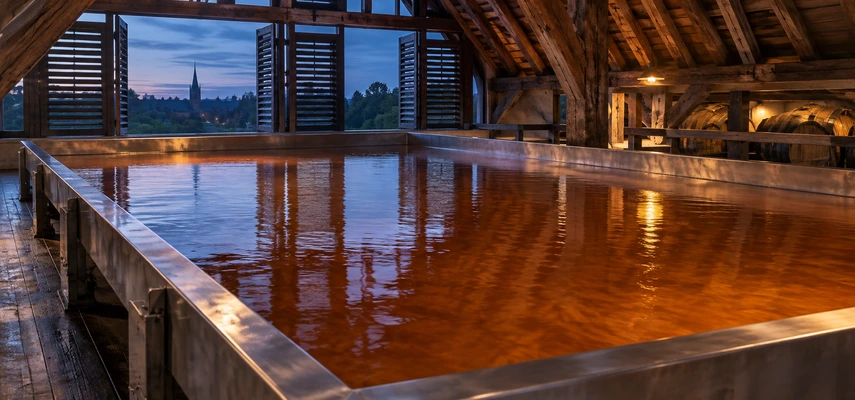
After boiling, hot wort enters a broad, shallow cooling vessel called a coolship, or koelschip. Its large exposed surface supports cooling and contact with environmental microorganisms. Nighttime conditions and the brewery environment influence the process, making this more specific than simply leaving any liquid uncovered.
Lindemans describes its coolship and subsequent fermentation as part of a managed production sequence. The brewery still selects ingredients, prepares the wort, chooses suitable conditions and monitors the developing beer. Spontaneous describes how the microbial inoculum is acquired, not an absence of human skill.
The tray is not necessarily where the entire long maturation takes place. Wort moves onward to fermentation and maturation vessels. Confusing the cooling stage with years of storage erases an important equipment distinction.
A community rather than one universal yeast
Conventional ale and lager production commonly starts with a deliberately pitched culture selected for predictable behavior. Lambic instead develops through a changing community. Saccharomyces, Brettanomyces and bacteria can contribute different parts of the resulting aroma, attenuation and acidity over time.
Lactic acid bacteria help explain tartness; Brettanomyces can contribute distinctive earthy, leathery or other complex fermentation associations. However, Brett is not simply a synonym for sourness, and not every earthy aroma proves a particular organism was present.
The microbial roles also explain why maturation can be lengthy. Different organisms use substrates differently, and the balance changes as fermentation progresses. A simple statement that wild yeast makes sour beer misses both the bacterial contribution and the difference between acidity and other fermentation aromas.
Grain and hops still matter
Traditional lambic wort commonly combines barley malt with unmalted wheat. The grist and mash process provide material for the extended fermentation. This differs from assuming every wheat-containing beer is a banana-scented German weissbier: the culture and process point toward another result.
Aged hops are another distinctive production reference. Their role in traditional brewing is different from seeking the fresh citrus or resin perfume of a newly dry-hopped IPA. Therefore, the presence of hops does not imply that assertive fresh hop aroma or high perceived bitterness will define the finished beer.
Keep recipe and observation connected without making them identical. Wheat does not automatically mean banana, aged hops do not mean a ruined batch, and pale color does not mean a clean neutral lager fermentation. The complete sequence supplies the explanation.
Lambic as a sensory anchor
A traditional unblended lambic reference is generally pale to golden, with clarity that can vary. It may be still or show low carbonation rather than a towering head. Acidity, grain and complex fermentation aromas take the lead over obvious hop bitterness.
Body is generally light to medium-light, sweetness low in a well-attenuated traditional example and alcohol often moderate rather than spirit-like. Aromas can suggest citrus, earth or mature fermentation character. Age and individual casks create variation, so one sample should not become a universal recipe.
Compared with geuze, unblended lambic commonly has less carbonation and lacks the same young-and-old blending step. Compared with a quickly soured light beer, its extended mixed microbial development can produce a different aromatic complexity. Acidity alone cannot distinguish the methods.
Geuze is a blending lesson
Geuze, also spelled gueuze, traditionally blends younger and older lambics. The younger component can supply fermentable material, while older beer supplies developed character. Subsequent fermentation in the bottle produces the lively carbonation associated with the traditional reference.
Expect gold to amber color, a sparkling presentation, low hop bitterness, a dry finish and pronounced acidity with complex fermentation aroma. Body generally remains relatively light, and alcohol should integrate rather than dominate. The nose can be layered even when the palate contains little sweetness.
Blending is therefore more than pouring leftovers together. The blender chooses components for balance and further development. Compared with a still lambic, the gas and blended profile change the experience; compared with a sweetened fruit product, dryness and fermentation complexity may be far more prominent.
Kriek and framboise name fruit connections
Kriek provides the cherry reference, while framboise or frambozen points toward raspberry. In traditional fruit lambic, fruit can be fermented or macerated with the beer, contributing color, acidity, aroma and fermentable material. Fruit is an ingredient with several effects, not merely a sweet flavoring.
Fruit lambic profiles depend on both the base and the fruit. Cherry can bring red tones and cherry associations; raspberry can bring its recognizable berry aroma. Remaining sweetness, body, carbonation and alcohol vary with fermentation, blending and finishing.
Some commercial products emphasize accessible sweetness and vivid fruit; others remain dry, tart and fermentation-led. Lindemans distinguishes these approaches within its own range in its producer FAQ. Never infer the exact sugar balance from a red appearance or a fruit name alone.
Traditional wording needs precise interpretation
Oude and related French wording such as vieille or vieux can signal a traditional reference on relevant labels. For study, recognize that these words can help distinguish traditional expressions from sweeter interpretations. They deserve attention alongside the full product description.
However, avoid turning a translated adjective into an invented universal rule. Exact protected naming conditions belong to their applicable specifications. A producer’s stated blending, refermentation and ingredient details give firmer evidence than assuming every bottle with a familiar word uses identical ages and proportions.
Similarly, older beer is not automatically better beer. Maturation can build the intended profile, while poor storage can still damage a finished product. Production age and time spent warm on a shop shelf are different kinds of history.
Wood, oxygen and patience are managed variables
Wooden vessels can support traditional maturation, but wood should not automatically mean fresh vanilla flavor or a spirit-barrel effect. Older vessels may serve primarily as a maturation environment. Producer equipment varies, and Lindemans also describes stainless vessels with wood in its own process.
Oxygen exposure likewise needs context. Acetic acid bacteria can create vinegary character when conditions favor them, but more oxygen is not a general recipe for better sour beer. Balance and control remain relevant even when multiple organisms participate.
For revision, explain one causal chain at a time: spontaneous inoculation establishes a community; extended fermentation develops the base; blending changes balance; bottle refermentation creates gas. Fruit additions introduce another decision rather than replacing all the earlier steps.
Compare the finished beer before guessing the process
Imagine three descriptions: a nearly still pale dry acidic beer, a highly carbonated dry blend and a red fruit-forward beer with noticeable sweetness. They suggest different family expressions, but the third still needs producer evidence before its production method is settled.
Make separate notes for acidity, sweetness and fruit aroma. A sample can be both acidic and sweet, while a dry sample can smell strongly of fruit. Keeping those observations separate prevents the familiar mistake that fruit aroma must equal residual sugar.
A blending exercise on paper
Suppose an older component has developed aroma but very little fermentable material, while a younger component retains more potential for further fermentation. A blend can combine those functions. The expected bottle carbonation depends on the available substrate, living organisms and packaging conditions, not simply on mixing two ages.
Now imagine fruit entering the process. Its aroma can remain even after much of its sugar has fermented, while acidity and tannin can change the texture. Therefore, predict each sensory dimension separately. This is a stronger explanation than assuming that adding fruit necessarily makes the finished beer sweeter or more alcoholic by a fixed amount.
One-page revision summary
Lambic connects regional tradition with spontaneous fermentation and extended microbial development. Geuze adds blending of younger and older components and traditional bottle refermentation. Kriek and framboise introduce cherry and raspberry references, with dry and sweeter expressions requiring careful distinction.
Use the coolship, culture community, maturation, blending and finishing as separate explanatory stages. Neither acidity nor fruit color proves the entire method. The strongest answer links the observed balance with confirmed production evidence.
Continue your beer studies
Explore the related lessons on beer fermentation alongside beer finishing alongside mixed-fermentation sour beers to extend the ingredient, process or sensory reasoning in this article.
Knowledge check: 10 original practice questions
Independent TFE questions, not official WSET examination items. Choose one answer per question; explanations follow separately.
1. What is the main role of a coolship in traditional lambic production?
- Final carbonation under pressure
- Shallow wort cooling with environmental inoculation
- Removing all microorganisms
- Distilling alcohol
2. Which production step most clearly distinguishes traditional geuze from unblended lambic?
- Using wheat alone
- Fresh dry hopping
- Blending younger and older lambics with bottle refermentation
- Removing every acid
3. Which fruit is the traditional kriek reference?
- Cherry
- Raspberry
- Peach
- Blackcurrant
4. Which conclusion about a raspberry lambic is most justified by its name alone?
- It must be dry
- It must be sweet
- It cannot be acidic
- It has a raspberry association, with final sweetness needing further evidence
5. Why is Brettanomyces not a complete explanation of sourness?
- Lactic acid bacteria can contribute acidity separately
- Brett only clarifies beer
- All acidity comes from hops
- Only malt creates acids
6. What do aged hops suggest in traditional lambic brewing?
- A mandatory fresh citrus perfume
- A different role from fresh aroma-driven IPA hopping
- A mandatory high IBU palate
- An absence of hops
7. Which typical contrast is most useful?
- Lambic always dark, geuze always pale
- Lambic always sweet, geuze always spirit-like
- Unblended lambic often less carbonated than traditional geuze
- Geuze never contains matured beer
8. What does spontaneous fermentation imply?
- No brewer chooses ingredients
- Every sour beer uses the same method
- No monitoring can occur
- Environmental acquisition of the inoculum rather than the conventional selected pitch
9. Which observation is distinct from fruit aroma?
- Sweetness
- An aroma descriptor
- A raspberry fragrance
- A cherry fragrance
10. What is the best interpretation of traditional label wording?
- It proves every producer uses identical blend ratios
- It is useful context to verify against the full product description
- It proves unlimited shelf life
- It measures the beer’s alcohol
Answers and explanations
1. B — Shallow wort cooling with environmental inoculation. The coolship exposes a broad shallow wort surface during cooling; extended fermentation then continues in other vessels. Mapping: LO3 AC3.
2. C — Blending younger and older lambics with bottle refermentation. The blend supplies complementary components and fermentable material for subsequent bottle fermentation and gas. Mapping: LO3 AC3.
3. A — Cherry. Kriek supplies the cherry connection; framboise identifies raspberry, while other fruit expressions exist separately. Mapping: LO3 AC1/AC2.
4. D — It has a raspberry association, with final sweetness needing further evidence. Fruit identity does not establish residual sweetness; fermentation and finishing choices produce different balances. Mapping: LO3 AC1.
5. A — Lactic acid bacteria can contribute acidity separately. The mixed community has distinct contributions; Brett-associated aroma and bacterial acid production should not be treated as synonyms. Mapping: LO3 AC2/AC3.
6. B — A different role from fresh aroma-driven IPA hopping. Aged hops have a traditional production function without making fresh hop aroma or assertive bitterness the sensory focus. Mapping: LO3 AC2.
7. C — Unblended lambic often less carbonated than traditional geuze. Traditional geuze bottle refermentation creates lively gas, while the unblended lambic anchor can be still or lightly carbonated. Mapping: LO3 AC1.
8. D — Environmental acquisition of the inoculum rather than the conventional selected pitch. The inoculation method differs, but ingredient selection, timing, vessel management and monitoring remain skilled decisions. Mapping: LO3 AC3.
9. A — Sweetness. Sweetness is a palate observation; a beer can smell of fruit while remaining dry after the fruit sugars ferment. Mapping: LO3 AC1.
10. B — It is useful context to verify against the full product description. Traditional terms can distinguish expressions, but exact recipe, age and finishing claims need supporting producer or specification evidence. Mapping: LO3 AC4.












