










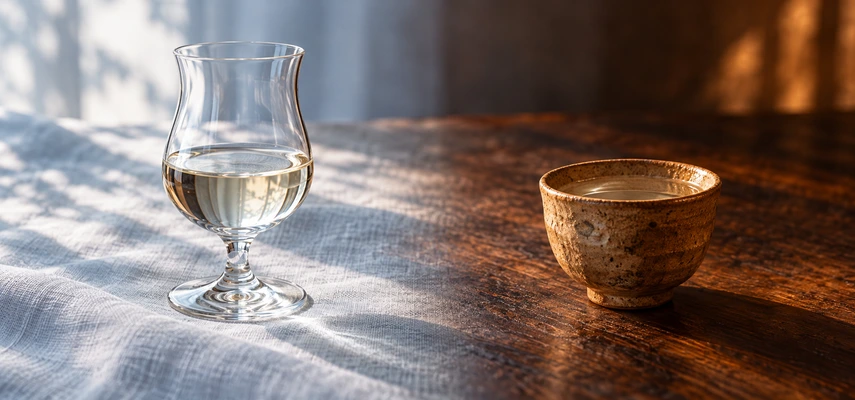

The same broad ingredient list can lead to a sake that seems airy and fruit-led or one that feels rounded and savory. Fruity ginjō vs. rich junmai is therefore best understood as two production briefs. The brewer coordinates several choices to reach an intended style, rather than relying on one special rice or a single number.
There is a crucial qualification at the start. Ginjō is a production-and-grade concept, while junmai identifies an ingredient condition that excludes added brewing alcohol. The terms can overlap in junmai ginjō. This comparison addresses the particular delicate, dry, fruity ginjō and rich junmai style patterns in the Level 2 syllabus, not every bottle carrying either word.
Fruity ginjō vs. rich junmai: define the destination
For the first brief, imagine a relatively delicate palate with clear fruit-like aromas and a dry impression. For the second, imagine more weight, savory expression and substantial flavor. Neither brief asks for flaws, clumsy alcohol or an unbalanced finish. Different intensity does not imply different standards of craftsmanship.
The official specification names six production factors for both patterns: rice type, polishing ratio, soaking and steaming, kōji style, yeast type and fermentation management. The point is to explain their interaction. Listing six ingredients without connecting them would not demonstrate how a brewer moves toward either destination.
| Production choice | Delicate fruity plan | Richer savory plan |
|---|---|---|
| Rice type | Select material suited to careful polishing and controlled digestion | Select material suited to the desired substantial expression and practical digestion |
| Polishing | More removal commonly helps restrain outer-grain contributions | Less removal can retain more components supporting weight and savory development |
| Soaking and steaming | Precise moisture and grain condition support restrained processing | Preparation supports the intended fuller breakdown and fermentation course |
| Kōji | Tsuki-haze commonly supports a restrained plan | Sō-haze commonly supports vigorous breakdown and broader contributions |
| Yeast | Choose aromatic capabilities and suitable fermentation performance | Choose performance and profile suited to the intended savory balance |
| Fermentation | Commonly cooler and carefully paced | Management can support a fuller expression without one universal schedule |
This is a comparison of tendencies. Each row is conditional on the other rows, and the final ingredient and grade rules still apply. The table is a starting map for an explanation, not an instruction to make every rich sake warmer or every fragrant sake identical.
Rice type sets practical possibilities
A rice variety contributes grain size, structure, strength and digestibility. Those properties can make a particular polishing and preparation plan easier to achieve. For delicate ginjō, a brewer may value material that can withstand substantial polishing while remaining suitable for controlled kōji cultivation and enzyme access.
For a richer plan, the brewer still needs useful rice. Choosing a fuller style is not a decision to stop caring about grain quality. It may involve using a variety and lot whose behavior suits the intended breakdown and fermentation. The link is material to process, rather than cultivar name directly to one fixed aroma.
Yamada-nishiki, Gohyakuman-goku and Miyama-nishiki are the prescribed reference varieties. None has exclusive ownership of one finished style. A producer can manage the same variety in different ways. If a comparison changes both rice and yeast, it becomes especially difficult to assign every sensory difference to the rice alone.
Polishing changes what the system receives
Greater removal of outer grain changes the available balance of proteins, lipids and other nutrients. That can support a plan for delicacy and clear aromatic expression. A lower remaining percentage indicates more polishing. It does not mean a greater percentage of the grain was retained for stronger flavor.
Less extensive polishing can retain more material contributing to nutrition and savory development. Protein breakdown can supply amino acids and peptides, helping explain why a richer expression is plausible. However, retaining more doesn’t guarantee a pleasing result. Balance and successful fermentation still need to be achieved.
The NRIB/JSS technical guide links raw materials and processing to style possibilities. The useful lesson is not a universal score in which the smallest polishing number wins. Each brief asks a different question of the material left after milling.
Soaking and steaming convert the brief into workable rice
Water uptake affects how the grain steams and how it later behaves during cultivation and fermentation. For a delicate plan, precision helps the brewery obtain the intended grain condition rather than uncontrolled soft, wet rice. For a richer plan, preparation is likewise chosen to support the desired digestion and fermentation behavior.
Steaming gelatinises hydrated starch, making it more accessible to enzymes. This shared mechanism doesn’t vanish when the desired style changes. Both plans need well-prepared rice; they may differ in the condition the brewery seeks and in how that condition supports the next stage.
Avoid saying the rich style simply uses badly steamed rice. That confuses a deliberate difference with a defect. Similarly, a fragrant style doesn’t result from keeping the rice raw so that less happens. The challenge is to prepare material for controlled activity, not to avoid preparation or let it become chaotic.
Kōji shapes breakdown and nutrient supply
Tsuki-haze, with localized surface growth and penetration into the grain, commonly fits the restrained ginjō brief. Sō-haze, with more extensive growth, commonly fits a fuller plan through substantial enzyme and nutrient contributions. These are useful relationships when attached to what the brewery wants the mash to do.
The JSS brewing guide discusses the contrast. Remember that visible coverage alone isn’t an enzyme measurement. The important downstream relationship concerns how the kōji supports sugar release, nutrition and the developing fermentation, not simply which rice sample looks whiter.
Now connect the first four factors. Rice type influences practical handling; polishing alters composition; soaking and steaming shape grain condition; kōji develops on that prepared substrate and supplies enzymes. The yeast receives the consequences of all four. That chain explains why changing one stage can require adjustments elsewhere.
Yeast turns the environment into alcohol and aroma
For a fruit-led brief, the brewer chooses a strain with suitable aromatic capabilities. Number 9 is the early ginjō reference, while number 1801 is a later aromatic option. The Brewing Society’s information illustrates that high ester production can coexist with useful fermentation strength.
For the rich junmai brief, a reliable fermenter such as the syllabus number 7 reference can be useful, depending on the producer’s aims. That doesn’t mean number 7 cannot produce pleasant aroma or that rich sake should smell dull. It means the aromatic balance may be different and should suit the overall style.
Yeast also responds to nutrient levels and conditions. A high-aroma strain cannot be treated as a packet of melon flavor that works independently of the mash. Likewise, a reliable strain doesn’t eliminate the need to manage temperature and sugar supply. Strain capability and the environment remain linked.
Fermentation management holds the plan together
Cooler fermentation is commonly associated with the delicate ginjō brief. It slows activity and requires careful pacing, helping the brewery work toward the intended aromatic expression. The brewer must still maintain useful balance between enzyme-driven sugar release and yeast use. Cold alone is not the objective.
A richer junmai plan can use management that supports more substantial expression, potentially including different temperatures or starter choices. Kimoto and yamahai can contribute to some richer profiles, but they are not mandatory for all rich junmai. Sokujō can also sit within a fuller plan.
Time, additions, monitoring and the endpoint all matter. The brewer may adjust the course rather than follow one fixed schedule regardless of material behavior. Fermentation management is the place where the earlier choices meet the actual developing mash. It is therefore both a response to the raw material and a contributor to the result.
Dryness and richness need their own explanations
Fruit aroma is not sugar sweetness. A sake can have prominent aromatic fruit character and still taste dry. Richness is not the same as sweetness either: savory compounds, texture, alcohol and other components can contribute to a substantial impression without a sweet palate.
That distinction prevents two common wrong conclusions. First, ginjō does not require residual sweetness merely because it smells of ripe fruit. Second, junmai does not require a thick, sweet taste merely because no brewing alcohol was added. The labeling standard and the sensory description answer different questions.
Finishing can then modify either brief further. Dilution changes concentration and balance, while pasteurisation and storage affect how the chosen expression develops. These later stages do not make the six earlier decisions irrelevant; they explain why the same fermentation plan can still reach the glass in different forms.
One-page revision summary
Start with the intended style, then connect six decisions. Rice type enables handling; polishing changes composition; soaking and steaming set grain condition; kōji shapes breakdown; yeast supplies fermentation and aroma capabilities; management keeps the system on course. Delicate fruity ginjō and rich junmai are useful syllabus patterns, not universal opposites. Junmai ginjō can unite the names, and neither fragrance nor richness alone establishes sweetness or quality.
Knowledge check: 10 original practice questions
Independent TFE questions, not official WSET examination items. Choose one answer per question; explanations follow separately.
1. Why is this comparison not a division of every sake into two exclusive camps?
- All sake tastes identical
- Junmai and ginjō can overlap
- Junmai means sparkling
- Ginjō contains no rice
2. Which set gives the six prescribed factors?
- Price, color, label, cork, age, glass
- Rice, bottle, menu, cup, cork, water
- Rice type, polishing, soaking/steaming, kōji, yeast, fermentation management
- Only yeast and rice
3. Why can more polishing support delicacy?
- It changes the balance of outer-grain components available to brewing
- It directly creates melon flavor
- It eliminates yeast
- It guarantees sugar sweetness
4. Which kōji commonly fits a fuller plan?
- No kōji
- Only charcoal
- Only raw rice
- Sō-haze
5. Which kōji commonly supports a restrained ginjō plan?
- Sake kasu
- Tsuki-haze
- Rice husk only
- A yeast number
6. What does yeast choice contribute?
- Only the label design
- Only the polishing number
- Fermentation performance and aromatic capabilities
- The rice harvest date
7. What must cooler fermentation still maintain?
- A useful balance between sugar release and yeast use
- A completely inactive mash
- No water
- Only maximum cold
8. Does rich junmai have to use kimoto or yamahai?
- Always
- Only if dry
- Only if polished below 60%
- No, other starter and management plans can produce richness
9. Can a fruit-led ginjō taste dry?
- No, fruit aroma is sugar
- Yes, aroma and sweetness are distinct observations
- Only after distillation
- Only if no yeast was used
10. What is the best explanatory approach?
- Assign one taste to each rice name
- Rank every sake by polishing alone
- Connect the full production chain to the intended result
- Ignore preparation once yeast is chosen
Answers and explanations
1. B — Junmai and ginjō can overlap. Junmai ginjō combines an ingredient condition with ginjō production, so the style patterns are not exclusive categories. Mapping: LO2.
2. C — Rice type, polishing, soaking/steaming, kōji, yeast, fermentation management. These are the six connected production choices named for both style patterns. Mapping: LO2.
3. A — It changes the balance of outer-grain components available to brewing. Polishing alters composition, which interacts with later production rather than making aroma by itself. Mapping: LO2.
4. D — Sō-haze. Its broader enzyme and nutrient contributions can support robust breakdown and fermentation. Mapping: LO2.
5. B — Tsuki-haze. Its controlled development can fit restrained processing alongside the rest of the brewing plan. Mapping: LO2.
6. C — Fermentation performance and aromatic capabilities. Strains differ in useful biological properties that interact with nutrition and management. Mapping: LO2.
7. A — A useful balance between sugar release and yeast use. Aromatic aims require successful fermentation, not simply the lowest possible temperature. Mapping: LO2.
8. D — No, other starter and management plans can produce richness. Starter method is one contributor and is not a compulsory definition of a rich junmai style. Mapping: LO2.
9. B — Yes, aroma and sweetness are distinct observations. Fermentation aromas can suggest fruit without establishing substantial residual sweetness. Mapping: LO2.
10. C — Connect the full production chain to the intended result. The six decisions interact, so a single-factor guarantee leaves out essential mechanisms. Mapping: LO2.
Continue studying sake
Article #2: Sake Rice Explained: Varieties, Growing Conditions, and Grain Structure · Article #3: Rice Polishing and Preparation Explained: Washing, Soaking, and Steaming · Article #5: Sō-haze vs. Tsuki-haze Kōji: How Mould Growth Influences Sake · Article #6: Sake Yeast and Water Explained: Strains, Minerals, and Aroma












