










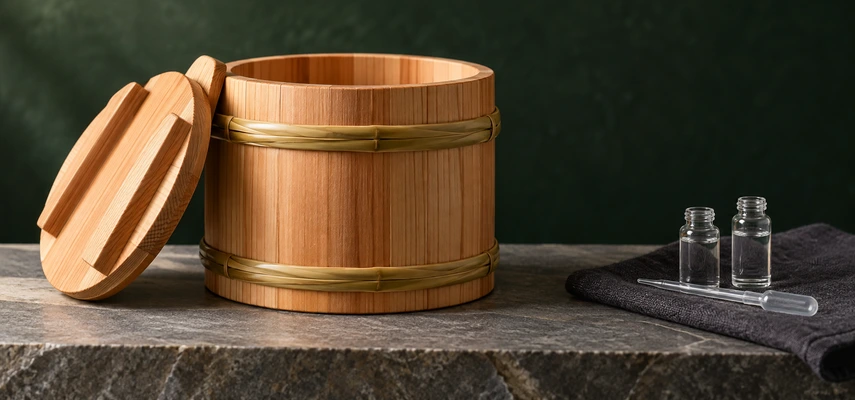

A tank can finish fermenting before the sake is ready to become the finished product. Sake maturation, blending and dilution give the brewer further ways to shape the result. These decisions can soften an impression of newly made sake, develop a deliberately aged style, introduce cedar character, assemble a consistent blend or adjust alcohol strength.
Those are different objectives. Resting isn’t automatically long aging; wood contact isn’t necessarily years in a barrel; blending isn’t the same as adding water. Keeping the operations separate makes their combined effect much easier to explain. The WSET specification explicitly includes rested sake, koshu, taru-zake, blending for style and volume, and dilution with water.
Sake maturation starts with an intended destination
Ask what the brewery wants the sake to become. A producer seeking delicate youthful fruit may choose cool storage and a relatively short route to market. Another may accept a reduction in primary fruit in exchange for developed nutty or savory complexity. The same storage decision can’t be judged sensible without knowing which destination was intended.
Time is only one variable. Temperature, oxygen exposure, light, composition and pasteurization history influence the changes available. Two samples kept for an equal number of months need not arrive at the same sensory point. The calendar records duration; it doesn’t measure maturity directly or award quality points.
In an explanation, distinguish deliberate development from accidental deterioration. A mature aroma can be part of a balanced aged style, while an unwanted stale character can undermine a product intended to be fresh. The assessment needs the full sensory picture and relevant context rather than a blanket rule that older is either better or worse.
Resting can prepare a young sake for release
Newly made sake can benefit from a period of resting before shipment. The JSS production overview places maturation among the finishing decisions. The intended effect may be greater integration and a less rough impression, rather than a transformation into a deeply colored, strongly aged sake.
Integration is a sensory description, not proof that the alcohol has disappeared. A sample can seem more harmonious even though resting alone hasn’t intentionally changed it to a lower labeled alcohol strength. If alcohol adjustment is wanted, that is a separate production decision. Avoid using a pleasant tasting word as a substitute for the mechanism being asked about.
Resting also needs a storage plan. Containers should suit the product and the brewery’s control requirements. Low temperature can help preserve a delicate profile, while warmer conditions generally allow many changes to proceed faster. Neither instruction means every sake follows one fixed number of months in one universal type of tank.
Koshu makes development part of the style
Koshu denotes aged sake, but it isn’t a single sensory recipe. Depending on the starting sake and maturation conditions, development can bring deeper color and aromas reminiscent of nuts, dried fruit, caramel or savory foods. Primary fruity aromas may diminish as the profile changes. These are possibilities to investigate, not a checklist every aged bottle must satisfy.
The NRIB/JSS guide describes chemical development involving sugars and amino acids during extended storage. This helps explain why color and aroma can evolve even after enzymes have been inactivated by heat. Pasteurization limits particular biological and enzymatic routes; it doesn’t freeze every molecule in its original state.
An aged sake should still be assessed for quality. Development can add interesting layers, but intensity alone isn’t complexity and an old date isn’t evidence of balance. Look for how sweetness, acidity, umami, bitterness and alcohol work together, how the flavors develop and whether the finish sustains attractive character.
Do not transfer every expectation from an amber example to cool-matured pale sake. A low-temperature maturation strategy can retain a different appearance and aromatic expression. This is why age, temperature and composition belong together in a production explanation. Saying only that it was stored longer leaves the causal story unfinished.
Taru-zake gains character from Japanese cedar
Taru-zake is associated with resting in cedar casks. Japanese cedar, often called sugi, can contribute a recognizable woody aroma. This isn’t automatically the vanilla-and-toast story associated with certain oak-aged drinks. The wood species and intended contact are different, so borrowing a familiar wine explanation can lead the answer away from sake.
Kikumasamune’s taru account provides a producer example centered on Yoshino cedar character. It demonstrates the purpose of cask contact without establishing an identical contact time for every brewery. The producer monitors the result and bottles when the intended expression has been achieved.
Wood contact and long maturation are separate axes. A sake can gain cedar character without spending years developing a dark koshu profile. Conversely, a long-matured sake need not have touched cedar. Keep container-derived aroma distinct from chemical development over time, even when a particular product combines both.
A useful tasting question is whether woody character supports the whole. An obvious cedar aroma can be appropriate to the style, yet the palate still needs balance and an attractive finish. Its presence doesn’t make quality assessment unnecessary, and its absence doesn’t disqualify a different style that was never intended to show it.
Blending builds a chosen style
Blending combines suitable sake components to achieve a target. One component may contribute aromatic lift, another a fuller palate or a different balance. The blender evaluates how they work together rather than assuming the most intense component should dominate. A successful blend can express a coherent style instead of tasting like an argument between tanks.
An interview with Gekkeikan’s production team discusses decisions about whether a blend reaches the quality sought. This is direct production evidence that blending is an intentional quality tool. It isn’t inherently a way of disguising a problem, nor does an unblended product automatically outrank a thoughtfully assembled one.
Trial blends let the brewery compare proportions before scaling up. Consider an original hypothetical example: component A provides lively fruit but feels narrow, while component B contributes texture and a quieter aroma. Different proportions may produce different balances. The right proportion depends on the intended result, not a universal rule that one tank must supply a fixed percentage.
Blending also solves a volume question
A product needs enough suitable liquid for the planned bottling. Several compatible tanks may be combined to provide the required volume while meeting the style target. This links a commercial requirement with a sensory constraint: enough liters of a different-tasting sake wouldn’t satisfy a specification for a consistent house product.
For a simple volume illustration, 600 liters of one component plus 400 liters of another gives a nominal 1,000-liter blend before practical losses and measurement refinements. The example explains assembling volume; it doesn’t prove the components are sensorially compatible. Taste, composition, labeling eligibility and production records still matter.
Separate consistency from uniformity across every product. A brewery may aim to keep one regular bottling recognizable while offering seasonal or small-batch expressions with deliberate variation. Both can be rational choices. A written question about consistency requires explanation of the stated product goal, not a philosophical verdict on whether variation is always good.
Dilution adjusts strength and perception
Water can be added to reduce alcohol strength after fermentation. The JSS production account describes this finishing step. Water adjustment also changes the concentration of other components, so its sensory effect extends beyond a lower alcohol number. Body, intensity and the relationship between sweetness, acidity and alcohol may feel different.
Dilution isn’t the same as blending two sake components, and it isn’t the same as adding neutral alcohol earlier in production. These operations move different variables. A non-junmai sake can later be diluted, while a junmai sake can also be diluted; water adjustment alone doesn’t decide whether brewing alcohol was used.
Use conservation of alcohol for a simplified calculation. Suppose 100 liters at 18% ABV is adjusted to 15% ABV. The original contains a nominal 18 liters of alcohol, so the target final volume is 18 divided by 0.15, or 120 liters. That suggests approximately 20 liters of added water, ignoring contraction and practical measurement details.
Genshu describes omitted adjustment, not guaranteed strength
Genshu concerns the absence of the usual water dilution for alcohol adjustment. Many examples are relatively strong because fermentation produced a high alcohol level, but the word alone doesn’t establish a particular ABV. A sake fermented to a lower strength can be undiluted at that lower strength.
This matters in service and tasting. Read the stated alcohol level rather than treating genshu as a numerical measurement. Likewise, don’t infer that a fuller palate must prove genshu: rice dissolution, sweetness, acidity and other production choices can affect texture and intensity. One sensory observation rarely supplies an entire finishing record.
The choices here connect to specialty styles and genshu labeling, but service still depends on the actual product. Explore that next step through temperature and vessels and food pairing.
One-page revision summary
Start with the target style. Resting can prepare a youthful sake for release; extended maturation can develop koshu character; cedar contact creates taru-zake without requiring years of aging. Blending assembles a chosen style and sufficient compatible volume. Dilution lowers strength and changes concentrations, while genshu describes omitted alcohol-adjustment dilution. Explain each action before combining its consequences.
Written practice: original TFE exercises
These suggested marks and indicative points are independent teaching guidance, not official WSET marking schemes.
Exercise 1: 5 suggested marks
Distinguish routine resting, koshu maturation and cedar-cask resting, linking each to an intended sensory effect. Mapping: Unit 1 LO1.
Indicative marking points:
- Routine resting can support integration before release.
- Koshu maturation makes longer development part of the intended style.
- It can develop nutty, dried-fruit or savory complexity and deeper color depending on conditions.
- Cedar-cask resting produces taru-zake with wood-derived cedar aroma.
- Cedar contact does not itself establish years of maturation or a dark koshu profile.
Model answer: Routine resting may allow a young sake to become more integrated before release. Koshu maturation seeks developed character, potentially including deeper color and nutty or savory aromas according to conditions. Taru-zake gains cedar aroma through cask contact, which can occur without the extended development of a dark aged style.
Why it works: The answer separates integration, time-related chemical development and wood contact instead of treating all three as identical aging.
Common mistake: Assuming every cedar-rested sake is several years old or must smell of toasted oak and vanilla.
Exercise 2: 5 suggested marks
Explain two purposes of blending and calculate the approximate water addition to adjust 100 L at 18% ABV to 15% ABV. Mapping: Unit 1 LO1.
Indicative marking points:
- Blending can achieve an intended sensory style or consistency.
- It can assemble sufficient volume from compatible components.
- The starting quantity contains a nominal 18 L alcohol.
- Target volume is 18/0.15 = 120 L.
- Approximate addition is 20 L water, ignoring contraction and practical measurement details.
Model answer: Blending can create a target style and assemble enough compatible sake for a bottling. For the simplified dilution, 100 L at 18% contains 18 L of alcohol. At 15%, this requires a final 120 L, so the approximate water addition is 20 L. Actual production accounts for measurement and volume behavior.
Why it works: It connects sensory and volume goals, then conserves alcohol through a clearly qualified calculation.
Common mistake: Subtracting 15 from 18 and assuming only 3 L water is required, or calling water addition the same as blending two sake components.
Knowledge check: 10 original practice questions
Independent TFE questions, not official WSET examination items. Choose one answer per question; explanations follow separately.
1. How should an intensely developed aged sake be assessed?
2. Which is a reasonable purpose of routine resting?
3. What is the approximate final volume for 100 L at 18% adjusted to 15% ABV?
4. Why does a cedar aroma not prove many years of aging?
5. What is the characteristic wood association of taru-zake?
6. Which statement best describes koshu?
7. Which pair identifies two purposes of blending in the syllabus?
8. Which interpretation of genshu is correct?
9. Why are trial blends useful?
10. What does dilution with water change?
Answers and explanations
1. C — Evaluate balance and other quality evidence in the intended style.. Development can support quality, but its integration and finish still require sensory evaluation. Mapping: Unit 1 LO1 Range 4; LO2 Range 4.
2. B — Allowing an intended young sake to become more integrated before release.. Resting can influence the sensory impression without being equivalent to dilution or a universal repair. Mapping: Unit 1 LO1 Range 4; LO2 Range 4.
3. A — 120 L.. The nominal 18 L of alcohol requires 120 L total volume at 15%, ignoring contraction. Mapping: Unit 1 LO1 Range 4; LO2 Range 4.
4. D — Wood contact and extended chemical maturation are separate variables.. A product can acquire cedar character without the extended development of a mature koshu style. Mapping: Unit 1 LO1 Range 4; LO2 Range 4.
5. A — Japanese cedar.. Cedar-derived character is distinct from assuming an oak-aged wine or whisky profile. Mapping: Unit 1 LO1 Range 4; LO2 Range 4.
6. C — Aged sake whose expression depends on starting material and maturation conditions.. Age is relevant but conditions determine development, so koshu is not one fixed sensory recipe. Mapping: Unit 1 LO1 Range 4; LO2 Range 4.
7. B — Style and volume.. Suitable components can create a target expression and provide enough compatible liquid for bottling. Mapping: Unit 1 LO1 Range 4; LO2 Range 4.
8. B — It concerns omitted alcohol-adjustment dilution; check actual ABV separately.. Undiluted status does not independently establish fermentation strength or other finishing choices. Mapping: Unit 1 LO1 Range 4; LO2 Range 4.
9. C — They allow comparison of proportions against the intended style before scaling.. The purpose is to evaluate the combined result, not merely to count available tanks. Mapping: Unit 1 LO1 Range 4; LO2 Range 4.
10. D — Alcohol concentration and concentrations of other components.. Its sensory effects can include changed intensity, texture and balance rather than only a numerical ABV change. Mapping: Unit 1 LO1 Range 4; LO2 Range 4.












