










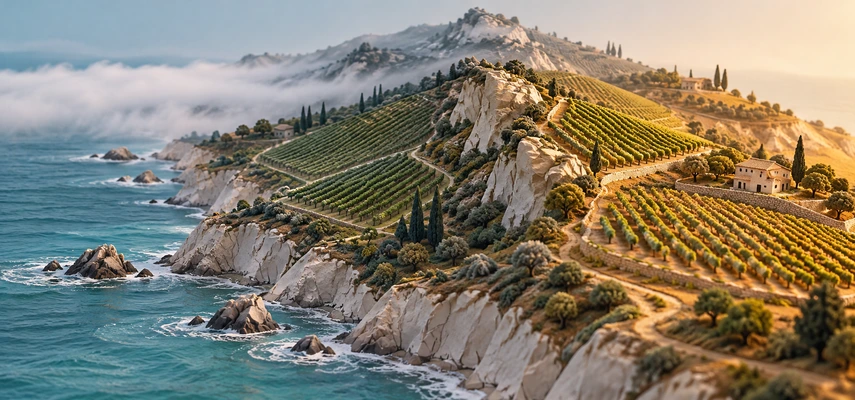

Two vineyards can share a region and a grape variety yet offer very different ripening conditions. One faces the afternoon sun above a sheltered valley. Another catches cool coastal air and morning fog. Climate and terroir become useful explanations when they show how those differences reach the vine, rather than merely giving each hillside an impressive description.
The task at Diploma level is to connect a factor with a mechanism, then evaluate its consequences. A cooler site might help preserve acidity but also struggle to ripen a late variety. A sun-exposed slope might provide useful warmth in one setting and excessive fruit heating in another. Neither “cool” nor “sunny” is a quality score.
Climate and terroir describe different things
Climate concerns a place’s prevailing weather patterns over time. Weather is what happens during a particular period: a rainy flowering week, a dry month or a heat event. Vintage variation reflects the differences between seasons within that longer-term setting. A climate description establishes probabilities; it does not guarantee the weather of a particular harvest.
Terroir is broader. The OIV’s descriptive definition connects a place’s physical and biological environment with viticultural practices and accumulated understanding. Soil, topography, climate, landscape and biodiversity are part of that concept. It is not simply another word for bedrock, and the OIV distinguishes the descriptive idea from the legal definition of a geographical indication.
Use these terms to sharpen an explanation. If “terroir” replaces the mechanism, it explains very little. If it introduces how a slope changes radiation, water supply or management choices, it begins to do useful work. Human decisions do not disappear because the wine has a place name.
Separate heat from light
Temperature influences the rate of development and many metabolic processes. Light supplies energy for photosynthesis and affects the exposure of leaves and fruit. Their effects interact, but air temperature, leaf temperature and berry temperature are not identical measurements.
A sunny berry can become warmer than the surrounding air. Conversely, shading can reduce direct radiation without making the entire region cooler. Wine Australia’s heat-management guidance identifies radiation, air temperature, shade, water availability and wind among the influences on fruit temperature. This is why a weather-station maximum cannot fully describe what happened inside a bunch.
Warmth can help a variety complete ripening where the season is otherwise limiting. Excessive heat can instead damage fruit or disrupt development. During ripening, temperature also influences acid metabolism. A statement such as “heat improves maturity” needs a range, timing and intended outcome; more heat does not deliver a steadily better version of the same wine.
Latitude and altitude: useful starting points
Latitude influences the sun’s angle and seasonal day length. In broad terms, moving towards the poles reduces available warmth, while higher-latitude summers can offer long daylight hours. Oceans, currents, elevation and other regional influences complicate that pattern. Latitude is therefore a clue to the growing environment, not a complete suitability test.
Altitude often lowers growing-season temperatures relative to nearby lower sites. It can allow a vineyard in a warmer latitude to experience cooler conditions. However, comparing two elevations requires actual local data. Exposure, mountain shading, air movement and temperature inversions can change the result; a higher site is not automatically colder at every hour or safer from every hazard.
The publicly available WSET teaching guidance on growing environments provides the basic latitude, altitude and coastal mechanisms. At Diploma depth, add the qualifications: which part of the season changes, whether the variety can mature and what costs or risks accompany the site.
Slope and aspect redistribute the same sunlight
Slope is the ground’s inclination; aspect is the direction it faces. They influence the angle and timing of solar exposure. Equator-facing slopes can intercept more useful radiation in cooler settings: broadly south-facing in the Northern Hemisphere and north-facing in the Southern Hemisphere. Local shading and the sun’s seasonal path still matter.
East-facing and west-facing slopes also receive their strongest exposure at different times. Afternoon exposure can coincide with already warm conditions. The preferred aspect therefore depends on whether additional warmth is desirable or whether limiting fruit heating is the greater priority.
Slope affects air movement as well. Cold air can move downhill and accumulate where drainage is obstructed, creating frost-prone low areas under suitable conditions. North Carolina State’s site-selection guide explains these terrain and local-climate relationships. A hillside’s thermal advantage should be weighed against access, machinery safety and erosion risks rather than treated as a free improvement.
Water, wind, fog and cloud modify the picture
Large bodies of water heat and cool differently from land and can moderate nearby temperatures. The actual effect depends on the water body, season, prevailing conditions and how air reaches the vineyard. An ocean influence may cool summer conditions, while a lake can reduce temperature extremes in a different setting.
The British Columbia site-selection guide describes the moderating influence of large water bodies and the importance of topography. It also shows why a regional description needs local detail: nearby slopes, shelter and elevation change how that influence is experienced.
Wind can move cool or warm air, alter heat exchange and influence water loss. Gentle ventilation can assist canopy drying; strong exposure can damage growth and complicate management. “Windy” is not a complete explanation until the direction, temperature, strength and timing are considered.
Cloud reduces incoming solar radiation, while mist and fog can interrupt direct sunshine close to the ground. They may limit daytime heating and change leaf-wetness or humidity conditions. Their duration and timing matter: morning fog that clears differs from persistent cloud through a critical developmental period. A cooler outcome may preserve freshness while making completion of ripening more difficult.
Soil joins the climate system
Soil characteristics influence heat storage and exchange, water availability and the vine’s rooting environment. A dry exposed surface and a moist covered surface can behave differently under the same weather. Reflected radiation can also affect exposed fruit.
This does not mean that a rock’s flavour travels intact from the ground into a glass. The stronger explanation follows physical and biological routes: root access to water, canopy growth, berry exposure and the resulting composition. Soil texture, drainage, nutrient availability and soil health receive detailed treatment separately. Here the point is that the soil participates in the growing environment rather than decorating it.
Use climate classifications for the question they answer
Cool, moderate, warm and hot describe relative thermal conditions. The classification method and measurement period must be stated before numerical boundaries are compared. A warmest-month average, a growing-season average and accumulated heat units summarise different things; their category names cannot safely be interchanged.
Continental climates generally show a larger seasonal contrast between summer and winter. Maritime climates have substantial ocean influence that moderates temperatures. Mediterranean climates feature relatively dry summers and more winter-dominated rainfall. These descriptions concern patterns, not just the temperature of a summer afternoon. A maritime influence can operate within a region described as Mediterranean.
McLaren Vale’s regional association supplies a concrete example: it describes a Mediterranean setting with winter-dominated rainfall, while the Gulf St Vincent and nearby ranges contribute local differences. Its account also distinguishes sea breezes from gully winds. A single climate label would miss those mechanisms.
Other systems make comparisons more precise. Growing degree days sum heat above a chosen base over a defined period. The Winkler approach groups regions using accumulated growing-season heat; the Huglin index additionally considers features such as maximum temperatures and day length. Such tools help compare environments, but do not directly measure wine quality or capture every damaging extreme.
For a simple hypothetical calculation, a method using a 10°C base assigns 8 degree days when the daily mean is 18°C. Under a method that floors negative daily values at zero, a 9°C daily mean contributes zero. The period, units and calculation convention must remain consistent. Oregon State’s establishment guide explains why heat accumulation and frost-free season length are both needed; neither replaces site observation.
Diurnal range and vintage variation need context
Diurnal range is the difference between daytime and nighttime temperatures. Compare the actual maximum and minimum, not just the size of the gap. A large range can accompany very hot days or relatively cool days, with different consequences for the vine and fruit.
Cooler nights can reduce temperature-driven malic-acid loss relative to warmer nights, all else equal. That may help retain acidity, but the daytime conditions, variety and timing still influence composition. A large diurnal range is neither a guarantee of balance nor an automatic signal of superior quality.
Vintage variation changes how these influences combine. Rainfall can replenish water supplies, interrupt flowering or threaten fruit health depending on timing and conditions. Warmth can assist development or bring damaging extremes; sunlight can support photosynthesis or increase exposed-fruit heating. Assess the sequence of events against the stages of vine development.
Climate change shifts the planning baseline
Longer-term change affects more than a region’s average temperature. Heat extremes, water demand, rainfall patterns and the timing of developmental stages can all matter. Wine Australia’s Climate Atlas explicitly brings seasonal variability and longer-term trends into regional planning, using several temperature, water and extreme-event measures.
Some previously marginal sites may gain more reliable ripening opportunities. Others may face greater pressure on acidity, water resources or fruit protection. An opportunity still requires suitable land, varieties, infrastructure, markets and legal permissions. A projection of warming is not a prediction that every new vineyard will be successful.
Costs connect the environmental question to price. A suitable site can reduce crop failure or intervention needs. A challenging one may require extra labour, protection or water infrastructure. Those costs affect viability, while demand, reputation and supply determine what buyers will pay. Climate helps explain a wine’s possibilities; it does not set its retail price alone.
Carry the climate mechanism into vineyard soil and water and vineyard weather hazards by explaining how water availability and an individual weather event differ from a long-term pattern. Use the grapevine growth cycle to locate the effect in the growing season and vineyard establishment to assess the choices made before planting.
Original Diploma practice and outline answers
The scenarios are hypothetical TFE exercises, with indicative points rather than official WSET marks.
Question 1: compare two slopes
Two nearby parcels have the same variety, but one receives stronger afternoon exposure. Explain why that difference could be useful in one season and disadvantageous in another.
Indicative points: Radiation and fruit heating; development under limiting warmth; excessive heat or sunburn risk; season and canopy conditions; no automatic aspect-quality ranking.
Outline answer: Greater exposure can increase useful heating where ripening is constrained, helping the variety reach its intended composition. During a hot season, the same exposure may raise berry temperatures excessively and increase damage risk. The result depends on canopy shade, water availability and the actual weather. Aspect changes the conditions, but suitability is determined relative to the crop’s needs.
Question 2: evaluate a climate index
Two sites have equal seasonal growing degree days calculated by the same method. Explain why their wine-production potential may still differ.
Indicative points: Distribution of heat; extremes; frost-free period; sunlight; rainfall and water; variety; index is not quality measurement.
Outline answer: A seasonal total can hide different sequences of warm and cool conditions or extreme events. Sites may also differ in frost exposure, sunshine and water supply. Those differences affect development, crop health and whether a variety ripens reliably. Equal accumulated heat therefore supports one comparison but does not establish equal suitability or quality potential.
Question 3: separate adaptation from a quality promise
A hypothetical cooler upland becomes warm enough to ripen a selected variety more often. Evaluate the claim that climate change therefore guarantees profitable premium wine there.
Indicative points: Improved ripening opportunity; remaining extremes and water risks; establishment and access costs; law and market access; sensory quality and price require evidence.
Outline answer: More reliable warmth may remove one constraint, but other hazards, soil conditions and water availability remain. Developing a vineyard and route to market still requires investment and legal compliance. Suitable grapes must be turned into a wine buyers value. A changing climate creates a possibility, not evidence of guaranteed quality, a particular price or profit.
Make place explain the wine
For each regional claim, add a mechanism and a qualification. Instead of “the vineyard is coastal,” explain how coastal air reaches it, when that influence operates and what it changes. Then connect the result to the variety, desired style and commercial choices. That is where climate and terroir become analytical tools.












