











Mezcal is sometimes introduced as tequila’s smoky relative. That offers a recognizable flavor cue and then immediately runs out of usefulness. Mezcal encompasses different agaves, growing conditions, cooking methods, fermentations and distillation arrangements. Smoke can be part of the picture, but it cannot explain the whole spirit, and it is not a quality score.
A better route begins with the maker’s actual material and method. Which agave was harvested? How was its carbohydrate converted and extracted? What fermented, in which vessel, and what apparatus separated it? Those questions reveal much more than a label promising authenticity. They also help you separate legal production categories from maturation or preparation classes.
Mezcal has its own protected framework
Mezcal is a protected Mexican agave spirit under its denomination-of-origin and production rules. The official NOM-070-SCFI-2016 defines it as 100% maguey or agave, with a commercial strength range of 35–55% ABV. The raw agave must meet the relevant origin, maturity, registration and permitted-harvest conditions. A spirit does not become certified Mezcal solely because someone roasted an agave in Mexico.
The protected geography has changed over time, so avoid treating an old state count as the enduring definition. The applicable declared area and certification requirements are what matter. Likewise, a flavorful agave distillate sold under a different legal designation should not automatically be dismissed as poor merely because its label does not use Mezcal.
The legal terms also describe different dimensions. Mezcal, Mezcal Artesanal and Mezcal Ancestral are production categories based on permitted stages and equipment. Joven, reposado and the other classes concern subsequent presentation or preparation. A young ancestral release can carry both kinds of information without any contradiction.
Agave diversity is a real production difference
Espadín is a central starting point, commonly identified with Agave angustifolia. Tobalá is commonly associated with Agave potatorum, while other local names and species expand the field considerably. Local names are useful, but they do not always provide a perfectly uniform botanical identification across every region. Read the actual producer information where precision matters.
Different plants present different growth, reserve and handling characteristics. Their maturity periods and practical yields need not be identical. A fixed number of years learned for blue agave cannot be applied to every mezcal agave. Nor does a long growth period automatically guarantee greater sensory complexity in the eventual spirit.
For a concrete multi-agave example, Amarás describes an Espadín–Tobalá ensamble. It identifies the two botanical sources as part of one expression. That demonstrates intentional combination, rather than a rule that every Mezcal must contain only one agave type or that one named plant necessarily tastes better than another.
Cultivated and wild describe sources, not scores
Both cultivated and permitted wild agaves can enter the production framework. Wild origin is not a universal quality grade, and cultivation does not make the plant inherently uninteresting. Condition, appropriate maturity, handling and the subsequent process remain relevant. The useful question is whether the raw material suits the intended spirit and has been responsibly obtained.
Long plant development also makes supply a practical issue. Harvesting a mature plant removes material that took years to develop, while future production depends on replacement and viable populations or cultivation systems. A scarce species name should invite questions about sourcing and management, rather than an automatic assumption that rarity improves the taste.
Keep those questions distinct in an examination answer. A sourcing claim concerns where material came from and how it was obtained. A sensory conclusion concerns the actual spirit. Both can matter, but one does not prove the other. A beautifully documented plant still requires skilled conversion, fermentation and separation.
Cooking makes usable sugars and can add character
Agave fructans require suitable hydrolysis to release smaller usable carbohydrates. They are not cereal starch, even when a simplified marketing account uses that word. Primary agave hydrolysis research helps distinguish the reserve structure and conversion from the later yeast fermentation that makes alcohol.
Pit cooking is important in many traditional routes. Heated stones, the covered environment, moisture and time act on the agave, while combustion products can contribute smoke-related character. The two effects should be separated in your reasoning: conversion prepares substrate, while the particular heating environment can add another sensory influence.
Not every permitted Mezcal route uses identical cooking equipment. The production categories distinguish their options, and even similar pits can operate differently. Fuel, load, heat distribution and material condition affect the treatment. Smoke intensity alone cannot reveal whether the carbohydrate was converted well or the batch handled carefully.
Crushing connects cooked hearts with fermentation
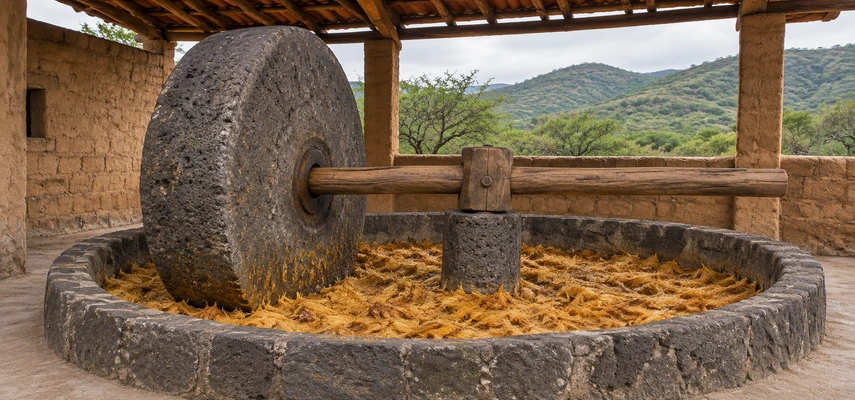
Hand pounding, stone wheels and permitted mechanical systems disrupt the fibrous material and help recover usable liquid. They differ in throughput, physical treatment and what accompanies the extracted sugars. A tahona is a heavy crushing wheel, not a fermentation culture or a guarantee that all later stages follow one recipe.
Some processes carry fibre into fermentation and distillation, while others use different separation arrangements. The physical medium influences handling, contact and process management. Naming the mill is therefore only part of the explanation. Follow the actual material onward to determine how that crushing choice fits the larger system.
For example, Del Maguey’s Minero production notes document hand milling in the described production. That is useful evidence of a real route. The historical sheet is not a promise that every future batch uses an unchanged fermentation duration, nor proof that all hand-milled spirits share one sensory profile.
Fermentation develops the aromatic feed
Yeast uses the available sugars to make alcohol and additional compounds. Mixed microbial activity, medium composition, vessel, temperature and time can influence the result. Open or traditional vessels do not remove the need for control; the maker works with a living environment whose behavior matters to both reliability and style.
Different fermentation histories can produce different aroma opportunities from the same named agave. Fruit-like, herbal, lactic or other associations may reflect several stages rather than a single plant trait. The eventual aroma is a record of transformation, not a perfectly preserved copy of the raw heart’s smell.
This gives a useful caution when comparing bottles. A distinctive Tobalá and a distinctive Espadín may differ in far more than species. Unless their other production variables are controlled, you cannot assign every sensory difference to the plant alone. Species matters, but it shares the explanation with the rest of the process.
Copper and clay provide distinct descriptive routes
Mezcal production includes permitted copper and clay arrangements within the appropriate categories. Pot distillation concentrates and selects the fermented material; many documented examples use two stages. The feed, vessel, heating and collection decisions establish the actual production history. Equipment material is one important detail among several.
Compare the documented clay still in the Minero notes with Chichicapa’s copper-pot description. Both use Espadín in the cited examples, yet the methods are not identical. They are useful illustrations of diversity without establishing that clay always tastes earthy or copper always makes a lighter spirit.
For practice, keep agave-distillation questions descriptive under the specification’s assessment scope. Being able to state the apparatus and sequence is valuable without inventing an explain-type task where the official topic is not marked for it. Cooking and fermentation offer appropriate mechanistic exercises elsewhere in the lesson.
The three categories describe permitted equipment
The category Mezcal permits the broadest set of listed equipment, including suitable modern systems. Mezcal Artesanal narrows the options across cooking, milling, fermentation and direct-fire distillation. Mezcal Ancestral specifies pit cooking, listed traditional milling options and the clay-pot route with the permitted head materials, among its conditions.
Learn the framework as a complete set of stage requirements. One photographed clay pot alone does not establish compliance with every ancestral condition. Likewise, the word artesanal is a regulated production category here, not merely a general adjective meaning someone cared about the product. The details of the whole route matter.
The categories should not become automatic quality rankings. They identify different production possibilities and constraints. Within each, raw-material selection, operation and final balance still need assessment. A historically resonant method can produce an exceptional spirit, but the method’s name does not erase poor execution.
Classes describe the next part of the history
Blanco or joven identifies the colorless young presentation under the standard. Madurado en vidrio concerns stabilization in glass for more than twelve months under specified conditions. That glass route is not equivalent to oak maturation: it provides time and a different environment without the same wood extraction.
Reposado involves between two and twelve months in suitable wooden vessels. Añejo involves more than twelve months in suitable wood of less than 1,000 litres capacity. These definitions differ from Tequila’s, so do not transfer every familiar tequila age term and vessel condition to Mezcal without checking the actual framework.
Abocado con concerns permitted ingredients added to impart flavor, while destilado con concerns distillation with ingredients. A pechuga-style process can illustrate the latter idea, but the presence of additional material must be understood through the actual class and method. Infusing a finished spirit and distilling with ingredients are different operations.
Quality needs evidence beyond smoke and scarcity
Assess whether agave-related, fermentation-derived, cooking-related and developed contributions form a convincing whole. Smoke can be integrated or dominant. Alcohol can provide appropriate warmth or overwhelm detail. Persistence can carry complexity or simply prolong a coarse sensation. These relationships matter more than rewarding the strongest single feature.
An unaged release can offer considerable complexity, while an aged one can lose definition under excessive wood. Judge each against its intended style using balance, persistence, complexity and integration. Species rarity, handwork and a high price provide context, but none can substitute for the actual performance of the spirit.
What to remember
Follow plant, harvest, conversion, crushing, fermentation, descriptive distillation and final preparation. Keep the three production categories separate from the six classes. Use documented producer examples to understand variation, then qualify sensory predictions where several stages differ. Mezcal’s range becomes much more interesting once smoke stops being asked to explain everything.
Written practice: original TFE exercises
These suggested marks and indicative points are independent teaching guidance, not official WSET marking schemes.
Exercise 1: 5 suggested marks
Explain why a smoky cooked agave aroma does not by itself prove suitable preparation for fermentation. Mapping: LO2 explain: cooking and fructans.
Indicative marking points:
- Smoke character can come from combustion exposure.
- Fermentation also needs usable sugars.
- Important agave reserves are fructans.
- Suitable hydrolysis must release usable smaller carbohydrates.
- The degree of smoke does not measure conversion or the final medium’s suitability.
Model answer: Smoke character can arise from combustion exposure, while fermentation requires usable sugars. Important agave reserves occur as fructans that need suitable hydrolysis to release smaller usable carbohydrates. Smoke intensity therefore does not measure conversion or establish that the resulting medium suits yeast fermentation.
Why it works: It separates an aroma contribution from the chemical preparation required for fermentation.
Common mistake: Using smoky as proof that all carbohydrate has converted confuses two distinct outcomes.
Exercise 2: 5 suggested marks
Explain why two batches from the same named agave can supply different aroma-related material to the still. Mapping: LO2 explain: alcoholic fermentation.
Indicative marking points:
- The species name does not fix every feed property.
- Nutrients or solids can differ.
- Microbial populations and conditions can differ.
- Fermentation can therefore produce different additional compounds.
- The resulting aroma-related feeds may differ despite the shared agave name.
Model answer: A shared agave name does not fix nutrients, solids or every other feed property. Microbial populations and working conditions can also differ, changing the compounds formed alongside ethanol. The batches can therefore supply different aroma-related material to the still despite using the same named plant.
Why it works: It follows variation in medium and organisms into the composition available for subsequent separation.
Common mistake: Assigning every difference to species ignores the transformation during fermentation.
Knowledge check: 10 original practice questions
Independent TFE questions, not official WSET examination items. Choose one answer per question; explanations follow separately.
1. What should wild sourcing alone establish about quality?
2. What distinguishes madurado en vidrio?
3. What is the wood-duration interval for reposado Mezcal?
4. Which pair identifies production categories?
5. What does an ensamble example demonstrate?
6. What is the key distinction between abocado con and destilado con?
7. What does agave cooking chiefly prepare for fermentation?
8. Why is strong smoke not an automatic quality advantage?
9. Why is a clay-still photograph insufficient to establish Ancestral compliance?
10. Which is a central Espadín identification?
Answers and explanations
- C — It does not independently establish sensory superiority. Source and permission need evidence; sensory quality requires assessment of the result. Mapping: LO2.
- B — More than twelve months in glass under specified conditions. Glass rest is not the same mechanism as oak extraction. Mapping: LO2.
- B — Between two and twelve months. Its class definition must be learned separately from Tequila terminology. Mapping: LO2.
- A — Mezcal Artesanal and Mezcal Ancestral. Categories concern permitted production methods; the other pairs concern classes. Mapping: LO2.
- B — Intentional use of more than one agave type. The cited producer identifies Espadin and Tobala as components of one expression. Mapping: LO2.
- D — Ingredient addition versus distillation with ingredients. The class terms describe different preparation operations. Mapping: LO2.
- B — Usable sugars through suitable fructan hydrolysis. Conversion supplies substrate; yeast subsequently makes alcohol. Mapping: LO2.
- C — Its balance with the rest of the spirit matters. Intensity can complement or dominate; integration and intended style determine its success. Mapping: LO2.
- A — Other stage requirements must also be met. The legal production route includes cooking, milling, fermentation and distillation conditions. Mapping: LO2.
- D — Agave angustifolia. Espadin is commonly linked with angustifolia, while Mezcal includes broader agave diversity. Mapping: LO2.
Continue exploring this series
2. Carbohydrates Explained: How Sugar, Starch, and Fructans Become Fermentable
3. Alcoholic Fermentation Explained: Yeast, Nutrients, and Flavor Compounds
6. Pot Still Distillation Explained: Design, Heating, Cuts, and Flavor
9. Oak Maturation Explained: Barrels, Oxygen, Evaporation, and Flavor Development
23. Agave Spirits Explained: Growing, Cooking, Crushing, and Fructan Conversion
24. Tequila Explained: Agave, Production Choices, and Legal Categories
29. Spirits Quality Explained: How Production Decisions Affect Balance and Complexity
30. How to Explain Spirits Production: Advanced Cause-and-Effect Case Studies
26. Vodka Explained: Neutral Spirits, Raw Materials, and Production Choices
50. WSET Level 3 Spirits Exam: Complete Revision Guide and Practice Examinations












