










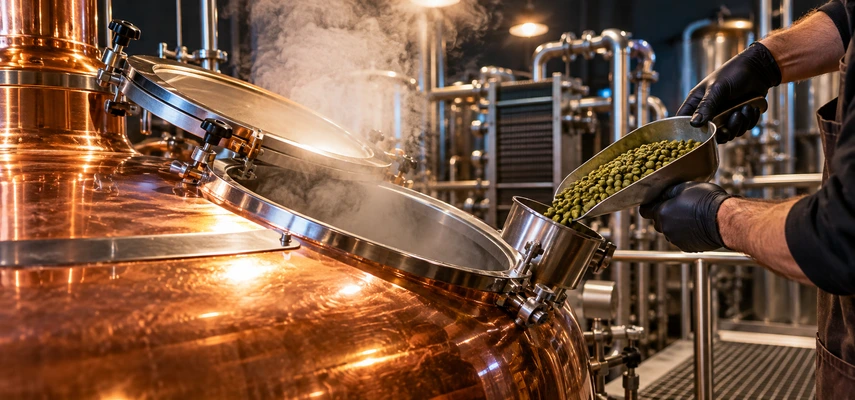

Put a handful of hops into wort early in the boil and you get one emphasis. Use the same material much later and the result can smell dramatically different. Wort boiling is where the brewer manages that trade-off, while also preparing the liquid for the next stages of production.
The kettle is not merely a large saucepan waiting for a timer. Heat changes hop compounds, drives off volatile substances, concentrates the wort and helps form material that can later be separated. To understand its effect on beer, follow both what the brewer wants to keep and what the brewer wants to remove.
Where wort boiling fits in the sequence
After mashing and mash separation, the collected sweet wort moves to the kettle. It contains soluble grain-derived material but is not finished beer. Fermentation has not yet made the alcohol and carbon dioxide that will define the next major transformation.
Kettle and copper are traditional names for the boiling vessel. A modern kettle may be made of stainless steel even when brewers still call it the copper. The equipment name tells you its process role, not necessarily the visible metal surrounding it.
The official Level 2 specification places wort boiling and main hop additions before clarification and cooling. Learn those operations as a causal sequence. Solids management protects the next equipment, and cooling prepares the environment for the selected fermentation culture.
The boil does several jobs at once
Boiling applies a substantial heat treatment that greatly reduces the wort’s microbial load. It also stops the mash enzymes from continuing their earlier work. Neither statement means the brewery can ignore cleanliness afterward. Once cooled, the wort is a nutrient-rich material that needs careful handling.
Evaporation removes water and can increase concentration. The actual change depends on the system, volume and process. A brewer therefore coordinates wort collection, boil performance and the desired starting extract rather than expecting one duration to deliver the same concentration in every kettle.
Heat promotes protein-related aggregation and the formation of hot break, part of the material that will be managed as trub. At the same time, volatile compounds are driven off. Some are unwanted in the finished beer; others include desirable hop aromas that the brewer may prefer to retain through later additions.
Bitterness starts with a chemical change
Hop alpha acids are important precursors of conventional kettle-derived bitterness. In hot wort they can isomerize into more soluble bitter compounds. Time and temperature influence that conversion, while wort conditions and the hop product also affect the brewer’s practical result.
This is why two additions containing the same hop mass do not necessarily yield identical bitterness. They may differ in alpha-acid content, contact time or process environment. The variety’s typical aroma tells you something useful, but it does not replace the analytical or production information used to plan bitterness.
The BJCP wort-production guide supplies wider process context. For examination reasoning, connect hotter, longer contact with the opportunity for isomerization, while avoiding a simplistic assumption that every other variable becomes irrelevant.
Early additions: build a bitter foundation
Hops added early receive substantial boiling time. Brewers commonly use this opportunity to establish bitterness efficiently. Meanwhile, volatile aromatic compounds may be lost with steam or transformed, so the raw hop’s fresh aroma is not preserved unchanged.
Early addition therefore usually emphasizes bittering relative to a comparable late addition. It does not mean that early hops can contribute no aroma under any circumstances. The final result reflects the material and the entire process, not a rigid category assigned to one minute on a schedule.
This distinction is helpful when comparing beers with firm bitterness but restrained hop aroma against beers with intense aroma. A brewer can pursue one emphasis without having to maximize the other. Bitter and aromatic are related dimensions of hop use, not synonyms.
Later additions: preserve a different expression
Adding hops toward the end of boiling shortens their exposure to vigorous heat. This often helps retain more aromatic expression. It can also yield a different mix of compounds from an early addition, so late hopping is more than making an identical aroma merely stronger.
Late hot-side hops can still contribute bitterness. The wort remains hot, and conversion and extraction do not stop simply because the main boil is nearly finished. The brewer must consider actual temperature and contact time, including time after the burner or steam supply is switched off.
Imagine two otherwise comparable hopping plans. One uses most of its hops early, while another puts a larger share late. You can predict different emphasis, but not the exact final bitterness from that description alone. Dose, product composition, wort and equipment are still missing parts of the comparison.
Whirlpool hopping is not automatically cold hopping
After the boil, hops may be added in a whirlpool or during a hot stand. Those additions can emphasize aroma, but the liquid may remain hot enough for substantial changes to continue. A long hot hold is different from a rapid temperature reduction.
The word whirlpool describes a vessel or process context, not one mandatory temperature. Brewers can manage that stage in different ways. A label saying whirlpool-hopped does not by itself tell you precisely how bitter the beer will be or how much aroma survives fermentation.
Dry hopping takes place in cooled wort or beer, often during or after fermentation, and gives a different extraction environment. It generally emphasizes aroma rather than conventional kettle isomerization, although perceived bitterness and other properties can change. Keep hot-side addition timing separate from this later method.
Clarification: leave troublesome solids behind
Wort clarification removes much of the unwanted suspended material following the boil. Trub includes aggregated grain-derived material and hop particles. The objective is a wort suitable for cooling and fermentation, with a sensible balance between recovery and solids carryover.
A whirlpool establishes a circular flow that helps collect solids into a localized deposit as the liquid’s movement changes and settles. Clearer wort can then be drawn off. It is not a blender intended to keep every particle permanently suspended.
Alfa Laval’s brewhouse engineering overview connects trub management to wort recovery and reduced cooler fouling. That practical connection explains why clarification belongs before the heat exchanger rather than being a cosmetic finishing step added whenever convenient.
A whirlpool is different from a lauter tun
Both operations separate material, which makes them easy to confuse on a quick revision card. A lauter tun handles the mash’s grain bed before boiling. A whirlpool handles post-boil solids in wort. The materials, process position and separation behavior differ.
Putting them in order gives you a useful examination check: mashing, mash separation and sparging, boiling with hops, wort clarification, then cooling. Fermentation follows in the conventional cultured-yeast sequence. A question placing yeast fermentation before routine kettle boiling should immediately make you inspect the proposed process carefully.
Some specialized souring methods introduce microbial activity before the main boil, but they are deliberate exceptions with their own logic. Article #9 explains them. Do not let a later exception erase your understanding of the normal sequence being tested here.
Cooling: make the wort suitable for the culture
Hot wort must reach a temperature suitable for the chosen fermentation. Pitching ordinary brewing yeast directly into near-boiling liquid would damage it. Cooling is therefore a biological preparation step as well as a heat-removal operation.
A plate heat exchanger transfers heat between wort and a cooler medium through separating surfaces. The fluids exchange heat without being deliberately mixed. That distinction is central: cooling the wort is not the same as diluting it by pouring coolant into the product.
Centec’s equipment explanation places cooling after boiling and trub separation and describes single- and two-stage systems. The desired outlet temperature depends on fermentation plans. There is no reason to impose one universal pitching temperature on ale, lager and all other fermentation approaches.
Control the process instead of worshipping a duration
Brewers coordinate boil performance with evaporation, volatile removal, hop treatment and the following hold and cooling stages. More vigorous or longer boiling is not automatically better in every system. The right comparison is whether the process reaches its targets without creating avoidable costs or unwanted character.
GEA’s modern boiling-system description illustrates that industrial systems can manage heat input and stripping differently. You do not need to memorize a manufacturer’s design. You do need to understand why the equipment is controlling several outcomes rather than merely keeping liquid visibly bubbling.
The same caution applies to a hopping schedule. A printed minute is only meaningful in relation to the process. It cannot independently promise a precise aroma concentration after yeast activity, maturation, packaging and storage have all had their say.
A practical reasoning exercise
Draw three columns for early kettle hops, late hot-side hops and dry hops. For each, note the intended emphasis, heat exposure and one uncertainty. Then explain why moving a dose from one stage to another can change the beer even when the variety and total mass stay unchanged.
You can complete this entirely from written recipes and technical descriptions without consuming alcohol. Add the kettle, whirlpool and heat exchanger to your production sketch, identifying what each changes or removes. If two pieces of equipment seem interchangeable, return to their inputs and outputs.
One-page revision summary
Wort boiling treats the liquid with heat, changes concentration, helps form separable material, removes volatiles and supports hop bittering. Addition timing shifts the balance between bitterness and retained aroma, with actual temperature and contact time governing the details.
Clarify the wort in the appropriate separation stage, then cool it through a heat exchanger for fermentation. Learn the sequence and its purpose together: the brewer is shaping flavor while preparing a cleanly handled, suitable environment for the microorganisms that come next.
Continue your beer studies
Explore the related lessons on hops explained alongside milling and mashing to extend the ingredient, process or sensory reasoning in this article.
Knowledge check: 10 original practice questions
Independent TFE questions, not official WSET examination items. Choose one answer per question; explanations follow separately.
1. What is copper in traditional brewing terminology?
- Only a yeast nutrient
- The boiling vessel
- A serving glass
- The grain bed
2. What important hop change occurs under hot kettle conditions?
- Hop cones become malt
- Yeast makes alcohol inside the pellets
- Alpha acids can isomerize into more soluble bitter compounds
- All aroma becomes sweetness
3. Why are early hop additions commonly used for bitterness?
- They receive substantial hot contact time
- They never contain aroma compounds
- They prevent boiling
- They create beer color alone
4. Which statement about late hot-side hopping is accurate?
- Late means no bitterness is possible
- It prevents any extraction
- It occurs only after packaging
- It can preserve aroma and still contribute bitterness
5. Which operation normally precedes wort cooling after boiling?
- Wort clarification
- Bottling finished beer
- Serving the first pint
- Removing alcohol from beer
6. What is a whirlpool principally used for in this sequence?
- Grinding intact malt
- Helping separate post-boil solids
- Fermenting all lager
- Adding coolant directly to wort
7. How does a plate heat exchanger cool wort?
- By permanently mixing glycol into it
- By fermenting it rapidly
- By transferring heat across surfaces to a cooler medium
- By adding hop pellets
8. Which conclusion follows from the phrase whirlpool-hopped alone?
- The wort must be at refrigerator temperature
- The beer must have zero bitterness
- All yeast has already been removed
- The exact bitterness still depends on conditions and dose
9. Which pair correctly distinguishes two separation stages?
- Lauter tun—mash grain bed; whirlpool—post-boil trub
- Whirlpool—intact raw grain; lauter tun—packaged beer
- Lauter tun—only yeast; whirlpool—only bottle caps
- Both occur only after serving
10. Why does cooled wort still need careful hygienic handling after boiling?
- Boiling produces every future contaminant
- Heat treatment does not prevent later contamination
- Cold wort contains no nutrients
- Yeast cannot grow in wort
Answers and explanations
1. B — The boiling vessel. Copper is a traditional name for the kettle or boiling vessel. A modern vessel may be stainless steel despite that inherited terminology. Mapping: LO2 AC2.
2. C — Alpha acids can isomerize into more soluble bitter compounds. Kettle heat supports alpha-acid isomerization associated with bitterness. It is distinct from yeast fermentation and from aromatic extraction alone. Mapping: LO2 AC3.
3. A — They receive substantial hot contact time. Extended hot contact provides opportunity for isomerization. Early hops may also influence aroma; the distinction concerns usual emphasis. Mapping: LO2 AC3.
4. D — It can preserve aroma and still contribute bitterness. Shorter heat exposure can retain more aroma, while hot conditions can still support bittering reactions. Actual time and temperature matter. Mapping: LO2 AC3.
5. A — Wort clarification. Clarification manages post-boil trub and hop particles before the wort enters the cooling equipment and fermentation sequence. Mapping: LO2 AC2.
6. B — Helping separate post-boil solids. The whirlpool helps collect and separate trub and hop material. It differs from the mill, lauter tun and heat exchanger. Mapping: LO2 AC2.
7. C — By transferring heat across surfaces to a cooler medium. Separated fluid channels exchange heat through surfaces. The cooling medium is not intentionally mixed into the brewing product. Mapping: LO2 AC2.
8. D — The exact bitterness still depends on conditions and dose. Whirlpool describes an addition context, not one fixed temperature, contact time or dose. It cannot independently determine the final bitterness. Mapping: LO2 AC3.
9. A — Lauter tun—mash grain bed; whirlpool—post-boil trub. Lautering handles grain solids before boiling; whirlpool separation handles trub and hop material after boiling. Process position is part of the distinction. Mapping: LO2 AC2.
10. B — Heat treatment does not prevent later contamination. Boiling reduces existing microbial load but does not prevent new contamination during subsequent handling of nutrient-rich cooled wort. Mapping: LO2 AC2/AC3.












