











The main fermentation tank is a difficult place to give a tiny yeast population its first chance. There is a great deal of material to work through, and other microorganisms may also find it inviting. Sake fermentation starters solve that problem by building a strong population in a smaller, managed environment before the main mash expands.
The starter is called shubo or moto. Both terms point to the same essential role: prepare the yeast population that will drive alcoholic fermentation. Sokujō, kimoto and yamahai are different approaches to making that starter. Their central contrast concerns how an appropriately acidic environment is established, with an additional handling distinction between kimoto and yamahai.
Sake fermentation starters give yeast a useful beginning
A starter uses steamed rice, kōji, water and yeast. Rice supplies potential carbohydrate; kōji enzymes release sugars; water supplies the medium; yeast multiplies and ferments. The aim is not simply to produce a small volume of finished sake. It is to create a viable, active population suitable for the much larger job that follows.
The Level 2 specification asks you to understand the starter’s aim, ingredients, lactic acid, lactic acid bacteria and the three named methods. Read those as linked requirements. The method makes more sense once the microbial problem is clear.
Suppose a brewery placed a small amount of yeast directly into a large volume of newly prepared material without an appropriate strategy. The selected yeast could face a less favorable ratio to its surroundings and competitors. A starter helps the brewery approach the main fermentation with a population already established under managed conditions.
Acidity helps discourage unwanted competitors
Lactic acid makes the environment less hospitable to many unwanted microorganisms. The desired sake yeast can operate under appropriately acidic conditions, so acidification helps favor the intended fermentation. This is microbial management. It is not a claim that acid sterilizes the starter or makes careful handling unnecessary.
Acidity and alcohol affect microbial survival as the starter develops, but the environment changes over time. Temperature and nutrient availability matter too. Avoid a cartoon in which one drop of acid instantly removes every possible competitor and the rest of the process takes care of itself.
The practical distinction is where the lactic acid comes from. It can be added directly, or it can be generated by lactic acid bacteria cultivated within the starter. In both cases, the brewer wants an environment that supports an effective yeast population. The routes differ even when the shared objective is similar.
Sokujō adds lactic acid directly
In the standard sokujō approach, the brewer adds lactic acid rather than waiting for a population of bacteria to produce it. This gives a relatively direct route to the desired acidic conditions. The name is associated with a quicker starter method, a useful clue to its practical role.
Direct acid addition can shorten starter preparation relative to the traditional bacteria-led methods. It also lets the brewer manage the acidification step more directly. That does not mean the rest of the starter becomes instantaneous. Yeast still has to grow and function, and the brewery still has to manage the material and conditions.
Masumi’s production explanation describes the difference between adding acid and producing it in the starter. The important exam contrast is the source of lactic acid. Don’t confuse adding acid with adding alcohol, and don’t describe sokujō as a process that avoids acidity.
Sokujō is often associated with a relatively clean, restrained style platform. However, the method doesn’t guarantee lightness, fruitiness or dryness. A producer can use other choices to create a fuller expression. A starter method is a contributing decision, rather than a tasting note printed in advance.
Kimoto develops acidity through bacteria
Kimoto uses lactic acid bacteria to produce acid within the starter. The brewery manages conditions that allow the desired progression rather than adding all the needed lactic acid at the outset. This takes time and attentive control. Naturally derived acidification should not be confused with leaving the starter entirely unmanaged.
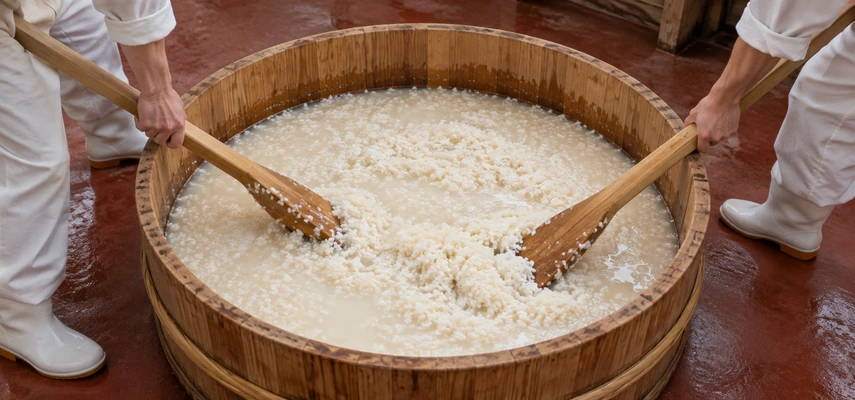
In traditional kimoto, a labor-intensive rice-working step called yamaoroshi is used. Rice and kōji are worked with tools to help produce the desired mash condition. Photographs of people using long wooden implements can make the process look purely physical, but the physical work is supporting a biological sequence.
Daishichi’s account of its own kimoto production illustrates the rice-working stage and subsequent starter development. It is useful direct evidence of a producer’s practice. Claims about that brewery’s particular microbial population should not automatically be generalized to every kimoto starter made elsewhere.
The broader mechanism is enough for Level 2: manage starter material, establish acid through lactic acid bacteria, and develop a suitable yeast population. The exact microbial sequence can be more complex than a beginner needs to memorize. Explaining the function accurately is more valuable than inventing a universal list of organisms.
Yamahai omits the yamaoroshi step
Yamahai also relies on lactic acid bacteria rather than the direct-acid shortcut characteristic of sokujō. Its name abbreviates a phrase referring to the omission of yamaoroshi. The critical contrast with kimoto is therefore a handling change within the traditional bacteria-led family of starter methods.
Omitting that labor-intensive step does not mean omitting rice breakdown or acidification. Enzymes still act, bacteria still produce lactic acid, and yeast still has to establish effectively. Yamahai is not simply an unfinished kimoto starter, nor is it another name for adding commercial lactic acid.
The NRIB starter overview explains the development of these approaches. Keep the causal distinctions in order: source of acidity separates sokujō from the traditional pair; use or omission of yamaoroshi separates kimoto from yamahai. That two-step comparison is easier to remember than three disconnected definitions.
Time differs because the biological route differs
Producing acidity through bacteria requires a period of microbial development. Adding the acid directly bypasses that part of the sequence. This is why sokujō can generally be prepared more quickly, while kimoto and yamahai commonly need longer. The time difference follows from the mechanism rather than from tradition simply preferring delay.
Approximate teaching comparisons often use about two weeks for sokujō and about four weeks for the traditional pair. Treat those as typical illustrations, not a stopwatch rule binding every brewery. Conditions, producer practice and the actual course of development can alter timing.
During that time, the brewery has work to do. Temperature management, observation and appropriate handling help the population develop as intended. A slower method is not automatically uncontrolled, just as a faster one is not automatically superficial. Both can involve careful skilled production.
What can the starter change in the glass?
Kimoto and yamahai are often associated with fuller, more savory or more complex styles. The different microbial and nutritional history can contribute to that tendency. Sokujō commonly provides a cleaner platform. These are useful patterns, provided the word often remains in the explanation.
Yeast strain, rice, kōji, temperature, fermentation length and finishing all remain influential. A delicate kimoto is not a contradiction in terms. A rich sokujō sake is not proof that the label is wrong. The brewer’s complete plan matters more than a single process word.
For a hypothetical tasting comparison, imagine two sakes with similar rice, polishing and final strength but different starters. Differences may help illustrate the starter’s contribution. If everything else also changes, the comparison becomes harder to interpret. One bottle cannot demonstrate that an entire method always tastes one way.
Don’t confuse bacteria with the yeast doing the main job
Lactic acid bacteria make lactic acid in the traditional starter approaches. Yeast makes alcohol from fermentable sugars. Kōji enzymes make sugars available from starch. These are three different roles, even though their work interacts. Calling all of them yeast would erase the very distinctions this lesson is intended to teach.
The starter then enters the main fermentation plan. More steamed rice, kōji and water will be added in a managed sequence, expanding the mash while supporting the established yeast population. The starter’s success matters because the next stage has a much larger amount of material to handle.
Meanwhile, a label term such as kimoto doesn’t tell you a premium grade or whether the sake has been diluted. It describes a production approach at one stage. A bottle can carry a starter term alongside a grade and a specialty-style description. The words answer different questions rather than competing for one classification slot.
Before moving on, explain the methods without their names. One adds acid; two cultivate acid-producing bacteria; of those two, one includes a particular rice-working step and one omits it. Then attach the Japanese terms. This checks whether the underlying distinctions are understood rather than merely whether three spellings have been memorized.
One-page revision summary
Shubo and moto refer to the starter that develops an effective yeast population. Lactic acid helps discourage competitors. Sokujō adds that acid directly; kimoto and yamahai cultivate bacteria to produce it. Kimoto includes yamaoroshi, while yamahai omits it. Bacteria-led methods generally take longer and can support fuller styles, but no starter term guarantees one taste. Keep mould enzymes, bacteria and yeast in their separate functional roles.
Knowledge check: 10 original practice questions
Independent TFE questions, not official WSET examination items. Choose one answer per question; explanations follow separately.
1. What is the chief purpose of a shubo or moto?
- Polish all the rice
- Develop a suitable active yeast population
- Distil finished sake
- Remove color with charcoal
2. How is lactic acid normally supplied in sokujō?
- Only by ageing the bottle
- Only by pressing rice
- It is added directly
- It is unnecessary
3. How do kimoto and yamahai usually obtain lactic acid?
- Lactic acid bacteria produce it in the starter
- Charcoal creates it
- Yeast distils it
- Rice husks release finished acid automatically
4. What does yamahai omit relative to traditional kimoto?
- All water
- All kōji
- The yeast population
- The yamaoroshi rice-working step
5. Why is an acidic starter useful?
- It guarantees sterility
- It discourages many unwanted microbial competitors
- It eliminates the need for sugar
- It turns starch directly into alcohol
6. Which method is generally faster to prepare?
- All methods are necessarily identical
- Kimoto always takes one day
- Sokujō
- Yamahai always finishes instantly
7. Which ingredient group fits a starter?
- Steamed rice, kōji, water and yeast
- Only alcohol and charcoal
- Only polished dry rice
- Grapes and barley malt only
8. Does a kimoto label guarantee a rich taste?
- Yes, without exception
- Yes, and a fixed alcohol level
- Yes, and a fixed polishing ratio
- No, the complete production plan still matters
9. Which organism performs alcoholic fermentation?
- Lactic acid bacteria only
- Yeast
- The wooden paddle
- The water supply
10. Which comparison is most useful for understanding starter effects?
- Bottles with no production information
- Any two different drinks
- Similar production conditions with the starter as a meaningful difference
- Price alone
Answers and explanations
1. B — Develop a suitable active yeast population. The starter establishes yeast for the larger main fermentation rather than serving as a finishing operation. Mapping: LO1.
2. C — It is added directly. Direct acid addition is the key contrast with standard kimoto and yamahai starter approaches. Mapping: LO1.
3. A — Lactic acid bacteria produce it in the starter. These approaches manage bacteria-led acidification as part of starter development. Mapping: LO1.
4. D — The yamaoroshi rice-working step. The omitted labor-intensive handling step is the central distinction between the traditional pair. Mapping: LO1.
5. B — It discourages many unwanted microbial competitors. Acidification favors controlled fermentation but does not replace hygiene or process management. Mapping: LO1.
6. C — Sokujō. Adding acid directly bypasses the period required for bacterial acid production. Mapping: LO1.
7. A — Steamed rice, kōji, water and yeast. The starter combines the basic brewing materials while managing acidity and microbial development. Mapping: LO1.
8. D — No, the complete production plan still matters. Starter methods influence style tendencies without overriding every other brewing decision. Mapping: LO1.
9. B — Yeast. Yeast converts sugars into alcohol, while lactic acid bacteria and kōji serve different functions. Mapping: LO1.
10. C — Similar production conditions with the starter as a meaningful difference. Controlling other variables makes a starter-related comparison more informative, though not absolute. Mapping: LO1.
Continue studying sake
Article #4: Kōji Production Explained: Enzymes, Mould Cultivation, and Brewing Science · Article #6: Sake Yeast and Water Explained: Strains, Minerals, and Aroma · Article #8: Multiple Parallel Fermentation Explained: How Sake Produces Alcohol · Article #15: Fruity Ginjō vs. Rich Junmai: How Brewing Choices Shape Sake Style











