










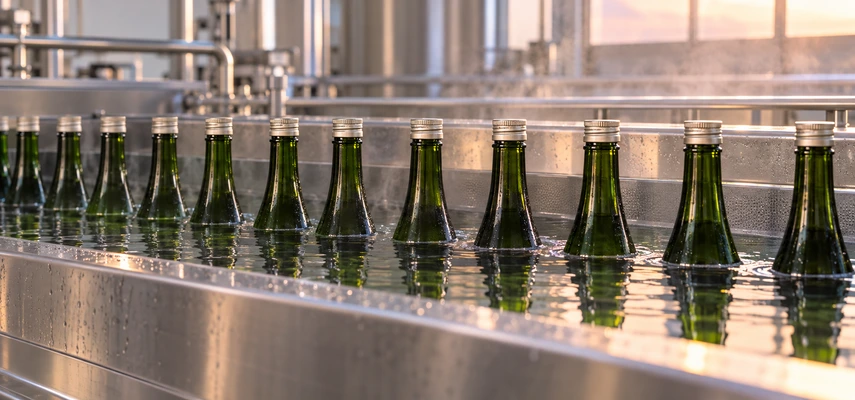

The sake is clear, but clarity doesn’t tell you whether enzymes are still active, how it will respond to storage or what strength it will have in the bottle. Sake pasteurisation and finishing deals with those remaining choices. The brewer is managing a liquid that can continue changing, not simply decorating a completed product with a label.
This lesson covers colour adjustment, heat treatment, brewery storage, water dilution and bottling. Each has its own purpose. The previous article dealt with separating liquid from the fermented mash; the operations here answer different questions about stability, balance and the condition in which sake reaches the drinker.
Sake pasteurisation and finishing starts with separate questions
Does the brewer want to remove or reduce certain colour and flavor components? Should heat inactivate relevant microorganisms and enzymes? Will the sake rest in a large vessel or in bottles? Does its alcohol need adjustment? Those are connected decisions, but they are not one interchangeable operation.
The Level 2 specification separates adjusting colour, adjusting stability, brewery storage and adjusting alcohol. That structure is a useful study tool. It prevents a learner from answering a pasteurisation question with a description of filtration simply because both happen after fermentation.
Imagine a hypothetical sake that has been pressed and settled. It may still have active enzymes, a pale yellow tint and a higher alcohol level than the intended final product. Charcoal treatment, pasteurisation and dilution would address different parts of that situation. Applying one does not automatically accomplish the others.
Charcoal fining changes selected components
Activated charcoal can adsorb substances from sake. Adsorption means substances adhere to the material’s surface; it is not the same idea as a sponge simply soaking up the whole liquid. The charcoal has a very large useful surface area, allowing it to interact with selected colour and sensory components.
The brewery can use it to reduce colour, adjust flavor and influence components involved in later development. Treatment must be managed because removing more is not always better. Desirable character can be reduced alongside unwanted material. The aim is a suitable result for a particular sake rather than the most extreme possible decolorisation.
The JSS process guide describes charcoal use as part of post-filtration adjustment. Keep that mechanism distinct from sedimentation. Settling removes suspended particles by gravity; charcoal works by surface interactions with components in the liquid and is then removed appropriately.
Nor should charcoal fining be described as pasteurisation. Removing colour does not establish that enzymes have been inactivated or microorganisms controlled by heat. A colourless sake can still need appropriate handling. Appearance remains an observation, not a certificate covering every aspect of production.
Muroka does not erase earlier separation
Within this syllabus context, muroka describes sake not charcoal-fined. The term is often translated as unfiltered, which can mislead readers into imagining that the entire rice mash went into the bottle without separation. A muroka sake can still have undergone pressing and other clarification.
The useful question is which treatment was omitted. Muroka can retain more of the colour or character that charcoal treatment might otherwise reduce. That does not guarantee cloudiness, high alcohol, sweetness or a particular grade. Those features belong to other decisions and descriptions.
Think of removing a step from a production plan rather than removing the whole plan. Omitting charcoal does not imply omitting pasteurisation or water dilution. A bottle can be muroka and still be heat-treated and adjusted to a conventional strength. Words on a label need to be read alongside one another.
Pasteurisation manages continuing biological activity
Pasteurisation is a controlled heat treatment, commonly called hi-ire in sake production. It helps control relevant microorganisms and inactivate enzymes that would otherwise continue changing the drink. It is not distillation: the brewer is not collecting alcohol vapor in order to make a stronger spirit.
Ongoing enzyme activity can alter composition after fermentation. Microorganisms can also create unwanted changes if conditions allow them to act. Heating provides a stability tool, while its sensory effects must be considered as part of the chosen style. The brewery balances protection and preservation of desired character.
The NRIB account of finishing explains the relationship between heat treatment and stable handling. Typical educational descriptions mention temperatures around 60–65°C, but effective treatment depends on time and method as well as a temperature number. This is an explanation of purpose, not a universal home-processing instruction.
Not all sake is pasteurised. Nama-zake omits heat treatment and needs handling appropriate to its condition. There are also once-pasteurised variants, which Article #17 distinguishes by timing. For now, remember that no heat treatment and heat-treated once are different production statements.
Bulk and in-bottle methods organize heating differently
Bulk pasteurisation heats sake before it is finally held in individual retail bottles, often using equipment that treats liquid as it moves through the system. The brewery has to control the treatment and protect the sake from later contamination. A successful heating step cannot compensate for careless downstream handling.
In-bottle pasteurisation heats the sake after it has been put into its bottle. The packaging and liquid are part of the managed treatment. This arrangement changes how the brewery organizes filling, heating and cooling. It is a method choice, not a separate premium grade.
The Hakushika Memorial Museum’s account of pasteurisation illustrates why heating has long mattered to sake preservation. Modern equipment choices can differ while serving the same central function. Historic importance should not be confused with a requirement that every brewery repeat one identical sequence.
Whichever method is used, the whole process matters. Heating, cooling, storage and clean transfer belong together. A label that says pasteurised gives useful information, but it does not imply immunity to light, excessive warmth or every other cause of deterioration afterward.
Brewery storage can be in bulk or in bottle
Sake may be stored at the brewery in larger vessels or in individual bottles. Storage allows the producer to manage the interval between production and release, including the desired degree of integration or development. That is different from advising a consumer to keep every bottle for years.
Bulk storage organizes a substantial volume together, while bottle storage divides it into smaller units. Vessel, temperature, time and the sake’s treatment history can affect development. None of these factors alone guarantees desirable maturation. The brewery chooses conditions for the product it wants to release.
This ordinary period of brewery holding should also be distinguished from koshu as a deliberately aged specialty style. A sake can rest before release without being presented as a mature, aged expression. Article #19 examines that deliberate stylistic objective in more detail.
Dilution adjusts strength and balance
Many sakes reach a higher strength through fermentation than the producer wants in the final bottle. Adding suitable water can lower alcohol concentration and adjust the overall impression. Sweetness, acidity, umami and texture are experienced in a different balance after dilution, rather than only the alcohol number changing in isolation.
A simple model helps: if a fixed quantity of alcohol is distributed through more total liquid, its concentration falls. Real production measurements require proper accounting, but the direction is straightforward. Dilution is not the same as extracting alcohol or stopping fermentation earlier.
Water quality still matters here. A carefully brewed sake should not receive an unsuitable final water addition. The water lesson’s distinction between useful composition and unwanted components therefore applies beyond the fermentation tank. Finishing is still production, not merely administration after the important work is over.
Genshu means undiluted, not one fixed strength
Genshu is the term for undiluted sake. It often has a relatively high alcohol level because it retains the strength produced before a routine final water adjustment. However, the term describes the omission of dilution, not a universal numerical strength. A producer can design fermentation toward a lower endpoint.
The NRIB label glossary connects genshu with the absence of post-pressing water addition. Read a specific bottle’s alcohol declaration rather than assuming every genshu is 20%. The same logic prevents assuming genshu must also be nama or muroka. These are independent aspects of treatment.
Bottling protects the result of the earlier work
Filling and final handling must maintain suitable cleanliness and protect the chosen product condition. Packaging decisions also interact with light exposure and later storage. A brewery can make careful fermentation choices and still undermine them through poor bottling or distribution conditions.
For the reader, the useful habit is to carry production understanding into handling. An unpasteurised sake, a delicate aromatic style and a deliberately matured expression may need different treatment. Instructions from the producer deserve attention because the label’s broad terms don’t describe every detail of that bottle’s history.
One-page revision summary
Charcoal fining adjusts selected colour and sensory components; muroka omits that treatment in the syllabus context without implying no pressing. Pasteurisation controls relevant organisms and enzymes by heat, using bulk or in-bottle methods. Brewery storage can be in bulk or bottle and need not create koshu. Water dilution adjusts strength and balance; genshu omits dilution but does not promise one alcohol level. Bottling and later handling must preserve the intended result.
Knowledge check: 10 original practice questions
Independent TFE questions, not official WSET examination items. Choose one answer per question; explanations follow separately.
1. What is a principal role of activated charcoal?
- Create new yeast
- Adjust color and selected sensory components
- Distil sake
- Grow rice
2. What does muroka mean in this syllabus context?
- Never separated from any solids
- Always cloudy
- Not charcoal-fined
- Always unpasteurised
3. What is the chief purpose of pasteurisation?
- Control relevant microorganisms and inactivate enzymes
- Increase rice polishing
- Add bubbles
- Raise alcohol by distillation
4. How does in-bottle pasteurisation differ from bulk treatment?
- It uses no heat
- It is a premium grade
- It always makes genshu
- It heats sake after filling into bottles
5. Must every sake be pasteurised?
- Yes, without exception
- No; nama-zake omits it
- Only cloudy sake is heated
- Only genshu is heated
6. What happens to alcohol concentration when suitable water is added?
- It always doubles
- It becomes distilled
- It decreases
- It necessarily reaches zero
7. What does genshu primarily describe?
- Omission of dilution
- A fixed 20% strength
- Omission of pressing
- Use of charcoal
8. Does brewery storage automatically mean koshu?
- Yes, even one hour
- Yes, in every bottle
- Only in a tank
- No, routine holding differs from deliberate aged-style production
9. Which two arrangements are prescribed for brewery storage?
- Only wooden casks and cans
- In bulk and in bottle
- Only cups and flasks
- Only frozen blocks
10. Why does clean bottling still matter after heat treatment?
- It changes the rice variety
- It replaces all storage advice
- Later contamination or poor handling can undermine earlier work
- It guarantees a higher grade
Answers and explanations
1. B — Adjust color and selected sensory components. Charcoal adsorbs components; it serves a different function from fermentation or heat treatment. Mapping: LO1.
2. C — Not charcoal-fined. Omitting charcoal treatment does not mean that pressing and other clarification never occurred. Mapping: LO1.
3. A — Control relevant microorganisms and inactivate enzymes. Controlled heating improves stability rather than creating alcohol or changing the rice grade. Mapping: LO1.
4. D — It heats sake after filling into bottles. The methods organize heating around different stages of packaging and liquid handling. Mapping: LO1.
5. B — No; nama-zake omits it. Unpasteurised and once-pasteurised styles show that heat-treatment history varies. Mapping: LO1.
6. C — It decreases. The same alcohol is distributed through a larger liquid volume, reducing its concentration. Mapping: LO1.
7. A — Omission of dilution. Genshu is undiluted sake; actual alcohol depends on the production endpoint. Mapping: LO1.
8. D — No, routine holding differs from deliberate aged-style production. Storage is a general operation, while koshu describes an intentionally matured specialty expression. Mapping: LO1.
9. B — In bulk and in bottle. The specification distinguishes larger-volume holding from bottle storage. Mapping: LO1.
10. C — Later contamination or poor handling can undermine earlier work. Stability depends on the complete process, including what happens after pasteurisation. Mapping: LO1.
Continue studying sake
Article #9: Sake Filtration and Alcohol Addition Explained: Pressing, Clarity, and Style · Article #17: Nama Sake Explained: Unpasteurised, Nama-chozō, and Nama-zume Styles · Article #19: Koshu Sake Explained: Ageing, Maturation, and Flavor Development · Article #21: How to Store Sake Properly: Freshness, Light, Temperature, and Ageing












