










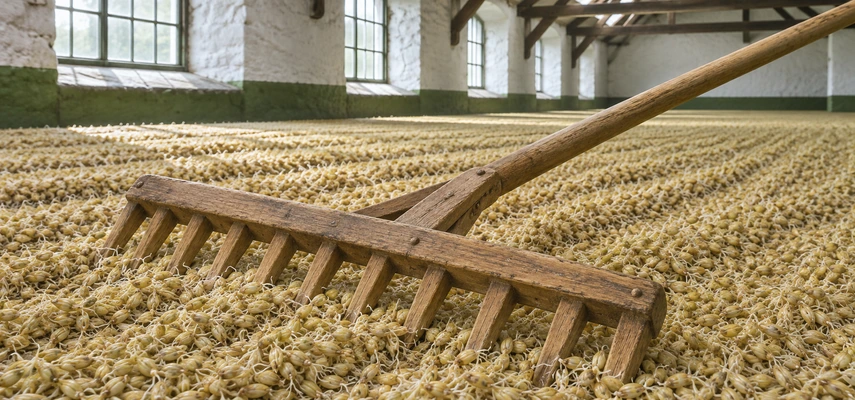

A sack of barley contains the potential for whisky, but the yeast can’t simply ferment the sack. Much of the useful carbohydrate is stored as starch inside grain structures. Malting and mashing make that material accessible and convert it into sugars the selected yeast can use. The distinction between access and conversion explains much of what follows.
This lesson follows the grain before the still becomes involved. It builds on the earlier carbohydrate lesson, but now examines the practical sequence: prepare a suitable malt, mill it, manage starch and enzymes in water, and deliver a useful fermentation medium. Each step affects the next, so good yield and desirable character begin well before distillation.
Malting and mashing solve different problems
Malting uses controlled germination followed by drying. It develops or makes available enzymes and modifies the structures surrounding stored material. Mashing combines prepared grain with water under conditions that permit extraction and conversion. The processes are linked, but neither word means alcoholic fermentation. Yeast still needs to perform that later job.
Imagine milling grain very finely without providing suitable conversion enzymes. You have changed particle size, but you haven’t necessarily created the fermentable sugars required. Now imagine adding active enzymes to material they cannot reach effectively. The biological tools are present, yet physical access remains a limitation. A working process coordinates both problems rather than solving one and hoping the other disappears.
The goal also extends beyond extracting the greatest possible amount of material. Fermentability, nutrients, handling and flavor precursors matter. Two media with similar measured extract can present different opportunities for yeast and later distillation. A production answer improves when it explains what the prepared liquid contains, rather than reporting one impressive yield figure without context.
Inside the grain: storage and protection
Barley has protective outer material, an embryo and an endosperm containing reserves, including starch. Proteins and cell-wall structures help organize that interior. For a developing plant, those reserves support growth. For a distiller, they represent potential fermentable material that must become accessible under controlled processing conditions.
The plant formed its stored carbohydrate before the maltster intervened. Malting doesn’t create the grain’s entire starch supply from nothing. It encourages the seed’s own machinery to begin mobilizing reserves. The maltster then manages how far that development proceeds, retaining material useful for the subsequent mash rather than growing a field of seedlings indoors.
Grain condition and suitability therefore matter at intake. Damaged or unsuitable material can create problems that later processing cannot be assumed to erase. The relevant choice isn’t merely an impressive variety name. A producer needs raw material that can perform in the intended process and produce a suitable substrate and character.
Steeping supplies moisture for germination
Steeping introduces water under managed conditions to begin the malting process. The grain takes up moisture, enabling germination. Maltsters control the environment rather than simply soaking barley indefinitely. Water, air and temperature management help create conditions for useful biological activity while limiting unwanted development.
Once germination begins, enzyme activity and structural changes make reserve material more available. The grain is still alive at this stage. It also produces heat, so distribution and environmental control matter within a working bed. Turning or other handling helps manage conditions according to the equipment in use.
Crisp’s malt-making account describes the sequence from steeping through germination and drying. It is a primary maltster example, rather than evidence that every malt house uses an identical schedule. Floor and modern engineered systems can serve related purposes while managing the material in different physical arrangements.
Germination modifies the interior
Modification describes changes that help make the grain’s interior useful for processing. Breakdown of surrounding structures and changes in enzyme availability contribute to access to stored starch and other components. The useful result is a prepared grain, not simply one with visible rootlets. Appearance alone doesn’t measure every property the distiller needs.
Too little appropriate modification can leave material harder to process. Continuing growth too far consumes reserves and creates a different practical problem. The maltster balances development against retention of useful extract. As elsewhere in production, “more” is not a complete objective: the right degree of change depends on the intended malt.
This gives a clear causal chain. Controlled germination changes structures and enzyme availability; prepared material becomes more accessible during later processing; the mash can release and convert useful substrate effectively. Don’t skip directly from a sprouting grain to a whisky flavor. Distillation and maturation still stand between that grain and the final assessment.
Kilning arrests growth and shapes the malt
Drying reduces moisture and stops further seedling development. Kilning conditions influence remaining enzyme activity and can contribute to the malt’s flavor character. Heat treatment therefore involves a tradeoff: useful sensory development may come with different effects on the enzymes and extract needed for production.
Distiller’s malt is generally selected with fermentation performance and spirit production in mind. Speciality malts may emphasize different sensory contributions through their treatment. They are not interchangeable simply because all are called malt. A producer considers how the chosen material contributes to the entire mash, including its ability to support conversion.
Muntons’ distilling range includes distinct malt products, illustrating that malt selection has a functional purpose. A malt intended for strong enzyme contribution and one chosen for a roasted character need not play the same role. The practical question is what the recipe needs from each component, within the category’s rules.
Milling exposes material without making alcohol
Milling breaks prepared grain into a useful grist. Particle size affects access and handling, including the movement and separation of liquid in processes that draw off wort. Crushing everything into the finest possible powder isn’t automatically optimal. The equipment and intended process determine the useful balance of particles.
The distinction is easy to test in an answer. Milling changes physical form; hydrolysis changes chemical bonds; fermentation converts usable sugars through yeast metabolism. All three can contribute to the journey from barley to alcohol, but they are not synonyms. Naming their different functions prevents a surprisingly large number of production errors.
For example, poor liquid drainage may be a handling problem rather than proof that the yeast is defective. Low fermentable sugar could reflect access or conversion. Follow the actual sequence and locate the plausible limitation before proposing a remedy. The same low alcohol result can begin with different upstream causes.
Heat, water and enzymes cooperate in the mash
Gelatinisation occurs when starch granules absorb water and lose their ordered structure under suitable heating conditions. This can improve accessibility to enzymes. It is a physical transformation with chemical consequences for processing, but it does not itself mean the starch has been fully converted into fermentable sugar.
Alpha-amylase can break internal starch links, producing shorter carbohydrates. Beta-amylase can release maltose from suitable chain ends. Branching and the enzyme system influence what remains and what becomes available. The mash therefore produces a mixture rather than one magically pure sugar, and yeast utilization depends on the sugars present and the selected organism.
Temperature and pH influence enzyme performance. Excessive heat can damage enzymes, while insufficient preparation can limit access to starch. A producer coordinates these needs, particularly when combining materials with different preparation requirements. A single quoted mash temperature cannot stand in for an explanation of every cereal and enzyme arrangement.
Wort connects conversion with fermentation
Wort is the sugar-containing liquid prepared from the mash in relevant grain processes. It carries more than sugar: dissolved nutrients and other material help establish the yeast’s starting environment. Where separation is part of the process, drawing off the wort also distinguishes the fermentation medium from much of the grain solids.
The Scotch Whisky technical file describes malted-barley enzyme conversion and the preparation of malt and grain whisky substrates. These are legally and technically situated examples. They don’t authorize importing every commercial enzyme or processing aid available elsewhere into Scotch production.
After appropriate preparation and cooling, yeast can ferment the usable sugars. It produces ethanol, carbon dioxide, heat and additional compounds that influence the feed for distillation. Conversion efficiency and fermentation performance are related but distinct. A well-converted wort can still ferment poorly if the yeast environment is unsuitable.
Unmalted cereals need a coordinated route
Wheat, corn and other unmalted cereals supply starch without having undergone the same controlled germination as malt. Their processing must provide access and suitable conversion activity through the permitted system. Cooking requirements differ between materials, so the treatment should reflect the cereal rather than assuming every grain behaves exactly like malted barley.
In grain-whisky contexts, malted barley can supply enzymes for a mixture that includes other cereals. Elsewhere, permitted commercial enzymes can perform appropriate tasks. The legal and production framework determines the options. The scientific principle remains the same: expose suitable starch, provide effective conversion and deliver usable sugars to fermentation.
Two comparisons clarify the principle
Potatoes also supply starch, but their physical material and preparation differ from dry cereal grains. They need suitable handling and starch conversion before conventional alcoholic fermentation. This comparison illustrates the shared carbohydrate problem; it does not make potatoes an ingredient in a spirit legally defined as whisky.
Filamentous fungi offer another enzyme source in relevant Asian traditions. The National Research Institute of Brewing explains kōji as mould cultured on grain, supplying useful enzymes. The grain supports culture preparation, and the resulting enzymes can help release sugars. Yeast then performs alcoholic fermentation; calling the mould “the yeast” erases that division of work.
What to remember
Follow storage starch through access, modification, milling, gelatinisation and enzyme action. Distinguish distiller’s malt from speciality choices, and distinguish wort preparation from fermentation. Then compare unmalted grain, potatoes and fungal-enzyme traditions through the same questions: what is stored, what makes it accessible, and what releases the sugars? Those questions turn a recipe into an explanation.
Written practice: original TFE exercises
These suggested marks and indicative points are independent teaching guidance, not official WSET marking schemes.
Exercise 1: 5 suggested marks
Explain why effective starch conversion requires more than milling alone. Mapping: LO2 explain: starch conversion.
Indicative marking points:
- Milling changes grain particle size and exposes material.
- Stored starch remains a larger carbohydrate.
- Suitable heat and water can improve accessibility through gelatinisation.
- Active enzymes hydrolyze appropriate links into smaller carbohydrates.
- Usable sugars then supply yeast fermentation.
Model answer: Milling exposes grain material but does not itself complete carbohydrate hydrolysis. Starch remains a larger reserve molecule. Suitable heat and water can improve its accessibility, and active enzymes then release smaller carbohydrates including usable sugars. Those sugars supply yeast fermentation, which is a separate transformation.
Why it works: The answer follows physical access into enzyme action and yeast substrate rather than treating every stage as fermentation.
Common mistake: Saying fine grinding creates alcohol skips both starch conversion and yeast metabolism.
Exercise 2: 5 suggested marks
Explain why processing an unmalted cereal together with malt requires coordinated preparation and enzyme conditions. Mapping: LO2 explain: sugary liquid from unmalted grains.
Indicative marking points:
- Unmalted grain supplies starch without the same malting preparation.
- Appropriate treatment must expose that starch.
- Malt can supply conversion enzymes in a suitable permitted process.
- Those enzymes require workable conditions and can be damaged by excessive heat.
- Coordinating preparation and enzyme activity yields usable sugars for fermentation.
Model answer: Unmalted cereal contains starch that needs suitable access and conversion. In an appropriate process, malt supplies enzymes, but these must meet accessible substrate under conditions in which they remain active. Excessive heat can damage them. Coordinating cereal preparation with enzyme conditions allows useful sugars to form before yeast fermentation.
Why it works: It explains why the producer must solve access and enzyme survival together, rather than treating malt as a universal additive that works regardless of conditions.
Common mistake: Assuming every cereal and enzyme system can use one unqualified cooking temperature ignores different preparation needs and enzyme stability.
Knowledge check: 10 original practice questions
Independent TFE questions, not official WSET examination items. Choose one answer per question; explanations follow separately.
1. Why mention potatoes in a starch lesson?
2. Where is much cereal starch stored?
3. What is wort in the relevant grain process?
4. Why do unmalted cereals need appropriate preparation?
5. What is the central distinction between kōji mould and yeast?
6. What is a principal role of malting?
7. What is the main distinction between milling and hydrolysis?
8. What does gelatinisation help change?
9. Why does kilning require control?
10. What can beta-amylase release from suitable starch chain ends?
Answers and explanations
- C — They illustrate a similar carbohydrate problem with a different physical material. The comparison teaches starch processing without claiming that a potato spirit meets a grain-based whisky definition. Mapping: LO2.
- B — In the grain endosperm. The endosperm contains reserve material that preparation must make accessible for conversion. Mapping: LO2.
- A — A prepared sugar-containing liquid for fermentation. Wort links mash preparation with yeast fermentation and contains nutrients and other dissolved material as well as sugars. Mapping: LO2.
- D — Their starch still needs access and effective conversion. Different grain materials require a suitable route to usable sugars within the relevant category and process. Mapping: LO2.
- C — Enzyme provision for conversion versus alcoholic fermentation. Mould culture can provide conversion enzymes; yeast uses available sugars to perform alcoholic fermentation. Mapping: LO2.
- D — Controlled germination modifies grain and enzyme availability. Malting prepares useful material and enzymes, while alcoholic fermentation and distillation occur later. Mapping: LO2.
- B — Physical size reduction versus chemical bond breakdown. Milling exposes material, while hydrolysis breaks carbohydrate bonds through suitable chemical or enzymatic action. Mapping: LO2.
- C — Starch organization and enzyme accessibility. Heat and water can disrupt starch granule structure, improving access without themselves completing fermentation. Mapping: LO2.
- A — Heat treatment can affect flavor and surviving enzyme activity. Drying arrests growth while heat history can influence both sensory material and conversion capability. Mapping: LO2.
- B — Maltose. Beta-amylase releases maltose where substrate structure permits; the overall sugar mixture depends on several enzyme activities. Mapping: LO2.
Continue exploring this series
2. Carbohydrates Explained: How Sugar, Starch, and Fructans Become Fermentable
3. Alcoholic Fermentation Explained: Yeast, Nutrients, and Flavor Compounds
4. Fermentation Methods Explained: Liquid, Solid-State, Sequential, and Parallel Fermentation
12. Single Malt Scotch Whisky Explained: Production, Distillation, and Quality
13. Grain and Blended Scotch Whisky Explained: Production Choices, Laws, and Style
14. Bourbon Explained: Mash Bills, Distillation, New Oak, and Quality
15. Rye and Tennessee Whiskey Explained: Production Rules and Flavor Differences
26. Vodka Explained: Neutral Spirits, Raw Materials, and Production Choices
32. Shōchū Explained: Honkaku Shōchū, Awamori, and Japanese Distillation
10. Spirits Finishing Explained: Blending, Filtration, Sweetening, Coloring, and Packaging
50. WSET Level 3 Spirits Exam: Complete Revision Guide and Practice Examinations












