










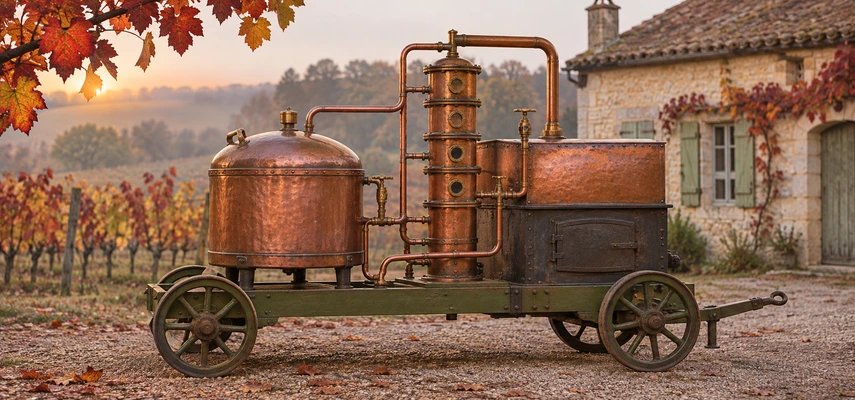

Armagnac is a good antidote to the idea that a column still must make flavorless spirit. Its familiar continuous apparatus is compact, comparatively lightly rectifying and capable of retaining a forceful wine-derived character. Put that spirit into a suitable cask, follow it for years and the result can be wonderfully individual. The column has not made the decisions disappear.
This lesson follows Armagnac from grape to glass, with particular attention to the moving streams inside its traditional still. Regional names, Baco and vintage bottlings all matter, but none works alone. The useful question is how the producer combines raw material, separation and maturation to achieve the intended style.
Armagnac begins with wine from its own region
Armagnac is a protected wine spirit from southwestern France. The official specification published in April 2025 defines its production area and methods. Its three principal geographical names are Bas Armagnac, Armagnac Ténarèze and Haut Armagnac. They describe origins within the framework, rather than three different categories of raw material.
The wine is made for distillation, with relatively low alcohol and useful acidity. As with Cognac, a sharply acidic base wine need not resemble an appealing dinner wine to perform well in its intended role. Its condition and composition matter to the still and the eventual eau-de-vie. Distillation is the next stage of a deliberate production chain.
The framework prohibits enrichment and sulphiting of the grapes, musts and wines. Good handling and timely processing therefore matter. The general distillation deadline is March 31 after the harvest, with campaign-specific provisions able to set an earlier date. A general rule should not be mistaken for permission to ignore the current campaign’s instructions.
Four grape names make a useful starting set
Ugni Blanc, Baco, Folle Blanche and Colombard are the principal names to connect with Armagnac study. The detailed permitted list is longer. Ugni Blanc provides an acidic, relatively low-alcohol wine suited to distillation, while the other varieties offer different growing characteristics and potential contributions to the spirit.
Baco, formerly often called Baco 22A, is especially distinctive in this context. The BNIA grape account describes its hybrid background and adaptation to the sandy soils of Bas Armagnac. It is associated with roundness and ripe-fruit character, particularly in developed examples. Those associations are helpful tendencies, rather than a tasting result guaranteed by the name alone.
Folle Blanche is historically important and often associated with floral finesse. Colombard can contribute another fruit-and-spice dimension, though it is also valued for wine production in the wider area. The practical lesson is diversity: grape choices interact with the wine’s condition, still operation and cask history. They do not arrive in the finished spirit wearing name badges.
Fermentation supplies the material to separate
Yeast converts grape sugars into ethanol and other products. Those additional compounds help create the aroma-related feed for distillation. A producer can seek a relatively expressive wine while still needing reliability and preservation. Fermentation is therefore an active influence on spirit style, not merely a way to prepare a tank containing alcohol.
The Armagnac specification distinguishes gross lees from fine lees in the wine destined for distillation. That matters because fine yeast-related material can contribute to the feed, while unwanted coarse sediment creates a different practical situation. Use the actual preparation requirements rather than assuming all sediment is identical or that every distiller seeks perfectly clear wine.
Consider the next stage while thinking about the wine. Its alcohol concentration, retained components and condition affect what the apparatus can recover. A change in feed may require operational attention if the producer wants a consistent distillate. The same still receiving different wine does not automatically deliver the same sensory result.
The continuous Armagnac still balances moving streams
The traditional alambic armagnacais works continuously rather than treating the whole production volume as two successive pot batches. Wine enters a cooling and preheating arrangement, then passes into the working column. Heat drives vapor upward while liquid wine moves downward through contact stages. The opposite directions create repeated opportunities for exchange.
At those contacts, vapor can become richer in alcohol and selected volatile material, while the descending liquid is progressively stripped. The enriched vapor is condensed and cooled into eau-de-vie. This is a coupled system: cooling incoming wine, heating the feed and recovering vapor are connected parts of the operation, not unrelated decorative vessels.
The BNIA distillation description follows that route. Its compact arrangement differs markedly from a large multi-column neutral-spirit plant. Both use phase contact, but their design and operation target different compositions. Calling each a column is as incomplete as calling two very different wines grape products and stopping there.
Continuous does not mean chemically neutral
Contact stages, heat, feed and withdrawal conditions influence separation. Relatively limited rectification can retain substantial wine-derived character. The legal working range for the principal continuous apparatus is 52–72.4% ABV in the daily receiver; traditional operating strengths are often toward the lower part of that broad range. A range is not an instruction to use one fixed strength.
Lower collection strength generally accompanies a different balance of retained compounds, but strength alone cannot specify every aroma. Two spirits at similar strengths can differ because their grapes, wines and operating conditions differ. Use the mechanism to develop a plausible consequence, then assess the actual distillate rather than reading its entire character from one number.
Copper also participates in the production environment, including interactions affecting sulfur-related compounds. The aim is a suitable spirit, not the absence of every compound other than ethanol and water. Retaining useful character and managing unwanted notes are simultaneous tasks. Greater chemical simplicity is not the universal objective of Armagnac production.
Pot double distillation is also permitted
Some Armagnac is produced by an approved batch double-distillation route. Its existence matters whenever a question uses the word all. The widespread continuous route is a defining study focus, but it should not be turned into a false statement that every Armagnac must have passed through the same apparatus.
The batch route gives another way to manage concentration and fractions within its own rules. That does not establish a quality hierarchy between the routes. Selection, feed quality and operating skill still matter. Explain the equipment’s action and the resulting style possibilities before deciding whether a particular example succeeds.
For comparison work, hold the wine and target in view. A different apparatus changes the producer’s controls, while the final eau-de-vie must still work with its intended development. This is more informative than dividing the world into rustic columns and refined pots, or the reverse. Neither stereotype describes a mechanism.
Three areas offer different contexts
Bas Armagnac lies toward the west, with sandy and silty soils often discussed through the sables fauves. Its spirits have a reputation for fruit and delicacy. Armagnac Ténarèze includes clay-limestone and boulbène contexts and is often associated with more powerful structure. Haut Armagnac, with its limestone associations, has a much smaller production presence.
These regional descriptions help organize the subject, but they do not replace the producer’s work. A Ténarèze spirit can be managed toward a particular maturation objective, while two Bas Armagnac stocks can differ substantially. Origin offers a context for investigating style rather than a compulsory tasting script.
Do not confuse Haut Armagnac’s historical association with the term Armagnac Blanc with Blanche Armagnac as a spirit style. Similar words can point to different facts: one is geographical context, the other concerns a colorless spirit’s production and rest. Establish which question is being asked before supplying an answer.
Wood maturation needs active decisions
The wood-aged route requires oak maturation; the detailed minimum is one year counted from April 1 following placement into aging. Longer-lived stocks can spend much more time developing. Fresh wood contributes extractable compounds, and transfers into previously used casks can moderate further extraction while other changes continue.
Cellar temperature, humidity, vessel characteristics and time influence evaporation and development. A forceful young spirit may need a suitable environment and patient assessment, but simply waiting longer cannot guarantee balance. Excessive wood can overwhelm fruit and make structure coarse. The useful target is integration, not the darkest possible sample.
Developed Armagnac can show dried or cooked fruit, spice, nutty or rancio-related associations. These emerge from interacting histories rather than one universally scheduled aroma change. Keep the original spirit, wood influence and resulting palate together when discussing quality. A mature descriptor is evidence to interpret, not an automatic mark awarded for age.
Blanche and vintage answer different questions
Blanche Armagnac follows an inert-container rest instead of the wood-aging route. The current specification requires at least three months of rest from the lot’s distillation, preserving a colorless presentation and a different relationship with fruit and floral character. It should be assessed on that purpose rather than criticized for lacking old-oak aromas it was not designed to acquire.
A vintage Armagnac identifies a harvest year. It does not mean one barrel, and the year alone does not disclose the time spent in wood. The BNIA vintage discussion stresses the individual production and maturation decisions behind each example. A vintage can combine appropriate stocks from its stated harvest while still meeting the relevant traceability requirements.
What to remember
Connect grapes and wine with the continuous still’s opposing streams, then follow the eau-de-vie into oak or the Blanche route. Learn the three regional names and distinguish harvest year from maturation duration. For quality, assess balance, persistence, complexity and integration in the particular spirit. Armagnac’s individuality comes from a sequence of choices, not a column operating on autopilot.
Written practice: original TFE exercises
These suggested marks and indicative points are independent teaching guidance, not official WSET marking schemes.
Exercise 1: 5 suggested marks
Explain how opposing wine and vapor flows support concentration in a continuous Armagnac column. Mapping: LO2 explain: distillation in Armagnac.
Indicative marking points:
- Heat generates rising vapor.
- Wine moves downward through the contact stages.
- The phases contact each other repeatedly.
- Exchange enriches the rising vapor in alcohol and selected volatile material.
- Condensation recovers the enriched vapor as liquid distillate.
Model answer: Heat generates vapor that rises against descending wine. Repeated contact allows exchange between the phases, enriching the rising vapor in alcohol and selected volatile material while the liquid is stripped. The enriched vapor is then condensed to recover liquid distillate.
Why it works: It connects equipment flow and phase contact to concentration and recovery rather than equating column with neutrality.
Common mistake: Saying the plates remove every aroma overlooks the deliberately characterful separation target.
Exercise 2: 5 suggested marks
Explain why extended time in a highly active oak cask may eventually reduce a spirit’s balance. Mapping: LO2 explain: post-distillation choices.
Indicative marking points:
- The cask supplies extractable wood compounds.
- Their contribution increases or changes over time.
- Wood aromas can become dominant relative to fruit.
- Structure can become excessively drying or coarse.
- Assessment and appropriate vessel management help preserve the intended integration.
Model answer: An active cask supplies wood-derived compounds, whose contribution changes over time. Wood can become dominant relative to fruit and the palate can grow excessively drying or coarse. Regular assessment and suitable vessel management therefore help preserve integration rather than assuming every extra year improves the spirit.
Why it works: It follows ongoing extraction into a specific possible imbalance and an appropriate control response.
Common mistake: Awarding quality solely for a longer age statement ignores the relationship among the components.
Knowledge check: 10 original practice questions
Independent TFE questions, not official WSET examination items. Choose one answer per question; explanations follow separately.
1. Which statement about Armagnac distillation is accurate?
2. Which is one of the three principal geographical names?
3. Why can a producer transfer spirit to a used cask?
4. What should a lower distillation strength establish by itself?
5. What is a sound quality approach?
6. Which grape is especially associated with Armagnac and its hybrid history?
7. What minimum inert rest does the current Blanche specification require?
8. What does a vintage identify?
9. What distinguishes the Blanche development route?
10. What happens in the traditional continuous working column?
Answers and explanations
- A — Continuous distillation predominates and a batch route is also permitted. A predominant method should not become an absolute claim excluding a permitted alternative. Mapping: LO2.
- D — Armagnac Ténarèze. Ténarèze belongs to Armagnac geography; the other names belong elsewhere. Mapping: LO2.
- D — To manage further wood extraction. A different vessel history changes the extractive environment. Mapping: LO2.
- D — Only limited compositional information, not an entire flavor profile. Feed and operation also influence the retained composition. Mapping: LO2.
- A — Assess the actual spirit against its intended style. Production context informs assessment without replacing sensory evidence. Mapping: LO2.
- C — Baco. Baco is an important Armagnac grape alongside Ugni Blanc, Folle Blanche and Colombard. Mapping: LO2.
- A — Three months. The rest is measured from the relevant lot distillation under the current rules. Mapping: LO2.
- A — A harvest year. Bottling and maturation history are additional information. Mapping: LO2.
- C — Rest in inert containers. The colorless route preserves a different style relationship from wood-aged Armagnac. Mapping: LO2.
- D — Wine descends while vapor rises. Opposing flows create repeated phase-contact opportunities. Mapping: LO2.
Continue exploring this series
7. Column and Hybrid Stills Explained: Plates, Reflux, and Continuous Distillation
9. Oak Maturation Explained: Barrels, Oxygen, Evaporation, and Flavor Development
16. How Fruit Spirits Are Made: Grapes, Wine, Pomace, and Fermentation
17. Cognac Explained: Grapes, Double Distillation, Oak, and Quality
18. Cognac Classifications Explained: Crus, Age Statements, and Blending
20. Cognac vs. Armagnac: How Production Decisions Shape Two Great Brandies
29. Spirits Quality Explained: How Production Decisions Affect Balance and Complexity
50. WSET Level 3 Spirits Exam: Complete Revision Guide and Practice Examinations












