










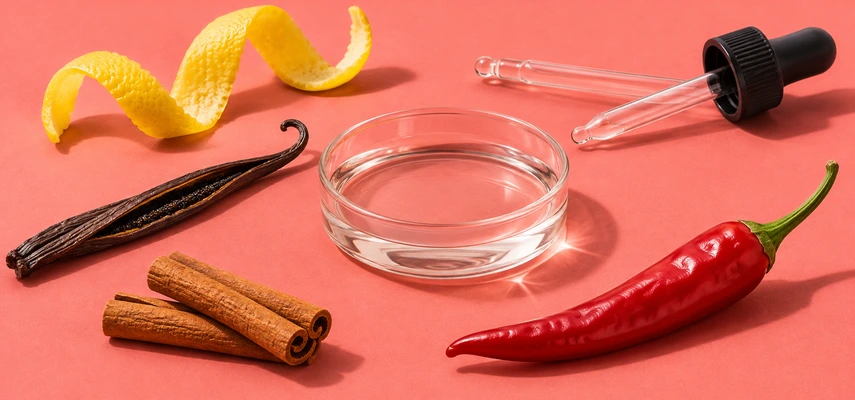

Flavored vodka makes the difference between a base spirit and a finished formulation especially clear. A restrained vodka can carry lemon, pepper or another added character without having been fermented from that ingredient. Spiced rum and flavored whiskey use the same broad idea with bases that may already bring more obvious fermentation, distillation and wood-derived flavors.
The useful question is how the flavor arrived. Was it extracted by soaking material in alcohol, carried through a redistillation, blended in as a prepared flavoring, or already present in the base? Following that route helps explain style and prevents a familiar tasting descriptor from becoming an unsupported ingredient claim.
Start with the base spirit
Vodka commonly provides a relatively restrained platform, but it is still the result of raw-material preparation, fermentation, extensive separation and final treatment. Grain or potato identity concerns the source of the alcohol. A raspberry flavor added afterward answers a different question. Confusing those stages would make a grain-based raspberry vodka look as though all its ethanol came from berries.
Rum and whiskey can contribute a more pronounced background of their own. A rum base might bring fruity or heavier fermentation-related notes, while a matured whiskey may bring grain-related character, vanilla and spice. The added material interacts with that existing profile; it doesn’t arrive in an empty sensory space.
Flavor can be extracted by maceration
Maceration puts suitable material in contact with a liquid that extracts some of its constituents. Time, temperature, alcohol strength and material preparation influence the result. A whole spice and the same spice broken into smaller pieces need not release constituents at the same rate, because their exposed surface areas differ.
Extraction is also selective. Extending contact indefinitely does not guarantee a better flavor: it may increase unwanted bitter, woody or otherwise dominant contributions alongside the desired aroma. Producers therefore choose conditions for a target profile rather than simply seeking the darkest possible liquid. Removing the spent solids ends one part of the process, but the extracted liquid may still need balancing.
Percolation uses moving liquid
In percolation, liquid moves through a bed of prepared material rather than merely standing with it. Liqueur producer M. J. Horn distinguishes macerates, percolates and distillates, providing a useful practical comparison of these flavor-building routes. Flow and contact conditions help determine what is recovered from the material.
The method does not guarantee a universally lighter, stronger or more natural result. Preparation, solvent composition, duration and the material itself still matter. For revision, remember what physically changes between static contact and liquid flowing through a bed, then connect the extraction conditions to the particular production objective.
Redistillation selects a different contribution
Material or an extract can enter a redistillation, where volatile constituents pass into the collected distillate with alcohol and water. Less volatile material may remain behind. This helps explain why a strongly colored infusion can yield a clear aromatic distillate: the still doesn’t transfer every dissolved constituent in the same proportion.
Heidolph’s botanical-processing account describes separate extraction and distillation choices. Different botanicals can be treated separately before the resulting components are combined. That gives flexibility, but it also requires careful blending. Distilling each ingredient individually does not, by itself, ensure that the eventual mixture is balanced.
Prepared flavorings make formulation another production stage
A producer may add a prepared extract or another suitable flavoring rather than soaking whole fruit or spices in every final batch. Such materials can supply a concentrated and reproducible contribution. Their use should not be confused with a complete absence of production work: selecting, dosing and integrating a flavoring are decisions with obvious sensory consequences.
Natural and artificial are classifications of flavoring materials under relevant rules, not automatic tasting scores. A declared natural flavor does not reveal the full extraction recipe, and a convincing aroma does not prove that a whole ingredient was physically present in the final mixing tank. Use the producer’s actual account where available.
Flavored vodka spans more than sweet fruit styles
Fruit and citrus are familiar possibilities, but pepper, herbs and other savory or spicy directions also occur. Absolut’s FAQ describes its flavored range as having no added sugar. That is a useful named counterexample to the assumption that a strong fruit or vanilla aroma necessarily means the producer added substantial sweetness.
For a newer example, the producer’s 2026 Absolut Tabasco announcement describes a natural essence derived from fermented, aged pepper mash. The example connects a prepared flavor contribution with a vodka base. It does not mean every pepper vodka uses that material or follows the sauce’s complete production sequence.
Sweetness and sweet-smelling aromas are different observations
Vanilla, ripe fruit or caramel associations can suggest sweetness before the liquid reaches the palate. Actual perceived sweetness depends on the finished composition and its interactions, including alcohol and any added sweetening. Record aroma and taste separately rather than treating a dessert-like nose as a laboratory measurement of sugar.
Consider two hypothetical citrus vodkas: one has a dry palate and bright peel aroma, while the other adds a sweet, rounded impression. The citrus family does not explain the entire contrast. Formulation, sweetness and strength can differ even when the front label emphasizes the same fruit. A useful comparison describes those separate dimensions.
Spiced rum combines rum character with another flavor layer
Vanilla, cinnamon and clove are familiar associations, although recipes and product names vary. Captain Morgan’s US Original Spiced account identifies rum, vanilla, spices and other natural flavors, with that market’s product at 35% ABV. Keep both the formulation claim and strength attached to the actual expression and market.
A spicy impression can also come from a matured base without separately added spices. Oak-derived clove or vanilla associations do not prove that a maker soaked cloves or vanilla pods in the liquid. The correct distinction is between sensory language and documented ingredients. Both can be informative, but they answer different questions.
Flavored whiskey keeps a relationship with the original base
An aged whiskey base may supply cereal, oak, fruit and other characteristics before the flavor addition. Honey, fruit or spice can then change the balance, sweetness and texture of the final product. A successful formulation needs to integrate those contributions; maximum flavor intensity is not the only possible objective.
The Jack Daniel’s Tennessee Honey fact sheet describes Tennessee whiskey combined with a proprietary honey liqueur and identifies a 35% ABV finished expression. This is a precise production relationship. Describing it simply as ordinary Tennessee whiskey would omit the liqueur component and blur the identity of the finished drink.
USA: flavored spirits have their own identity standard
Current US regulation, 27 CFR 5.151, describes the flavored-spirits class using a qualifying base and specified natural flavoring materials, with or without sugar, at no less than 30% ABV. The designation identifies the base spirit and predominant flavor or flavors. The base must qualify before flavoring is added.
That sequence matters. An otherwise nonqualifying alcohol cannot be made Bourbon simply by adding a bourbon-like flavor and printing flavored Bourbon on the bottle. Equally, the final flavored product should not be assessed as though none of the additions occurred. Read the actual class and designation instead of inferring identity from a familiar brand name.
EU: the finished category can change
The EU spirits framework recognizes flavored vodka separately, with a 37.5% ABV minimum and predominant flavor beyond the raw-material contribution. Ordinary rum and whisky categories do not permit flavoring in the same way. A rum-based or whisky-based flavored drink therefore needs an appropriate final legal designation rather than automatically retaining the unmodified category name.
Do not treat a US market label as a universal legal classification. Different market versions and frameworks can lead to different descriptions. The helpful revision habit is to keep jurisdiction, base identity and final formulation in the same note. That prevents several nearly familiar numbers from being remembered in the wrong category.
Stability and final adjustment affect the finished style
After flavor components are combined, the producer may adjust strength, sweetness and clarity. Some extracted oils dissolve differently as alcohol concentration changes, so adding water can alter appearance as well as strength. Filtration can help manage unwanted solids or instability, but it may also affect the flavor materials retained in the drink.
Imagine a lemon extract that is clear at its preparation strength but becomes hazy after dilution. That appearance change does not mean yeast has restarted fermentation or that all flavor has disappeared. It points to the relationship between composition and solubility. The production response should fit the intended stable product rather than treating every haze in every category identically.
For a practical comparison, record whether dilution changes aroma intensity, texture or appearance. Recheck those observations against the known formulation rather than assuming the most transparent sample must contain the fewest flavor compounds.
What to remember
Separate the base from the added flavor, and distinguish extraction from redistillation and final blending. Flavored vodka need not be sweet, spiced rum need not use one universal recipe, and a whiskey-based liqueur is not an unchanged whiskey. Compare aroma, sweetness, texture and integration, then read the final identity under the correct market’s rules.
Knowledge check: 12 original practice questions
Independent TFE questions, not official WSET examination items. Choose one answer per question; explanations follow separately.
1. What can happen when a flavor extract is diluted?
2. What minimum strength applies to the cited US flavored-spirits class?
3. When must the US flavored-spirits base meet its relevant identity?
4. What is maceration?
5. What distinguishes percolation from simple static soaking?
6. What does the Tennessee Honey example combine?
7. What EU minimum applies to flavored vodka?
8. What does raspberry-flavored grain vodka imply about the alcohol source?
9. What is the correct reading of a vanilla aroma alone?
10. What does no added sugar establish for a flavored vodka?
11. Why can market labels differ for flavored rum-based products?
12. Why can a colored infusion produce a clear aromatic distillate?
Answers and explanations
- A — Some oils may become less soluble and cause haze. Changing alcohol concentration can change solubility and therefore final appearance or stability. Mapping: LO3.
- C — 30% ABV. The class has its own minimum rather than borrowing every unmodified base category strength. Mapping: LO3.
- C — Before the flavoring is added. The standard requires a qualifying base rather than creating identity through flavor alone. Mapping: LO3.
- C — Extracting suitable constituents through liquid contact with material. Liquid contact extracts a selection of constituents under chosen working conditions. Mapping: LO3.
- A — Liquid moves through a bed of material. Flow through prepared material is the defining operational distinction in this comparison. Mapping: LO3.
- A — Tennessee whiskey and a proprietary honey liqueur. The producer account identifies a blend relationship that differs from unchanged whiskey. Mapping: LO3.
- D — 37.5% ABV. The EU flavored-vodka category must be kept separate from the US flavored-spirits minimum. Mapping: LO3.
- A — The base may remain grain-derived despite the added berry flavor. The flavor addition and the agricultural origin of the base alcohol are separate matters. Mapping: LO3.
- A — A descriptor that does not prove added vanilla pods. Similar aroma associations can arise from different production routes, including wood influence. Mapping: LO3.
- C — A formulation claim, not an absence of aroma. A pronounced flavor can be supplied without adding a substantial sweetening contribution. Mapping: LO3.
- A — Jurisdictions and finished formulations affect legal designation. The final identity depends on the relevant rules rather than a universal colloquial name. Mapping: LO3.
- B — Distillation transfers volatile constituents selectively. The collected vapor-derived liquid need not contain the original nonvolatile color compounds. Mapping: LO3.
Continue exploring this series
14. Bourbon Explained: Mash Bills, Distillation, New Oak, and Quality
15. Rye and Tennessee Whiskey Explained: Production Rules and Flavor Differences
26. Vodka Explained: Neutral Spirits, Raw Materials, and Production Choices
28. How Botanicals Flavor Spirits: Maceration, Percolation, and Redistillation
38. Other Rum Traditions Explained: Haiti, Puerto Rico, Trinidad, Guyana, and Beyond
44. Liqueurs and Non-Alcoholic Spirits Explained: Sweetness, Flavoring, and Production
40. Bacanora, Raicilla, and Sotol Explained: Mexico’s Other Distilled Traditions
42. Aniseed Spirits and Aquavit Explained: Botanicals, Production, and Styles
50. WSET Level 3 Spirits Exam: Complete Revision Guide and Practice Examinations












