










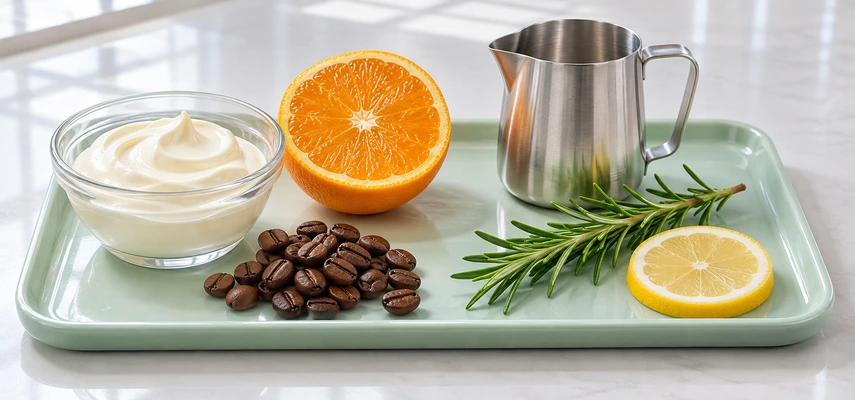

Liqueurs are assembled around flavor, sweetness and an alcoholic base. That simple description covers a surprisingly wide range: a clear orange liqueur, an opaque cream expression and an intensely herbal drink can all require quite different production decisions. The final formula matters as much as the source of the alcohol.
Non-alcoholic alternatives make another useful comparison because they must build aroma, texture and structure with little or none of ethanol’s familiar contribution. Some use botanical distillates, while others combine carefully prepared flavor components. This lesson follows the production choices and keeps the syllabus’s excluded liqueur-labeling details out of the practice questions.
A liqueur has several components to coordinate
The base may be relatively neutral alcohol, a characterful spirit or a combination. Flavoring can come from fruit, peel, herbs, spices, nuts, coffee, dairy ingredients or prepared materials. Sweetening then contributes to the finished taste and texture. These roles can overlap, but identifying them separately makes the formulation easier to understand.
An orange liqueur need not obtain its alcohol by fermenting oranges. Its citrus character can be extracted from peel into an independently produced alcohol base. Conversely, a whiskey-based cream liqueur can retain an identifiable contribution from the whiskey. Always ask which ingredient supplied the alcohol and which supplied the added flavor.
Select material for the intended flavor contribution
Fresh fruit, dried peel and a concentrated extract do not present the same working material. Moisture, surface area and the condition of the ingredient affect handling and extraction. A producer may seek fresh, bright citrus notes from one material and a more developed, bitter or aromatic contribution from another.
Cointreau describes selecting and combining sweet and bitter orange peels, with proportions adjusted to achieve its intended balance. The named example makes a useful point: consistency does not always mean weighing an unchanged amount of a variable crop and assuming the resulting aroma will automatically remain identical.
Maceration extracts through sustained liquid contact
Maceration holds material in a suitable liquid so selected constituents dissolve into it. Alcohol strength, time, temperature and preparation influence the extraction. Breaking material into smaller pieces generally changes contact and handling, while very extended extraction can bring unwanted contributions alongside the aromas the producer wanted initially.
Think of the difference between a controlled citrus-peel extraction and leaving every part of the fruit in contact indefinitely. The latter is not guaranteed to be more complex or more authentic. The process should recover a useful component for the final drink, rather than simply the greatest possible quantity of dissolved material.
Percolation and distillation recover different mixtures
Percolation passes liquid through a prepared bed of material. Distillation instead recovers a volatile fraction from a heated mixture. M. J. Horn explains these contrasting flavor-production routes, which can be used separately or in appropriate combinations. The same botanical can yield different contributions depending on the selected operation.
Distilling an aromatic extract can leave much of its less volatile color and other material behind. A clear liqueur can therefore have a powerful flavor. Transparency is not proof that no botanicals were used, and a darker appearance does not prove a more complete extraction. The production sequence explains which materials were retained.
Sweetness is a structural choice
Sweetening can provide texture, soften a bitter impression and help integrate flavor with alcohol. Its effect depends on the rest of the formula. Two liqueurs with similar sugar concentrations can seem different if one combines strong bitterness, another has more acidity, or their alcoholic strengths and aromatic profiles differ.
Avoid treating sugar only as a way to conceal a bad base. In a well-designed liqueur, sweetness can be part of the intended style from the outset. The useful quality question is whether it forms a coherent whole with the other contributions, rather than whether the drink resembles an unsweetened spirit as closely as possible.
Blending connects the prepared components
The producer can combine separate extracts, distillates, alcohol, water and sweetening materials in controlled proportions. This permits adjustment when one crop or extraction batch differs from another. It also allows ingredients that need different treatments to be processed appropriately, rather than forcing every botanical into one shared preparation.
Imagine a coffee-led formulation with one component providing roast aromas and another adding vanilla. Increasing both equally may not preserve the intended balance, because their concentrations and sensory effects differ. Small bench trials let the producer compare mixtures before scaling the selected formula. More ingredients increase the number of decisions; they do not guarantee a better result.
Cream liqueurs add an emulsion problem
Cream introduces fat droplets and proteins into a liquid that also contains water, alcohol and other components. A stable emulsion keeps the dispersed material appropriately distributed rather than separating into an unattractive layer. Ingredient compatibility, processing and the final formulation therefore matter to appearance and texture as well as flavor.
Baileys identifies Irish dairy cream, whiskey and other spirits, with chocolate and vanilla flavors, in its Original Irish Cream. That is a producer example, not a rule that every cream liqueur uses Irish whiskey or the same dairy proportions. Nor should a cream liqueur’s production controls be treated as instructions for mixing arbitrary dairy and spirit at home.
Flavor families organize the range without fixing every recipe
Fruit and citrus liqueurs emphasize one broad set of materials; nut, coffee and chocolate styles emphasize others; herbal expressions can combine numerous plant contributions. Cream liqueurs add a distinct texture and stability relationship. A single product may cross several of these descriptive families rather than fitting only one box.
Use the families to ask sensible production questions. Does a nut-like aroma come from the named nut or a different permitted flavor source? Does a coffee expression use an infusion, a distillate or prepared flavoring? A familiar sensory description does not answer those questions by itself. Check the declared composition before assigning a complete recipe.
Laws define identity under a particular framework
In the USA, the cordial and liqueur standard uses a minimum sugar content of 2.5% by weight in the finished product, with additional type-specific provisions. The EU framework generally uses a 15% ABV minimum and 100 grams per liter of sweetening expressed as invert sugar, with specified exceptions.
These figures use different measurement bases and should not be treated as interchangeable. For this syllabus, the designated other labeling terminology and notes on EU regulations are excluded from examination. The practical point is to recognize that a liqueur has a defined identity, then keep detailed market-specific labeling research separate from the original practice bank here.
Non-alcoholic alternatives need their own formulation
Ethanol contributes more than a number on the label. It affects aroma release, solvent behavior, texture and the familiar warming impression of a full-strength spirit. Removing or avoiding it changes several relationships at once. A successful alternative therefore needs an intentional formula rather than only a large addition of water to a conventional spirit.
Distillation can also be used to recover aromatic botanical material without requiring the final drink to be an ordinary alcoholic spirit. The result may contribute aroma while other ingredients provide structure. Judge the intended final drink on that basis instead of assuming it must reproduce every sensory feature of a forty-percent spirit tasted neat.
Botanical distillates and direct formulation offer different routes
Seedlip’s producer booklet describes blends of botanical distillates. Its range account includes citrus, herb and spice directions, illustrating how different botanical selections can organize distinct profiles. The examples demonstrate a production approach without proving that every alternative uses the same extraction equipment or ingredient set.
Lyre’s distinguishes its intentionally non-alcoholic formulation from dealcoholized products. Dealcoholization begins with an alcoholic liquid and subsequently removes alcohol; direct formulation builds the low-alcohol or non-alcoholic drink through another sequence. Neither route should be assumed from a category nickname alone. Read the maker’s actual description and the particular product’s stated strength.
Texture, acidity and preservation require attention
Water-based drinks can use permitted ingredients to shape body, acidity and stability. For example, Lyre’s Coffee Originale lists coffee infusion, sweetening, flavoring and stabilizing or preserving ingredients. The list is a formulation example, not evidence that the drink contains the same alcoholic base as a conventional coffee liqueur.
Product-specific storage instructions matter because these drinks do not necessarily have the same preserving conditions as full-strength spirits. Follow the maker’s guidance after opening, including refrigeration where specified, rather than applying an open whisky bottle’s routine automatically. Also read actual ingredient and allergen information: a category name cannot establish the absence of every relevant ingredient.
Compare the intended finished serve
A botanical alternative may be designed for mixing, while a concentrated liqueur may play a smaller role in a cocktail or be served on its own. Evaluate aroma, sweetness, bitterness, acidity, texture and finish in the intended context. A neat comparison alone may miss how a particular formulation interacts with its mixer.
Keep the observation separate from the explanation. A creamy texture does not prove dairy is present, a dry-seeming palate does not measure sugar, and a spirit-like aroma does not establish an alcoholic fermentation source. Use the sensory evidence to describe the drink, then use verified production details to explain the relationship.
What to remember
Liqueurs combine a base, flavoring and sweetening through deliberately chosen extraction and blending methods. Cream styles add an emulsion requirement. Non-alcoholic alternatives can use botanical distillates, direct formulation or other appropriate routes, with their own stability and storage needs. Across both groups, read the actual ingredients and production account instead of treating a familiar flavor as a complete recipe.
Knowledge check: 12 original practice questions
Independent TFE questions, not official WSET examination items. Choose one answer per question; explanations follow separately.
1. What additional technical relationship matters for cream liqueurs?
2. What is a useful role for sweetening in a liqueur?
3. What does a creamy texture alone prove?
4. What does the Baileys example illustrate?
5. Why is simple water dilution not a complete approach to an alcohol alternative?
6. Why process different ingredients separately?
7. How does direct non-alcoholic formulation differ from dealcoholization?
8. Which question separates alcohol origin from flavor addition?
9. What should guide storage after opening?
10. Why can a clear liqueur have intense botanical flavor?
11. What does maceration involve?
12. What operational feature defines percolation here?
Answers and explanations
- A — Maintaining a stable emulsion. Dispersed fat and other components must remain appropriately distributed in the finished formulation. Mapping: LO3.
- D — Helping shape the intended balance and texture. Sweetness can be an intentional structural component rather than only a corrective disguise. Mapping: LO3.
- C — A sensory impression rather than a complete ingredient list. Texture observations need verified ingredients before they become claims about composition. Mapping: LO3.
- C — A specific cream, whiskey and other-spirit formulation. The maker account supplies a named example rather than a universal recipe. Mapping: LO3.
- B — Ethanol affects several sensory and solvent relationships. Avoiding ethanol requires attention to structure, flavor expression and stability together. Mapping: LO3.
- B — They may need different extraction conditions. Separate preparation allows suitable treatment before the components are combined. Mapping: LO3.
- D — It builds the intended drink without first relying on a conventional alcoholic beverage. The starting point and processing sequence differ even when both target an alternative final drink. Mapping: LO3.
- A — Which material supplied the base and which supplied the flavor?. The source of the ethanol and the source of a later aroma can be different materials. Mapping: LO3.
- D — The particular producer and product instructions. Low-alcohol formulations can have different preservation needs from full-strength spirits. Mapping: LO3.
- A — Distillation can recover aroma without all original color constituents. Volatile aromatic material can transfer while less volatile color remains behind. Mapping: LO3.
- B — Sustained contact between material and a suitable extracting liquid. Contact conditions determine what is extracted into a component used in formulation. Mapping: LO3.
- B — Liquid passing through prepared material. Flowing solvent through a bed differs from static soaking and from volatile recovery. Mapping: LO3.
Continue exploring this series
5. Distillation Science Explained: Volatility, Congeners, Reflux, and Rectification
10. Spirits Finishing Explained: Blending, Filtration, Sweetening, Coloring, and Packaging
28. How Botanicals Flavor Spirits: Maceration, Percolation, and Redistillation
41. Flavored Vodka, Spiced Rum, and Flavored Whiskey Explained
42. Aniseed Spirits and Aquavit Explained: Botanicals, Production, and Styles
43. Genever, Amaro, and Cocktail Bitters Explained: Production, Styles, and Laws
45. Aromatised Wines Explained: Vermouth, Production, Laws, and Style
50. WSET Level 3 Spirits Exam: Complete Revision Guide and Practice Examinations












