











A technically clever pairing is of limited use if the person at the table doesn’t enjoy it. Food and sake pairing begins with that practical fact. The aim is to make a meal more enjoyable, not to demonstrate that every dish has one compulsory bottle waiting somewhere in Japan.
The Level 2 syllabus gives three central considerations: personal preference, flavor intensity and sweetness. They provide a useful decision order. Find out what the diner likes, assess how forcefully the food and sake present themselves, then consider whether their sweetness levels will work together. More elaborate ideas can help afterward, but shouldn’t obscure those three questions.
Food and sake pairing starts with personal preference
Preference includes the styles and sensations a person enjoys. Someone may love savory warmth and dislike intense fruit aromas; another may want a chilled, delicate drink. Neither has failed a tasting exam. A recommendation should respond to those preferences instead of treating them as obstacles to the expert’s favored theory.
Ask concrete questions. Do you prefer dry or noticeably sweet drinks? Is a light or fuller texture more appealing? Would you like sake served chilled or are you interested in warmth? These answers are more actionable than asking whether someone wants a good sake, which rarely narrows the field.
The official specification puts personal preference alongside intensity and sweetness. That placement matters: preference isn’t an optional concession after the theoretically correct pairing has been announced. It is part of a sensible recommendation from the beginning.
Consider a hypothetical guest who dislikes sweet drinks. A sweet nigori might be an interesting contrast with the dish, but it could still be a poor recommendation for that guest. Offer an alternative and explain its likely effect. Pairing knowledge should increase useful choices rather than reduce the meal to a rule-following exercise.
Flavor intensity is about presence, not just ingredients
A delicate food can be overwhelmed by a forceful drink, while a strongly flavored dish can make a subtle sake seem absent. Matching broadly similar intensity is a useful starting point. The goal is to let both remain perceptible, rather than have one disappear beneath the other.
Intensity is not identical to alcohol strength, body or price. A relatively light drink can have striking aroma, and a fuller one can be comparatively restrained in smell. Describe the particular sake. A grade name alone doesn’t tell you exactly how forcefully it will present itself beside a dish.
The JSS pairing guide uses intensity matching as a practical principle. Apply it to the finished food, not just the headline ingredient. A grilled fish with a powerful glaze is a different pairing problem from the same fish steamed with a light seasoning.
This is where the sauce can become the central clue. Roasting, smoking, browning, spice, reduction and seasoning can all change a dish’s impact. Naming the protein and ignoring its preparation would be like naming the rice variety and ignoring everything the brewer did afterward.
Sweetness can change the balance of the combination
A sweet dish can make a drier drink seem less generous or more austere by comparison. A sake with sufficient sweetness may provide a more comfortable match, depending on the food and the diner. This is a useful tendency, not an instruction that every dessert must have the same sweet bottle.
Judge actual sweetness rather than fruit-like aroma. A fragrant ginjō can taste dry, and a cloudy sake need not be sweet. If the dish is a pear tart, the presence of pear-like aroma in the sake doesn’t establish that the palate has enough sweetness to balance the dessert.
Sweetness also affects contrast in savory dishes, especially where sauces include sugar. A glazed vegetable dish may ask different questions from plain roasted vegetables. Taste the sauce, or read the recipe carefully, before assuming a savory course contains no meaningful sweetness.
The NRIB/JSS guide provides broader service and food context. For Level 2 study, keep the prescribed consideration visible: sweetness belongs in the decision even when aroma matching offers an attractive story.
Three hypothetical dishes show the method
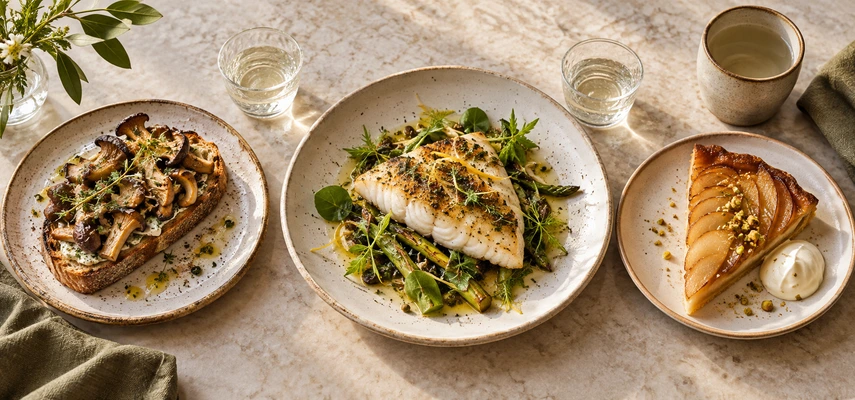
For simply grilled white fish with a light herb garnish, consider a restrained sake whose intensity won’t obscure the food. A chilled delicate expression could be a plausible starting point if the diner likes that style. This is a reasoned proposal rather than a claim that fish can only accompany ginjō.
For roasted mushrooms on toast, a fuller savory sake might provide enough presence to meet the browned flavors. A rich junmai could be considered, perhaps at room temperature or gently warm if the particular product suits it. The choice follows the dish’s intensity and the diner’s preference, not a rule that mushrooms require one legal grade.
For a modest pear dessert, assess the dessert’s sweetness first. A sweeter sake may work more comfortably than a very dry one, while a strongly mature koshu could offer a different aromatic relationship if the diner enjoys it. The actual sample still needs to fit the intensity of the dessert.
| Question | Practical use |
|---|---|
| What does the diner enjoy? | Avoid recommending a disliked style merely to satisfy a theory |
| How intense are food and sake? | Keep one from overwhelming the other |
| How sweet is the dish and drink? | Anticipate a change in perceived balance |
The table summarizes the method, not the answers for every menu. Change the sauce, portion, preparation or preference and the recommendation may change. A good explanation should be able to say which change mattered and why.
Umami and texture can refine the idea
Sake often offers savory character associated with amino acids and related components. That can provide a useful connection with savory foods. However, umami isn’t a license to claim that every sake pairs perfectly with every mushroom, cheese or stock-based dish. Intensity, sweetness and preference still need to fit.
Texture can matter too. A creamy nigori may provide a different experience from a light, clear sake beside the same food. Bubbles can create a lively physical contrast. These observations enrich the comparison without replacing the syllabus’s three main considerations.
The NRIB discussion of sake with food illustrates the broader relevance of sake’s composition. Use scientific context to make a recommendation more intelligible, not to turn a flexible sensory choice into a guaranteed chemical formula for pleasure.
Temperature is another adjustable part of service
A sake’s expression changes with serving temperature, so the same bottle can relate differently to food when chilled or warm. For an appropriate savory style, gentle warmth may help it meet a warm dish’s character. A delicate cold dish may lead to another choice. These are experiments to assess, not universal obligations to match temperatures exactly.
Check the product before adjusting it. Not every sake benefits from warming, and a sealed sparkling bottle should not be heated as though it were still sake. The service lesson’s practical controls still apply during a pairing experiment. Food context does not cancel packaging and handling needs.
Small servings help compare deliberately. Taste the sake alone, take a bite, then reassess the sake and the food. Note what became more noticeable, less noticeable or less pleasant. This turns a vague declaration of works well into an observation that can guide the next choice.
Sake is not limited to Japanese cuisine
The drink’s origins do not restrict its dining uses. Roast vegetables, cheese, seafood, poultry, pasta and many other foods can be explored through the same questions. A cuisine label is often less informative than the preparation and actual flavor of the dish.
Likewise, Japanese food is not one intensity level. A delicate broth, a sweet glaze and a deeply savory grilled dish present different combinations. Saying sake goes with Japanese food is too broad to be a useful recommendation when someone is choosing between several bottles for a specific course.
Avoid rigid regional matching as the only explanation. Shared origin can be an interesting cultural connection, but it doesn’t establish the diner’s preference or the actual sweetness and intensity relationship. A useful recommendation should still make sense when the place names are removed.
A written exercise works without alcohol: choose a menu dish, describe its dominant sauce and cooking method, then propose two contrasting sake profiles rather than two brand names. Explain who might prefer each and where sweetness could create a difficulty. This tests the reasoning more clearly than memorizing a restaurant recommendation. If the actual sake later tastes different from the assumed profile, revise the recommendation instead of forcing the bottle to fit the original story.
One-page revision summary
Start with personal preference, flavor intensity and sweetness. Assess the finished dish, especially sauces and cooking methods, and taste the actual sake rather than relying on a grade stereotype. Umami, texture, bubbles and temperature can refine the choice. Explore food beyond Japanese cuisine and explain recommendations as plausible options, not compulsory matches. The purpose is a better meal for the person eating it.
Knowledge check: 10 original practice questions
Independent TFE questions, not official WSET examination items. Choose one answer per question; explanations follow separately.
1. Which three considerations are prescribed at Level 2?
- Price, packaging and prestige
- Personal preference, flavor intensity and sweetness
- Bottle size, closure and label color
- Region, cup shape and age only
2. A guest dislikes sweet drinks. What should guide a recommendation?
- Ignore the preference
- Choose the sweetest bottle to prove a theory
- Take the preference seriously and offer a suitable option
- Assume every nigori is dry
3. Why does a strong glaze matter on a delicate fish?
- It can determine the finished dish’s intensity and sweetness
- It changes the rice variety
- It makes all sake unsuitable
- It removes all flavor
4. Does pear-like aroma prove a sake is sweet enough for a pear tart?
- Always
- Only if ginjō
- Only if served warm
- No, palate sweetness needs separate assessment
5. What is a useful intensity starting point?
- Always overwhelm the food
- Keep food and sake at broadly compatible intensity
- Always choose the highest alcohol
- Always choose the most expensive grade
6. Can sake accompany non-Japanese food?
- Never
- Only if it contains rice
- Yes, apply the same pairing considerations
- Only after distillation
7. How should umami be used in the explanation?
- As a useful refinement without replacing the three core considerations
- As proof every sake matches every food
- As another word for sweetness
- As a premium grade
8. What can serving temperature change?
- The legal rice variety
- The printed grade
- The origin of the brewery
- How the sake expresses itself beside the dish
9. Which comparison is useful?
- Judge from the label color only
- Taste sake alone and then reassess after a bite
- Assume the first theory is correct
- Ignore the sauce
10. Which statement best describes a pairing recommendation?
- One compulsory bottle exists for every dish
- Regional origin settles everything
- A plausible choice whose result depends on the actual food, sake and diner
- Premium grades all taste alike
Answers and explanations
1. B — Personal preference, flavor intensity and sweetness. These are the official core pairing considerations, with other ideas serving as supplements. Mapping: LO3.
2. C — Take the preference seriously and offer a suitable option. A pairing should work for the diner, not just fit an abstract explanation. Mapping: LO3.
3. A — It can determine the finished dish’s intensity and sweetness. Preparation and sauce can be more informative than the main ingredient alone. Mapping: LO3.
4. D — No, palate sweetness needs separate assessment. Fruit aroma and sweetness are distinct, so an aroma match may still be unbalanced. Mapping: LO3.
5. B — Keep food and sake at broadly compatible intensity. Broad intensity compatibility helps both food and drink remain perceptible. Mapping: LO3.
6. C — Yes, apply the same pairing considerations. Actual flavor and preference matter more than restricting the drink to one cuisine. Mapping: LO3.
7. A — As a useful refinement without replacing the three core considerations. Savory relationships can help, but intensity, sweetness and preference remain central. Mapping: LO3.
8. D — How the sake expresses itself beside the dish. Temperature affects perception and should be chosen for the actual product and diner. Mapping: LO3.
9. B — Taste sake alone and then reassess after a bite. A deliberate before-and-after comparison provides observations to support the recommendation. Mapping: LO3.
10. C — A plausible choice whose result depends on the actual food, sake and diner. Pairing principles guide choices without eliminating product variation and personal preference. Mapping: LO3.
Continue studying sake
Article #1: How to Understand and Evaluate Sake: The WSET Level 2 Framework · Article #15: Fruity Ginjō vs. Rich Junmai: How Brewing Choices Shape Sake Style · Article #16: Nigori Sake Explained: Cloudiness, Filtration, and Texture · Article #18: Sparkling Sake Explained: Carbonation vs. Bottle Fermentation












