











The same sake can seem more reserved when cold and more expansive as it warms. To serve sake well, choose conditions that support the particular drink and the person enjoying it. Temperature and vessels are useful tools, not a ceremony in which every bottle must follow the same rule.
Level 2 asks for four temperature categories, two warming methods, four drinking vessels and two serving vessels. This lesson connects those requirements to practical choices. The central distinction is simple: a cup is where a person drinks; a pouring vessel helps deliver the sake. Neither automatically determines quality.
Serve sake at a temperature that suits the expression
The prescribed categories are very chilled, chilled, room temperature and warm. These describe a range of service possibilities rather than four legal grades. A delicate fruit-led sake often benefits from cooler service, while a fuller savory expression may show well at room temperature or warm. Producer guidance and personal preference should refine the choice.
The official syllabus names the categories without making one temperature compulsory for all examples of a grade. Avoid a rule such as every ginjō must be served ice cold. Excessive chilling can suppress the aromas the producer worked to create.
The WSET service guide discusses chilled service broadly around 5–15°C and warming around 40–55°C, with style-dependent choices. These are useful reference ranges, not a command that a room-temperature bottle must be left in whatever heat the room happens to reach.
Very chilled and chilled are different degrees of restraint
Very chilled service emphasizes a cold, refreshing impression and can help manage sparkling products as directed. Chilled service allows somewhat more aromatic expression as the temperature rises. The distinction is one of degree, and the sample continues changing after it is poured.
Cold can make a drink seem less aromatic and change how sweetness, texture and alcohol register. A sake that seems quiet straight from the refrigerator may become more expressive after a few minutes in the glass. That does not mean its ingredients changed; perception and volatility have changed with temperature.
For a practical comparison, pour small amounts under similar conditions and note the progression. Do not keep adding warm liquid to a cold sample while trying to assess a stable temperature. A modest, controlled comparison teaches more than a guessing contest involving a large glass gradually warming unnoticed.
Room temperature is a service choice, not a storage excuse
Room-temperature service can suit some savory or restrained aromatic sakes. It may make certain flavors and textures easier to notice than very cold service. However, service temperature and long-term storage temperature are different decisions. A bottle can be stored cool, then allowed to reach the chosen temperature shortly before serving.
This distinction matters in a hot environment. The phrase room temperature should not be taken to mean that a 30°C room is automatically the ideal reference for every sake. The JSS service explanation describes temperature categories while connecting them to changing flavor expression.
Start from the bottle’s style and instructions, then adjust deliberately. If a sample becomes less balanced as it warms, that is useful information. There is no need to defend the higher temperature merely because another sake performed well that way.
Warm service can suit carefully chosen sake
Warm sake can emphasize cereal, savory or fuller aspects of some styles. It is not automatically a method for disguising low quality. Equally, warming is not a universal improvement: heat can reduce delicate aromatic complexity or make alcohol seem intrusive if it is poorly matched to the drink.
The aim is a chosen serving condition, not boiling. Warm a small amount rather than repeatedly heating and cooling the entire bottle. That makes control easier and protects the remaining sake for later service. The producer’s recommendations are especially useful when a style is unfamiliar.
Do not apply still-sake warming instructions to a sealed sparkling bottle. Carbonation and package pressure create a different handling situation. Product-specific instructions take priority over a general desire to experiment with temperature.
A hot-water bath offers gradual control
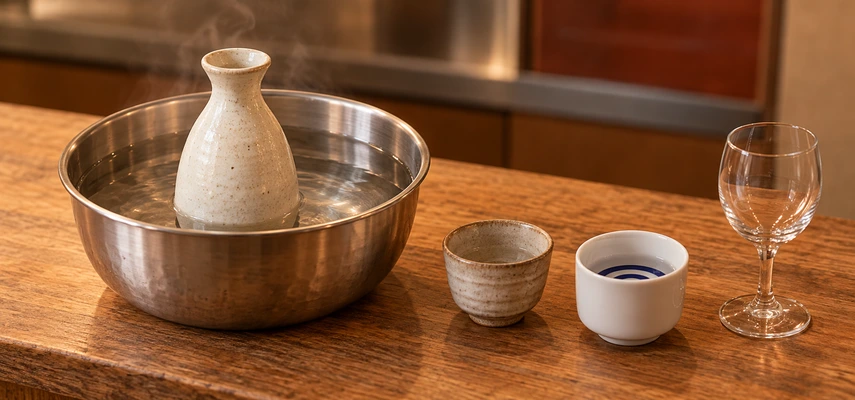
For a hot-water bath, place an appropriate heat-safe serving vessel containing sake into hot water, keeping bath water out of the drink. Remove it when the desired temperature is reached. A thermometer is useful because the outside of the vessel and the liquid inside need not feel identical.
The JSS guide illustrates the method. Control the water and the heating time, and use equipment suitable for the task. Avoid leaving the vessel on direct aggressive heat while assuming the surrounding water will prevent every problem.
After removing the vessel, handle it carefully and check the liquid before pouring. The vessel may be hotter than expected. A controlled water bath warms the sake; it is not supposed to add water to it. If bath water enters, you have changed composition as well as temperature.
A microwave is practical when used carefully
Use an open microwave-safe container without metal decoration or unsuitable fittings. Heat in short intervals, mix gently to distribute temperature and check before serving. The required time depends on volume, starting temperature, vessel and microwave power, so one fixed number of seconds cannot fit every situation.
Microwaves can produce uneven heating. A drink can have hotter areas even when part of the vessel feels moderate. Stirring and checking help avoid serving an unexpectedly hot mouthful. Do not heat a sealed bottle or assume a traditional-looking ceramic piece is microwave-safe without checking it.
Both prescribed methods can work. The meaningful comparison is control, convenience and suitability for the vessel and sake. One is not automatically more authentic in a way that makes the other educationally invalid. The syllabus includes both because they are practical methods with different handling details.
Four drinking vessels answer different needs
Wine glasses can help present aroma, particularly with a suitable tulip shape and manageable serving size. They are useful for learning because the drinker can observe the liquid and bring aromas toward the nose. A small glass can also help the sake remain near its intended temperature during the serving.
An o-choko is a small traditional sake cup, available in different materials and shapes. Its scale supports small pours and frequent refilling. It is a drinking vessel rather than a required grade indicator; ceramic does not mean warm sake only, nor glass cold sake only in every circumstance.
A kiki-choko is a white tasting cup with blue concentric rings inside. The white surface and contrast help observers assess colour and haziness. The circles are a viewing aid, not a mystical device that identifies rice variety or yeast. The NRIB/JSS guide places tasting vessels within systematic observation.
A masu is a small box historically used as a measure and sometimes used for sake service. Wooden examples can contribute wood character, which may affect a neutral tasting comparison. Its square shape also changes the drinking experience. It is a cultural option, not mandatory equipment for appreciating every bottle.
Tokkuri and katakuchi are for serving and pouring
A tokkuri is a flask-like serving vessel, commonly with a narrow neck. Suitable examples can be used in a warming arrangement or for pouring portions into cups. Materials and designs vary, so assess heat suitability rather than assuming every attractive flask belongs in hot water or a microwave.
A katakuchi is an open pouring vessel with a spout or lip. It is useful for serving, especially chilled sake, and is distinct from the individual cups into which it pours. The opening makes the structure visually different from a narrow-necked tokkuri.
This distinction is an easy examination point to lose if every unfamiliar vessel is memorized as a sake cup. Group the four drinking vessels together, then the two serving vessels. Function makes the vocabulary easier to remember than shape alone.
Put the service decisions in a sensible order
First check condition and product guidance. Then choose the intended temperature, select suitable vessels and prepare only the amount needed. This order prevents an attractive serving flask from deciding the whole plan before the sake has been considered. A neutral glass may be useful for checking aroma even when the final service uses another vessel.
For a hypothetical warm savory sake, a heat-safe tokkuri and small cups could suit both preparation and drinking. For a delicate chilled aromatic sake, a small wine glass may make aroma assessment easier. Neither arrangement establishes quality by itself; it simply supports a different expression and use.
Finally, observe what happens after pouring. A warm portion cools and a chilled portion warms. Small pours and timely refilling help manage that change, while leaving the guest free to prefer another point in the temperature range. Good service responds to the drink and diner rather than insisting that the first setting was sacred.
One-page revision summary
Choose among very chilled, chilled, room temperature and warm according to the actual sake and preference. Avoid both excessive chilling and overheating. Use a controlled hot-water bath or a microwave-safe open container with careful temperature checks. Wine glasses, o-choko, kiki-choko and masu are drinking vessels; tokkuri and katakuchi help serve and pour. No single traditional vessel or temperature is compulsory for all sake.
Knowledge check: 10 original practice questions
Independent TFE questions, not official WSET examination items. Choose one answer per question; explanations follow separately.
1. Which four temperature categories are prescribed?
- Frozen, boiling, steaming and hot
- Very chilled, chilled, room temperature and warm
- Only cold and boiling
- Only warm and hot
2. What can excessive chilling do?
- Change the rice variety
- Guarantee greater complexity
- Suppress aromatic expression
- Add alcohol
3. Which pair gives the prescribed warming methods?
- Hot-water bath and microwave
- Open flame and sealed-bottle boiling
- Sunlight and freezing
- Distillation and carbonation
4. Which precaution fits microwave warming?
- Use any metal-decorated flask
- Heat a sealed bottle
- Ignore uneven temperature
- Use an open suitable container and mix/check carefully
5. What is an o-choko?
- A rice cultivar
- A small sake drinking cup
- A fermentation tank
- A charcoal press
6. What helps identify a kiki-choko?
- A mandatory gold cap
- A wooden lid
- White cup with blue concentric rings inside
- A long narrow pouring neck
7. Which pair contains serving vessels?
- Tokkuri and katakuchi
- Wine glass and o-choko
- Masu and kiki-choko
- Rice and kōji
8. What can a wooden masu contribute?
- A verified yeast strain
- A fixed premium grade
- A guaranteed sweet taste
- Wood character affecting the experience
9. Does room-temperature service mean warm storage is always suitable?
- Yes
- No, storage and service are different decisions
- Only for clear sake
- Only for expensive sake
10. Which statement about warm sake is accurate?
- It is always low quality
- Every ginjō improves when heated
- It can suit some styles but is not a universal improvement
- It requires boiling
Answers and explanations
1. B — Very chilled, chilled, room temperature and warm. The syllabus spans these four service categories rather than one compulsory temperature. Mapping: LO3.
2. C — Suppress aromatic expression. Temperature affects aroma release and perception, so colder is not automatically better. Mapping: LO3.
3. A — Hot-water bath and microwave. Both are practical methods when suitable equipment and temperature control are used. Mapping: LO3.
4. D — Use an open suitable container and mix/check carefully. Container suitability and even heating matter more than one universal heating time. Mapping: LO3.
5. B — A small sake drinking cup. O-choko is a drinking-vessel term, with a range of materials and shapes. Mapping: LO3.
6. C — White cup with blue concentric rings inside. The contrasting base helps assess sake appearance, including color and haziness. Mapping: LO3.
7. A — Tokkuri and katakuchi. Tokkuri and katakuchi are used to hold and pour portions into drinking vessels. Mapping: LO3.
8. D — Wood character affecting the experience. The material can influence aroma, making it a different choice from a neutral tasting glass. Mapping: LO3.
9. B — No, storage and service are different decisions. A bottle can be stored cool and adjusted shortly before service without prolonged warmth. Mapping: LO3.
10. C — It can suit some styles but is not a universal improvement. Temperature should support the actual drink’s balance and character rather than a blanket rule. Mapping: LO3.
Continue studying sake
Article #1: How to Understand and Evaluate Sake: The WSET Level 2 Framework · Article #17: Nama Sake Explained: Unpasteurised, Nama-chozō, and Nama-zume Styles · Article #18: Sparkling Sake Explained: Carbonation vs. Bottle Fermentation · Article #19: Koshu Sake Explained: Ageing, Maturation, and Flavor Development












