










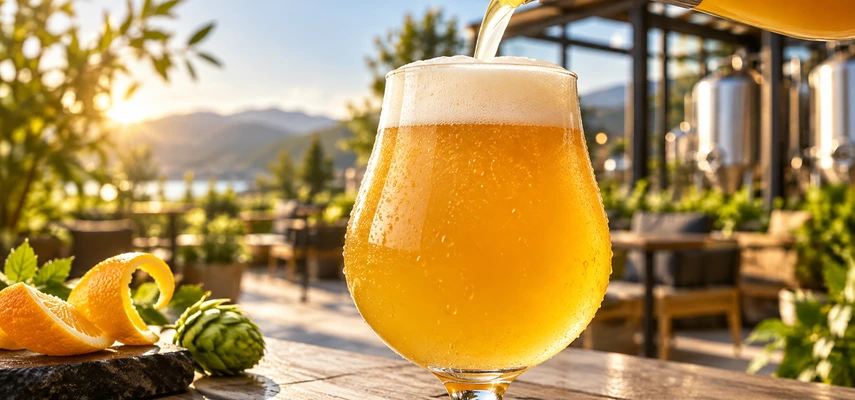

A beer can smell like a fruit bowl and still finish dry. Another can have a brilliant golden color and a firmly bitter edge. Pale ale and IPA become easier to understand when fruit-like aroma, sweetness, bitterness and haze stop being treated as one package deal.
The prescribed comparison includes American pale ale, American IPA and hazy IPA. All are hop-driven, but they don’t give hops the same kind of stage. Intensity, texture, perceived bitterness and production choices help separate the patterns.
Modern hop character is a broad palette
American, Australian and New Zealand hop varieties can bring citrus, pine, resin, tropical-fruit, stone-fruit or other associations. A particular beer doesn’t need to show every one of these. The choice of variety and how it is used matter more than memorizing a compulsory fruit list.
The official specification groups the three styles within this hop-driven context. Their malt and fermentation contributions remain important, even when hop aroma attracts attention first. Without that background, hop-driven could be mistaken for a drink made from hops alone.
The mechanism from the ingredient chapter still applies. Hot-process additions can build bitterness, while later additions and dry hopping often emphasize aroma. The finished beer’s balance depends on several choices, so a large aroma doesn’t automatically predict a large bitter taste.
American pale ale: hops with supporting malt
American pale ale commonly appears pale gold to amber, generally clear, with white or off-white foam. Aroma often gives a clear hop signal, perhaps citrus, pine, flowers or other fruit-like impressions. Malt usually supports it with grain, bread, biscuit or a restrained caramel-like note.
Flavor continues that hop-forward balance without making malt disappear. Bitterness is noticeable, commonly moderate to high, while sweetness is usually restrained in a medium-dry to dry finish. Body commonly falls around medium-light to medium, with enough carbonation to keep the overall impression lively rather than dense.
Characteristic ingredients include a pale malt base, selected aromatic hops and an ale yeast that is clean or lightly fruity. Some specialty malt can add support, but strongly distracting caramel or roast is not the central objective. Production choices encourage the hop profile while leaving a drinkable malt foundation.
The BJCP American pale ale reference helps explain its position between blonde ale and American IPA. It is generally more assertively hoppy than blonde ale, while American IPA commonly pushes hop emphasis and strength further. Those comparisons are more useful than a rule that every pale ale must be weak.
American IPA: a firmer hop-led statement
American IPA commonly ranges from gold to amber, with white or off-white foam. It is often clear, although a little haze can occur. Its aroma is generally prominent to intense in hops, with possible citrus, pine, resin, floral or fruit-like character depending on the varieties.
Flavor gives hops a leading role and usually carries firm bitterness into a dry or medium-dry finish. Supporting malt may be grain-like or lightly bread-like, with restrained caramel in some examples. Sweetness should not be assumed from the aroma. A beer that suggests ripe fruit can still taste comparatively lean and bitter.
Body is commonly medium-light to medium rather than necessarily thick. Alcohol may be more noticeable than in many pale ales, but this remains a style tendency rather than permission to estimate a bottle’s ABV by taste. Verified labeling is the appropriate source for the actual number.
The ingredients often center on pale malt, expressive hops and a clean or lightly fruity ale yeast. Hop use, including later additions or dry hopping, helps develop intensity. The BJCP American IPA description emphasizes a hop-led, bitter and relatively dry pattern rather than mandatory sweetness or a single geographic flavor.
Hazy IPA: aroma emphasis and a softer impression
Hazy IPA commonly appears straw to gold or light amber, often with an orange-like glow, obvious haze and white foam. The visual cue matters, but it is not enough on its own. A pale beer made cloudy by a fault or an unrelated process doesn’t automatically become hazy IPA.
Aroma and flavor tend toward intense fruit-like hop character: citrus, tropical fruit or stone fruit are useful possibilities. The malt background is often comparatively gentle and grain-like. Fermentation can also contribute fruit-like character, so the final aroma need not come from one source alone.
Perceived bitterness is often softer or less sharp than in a more traditional American IPA. Body commonly feels fuller and smoother, with moderate carbonation and a rounded impression. This doesn’t mean no bitterness, nor a requirement that the beer taste sugary. Aroma, body and reduced bitterness can suggest sweetness without proving a large sugar content.
Characteristic ingredients often include pale malt with wheat or oats in some recipes, expressive fruit-forward hops and a suitable yeast. Heavy later hopping and dry hopping are important production influences. The BJCP hazy IPA reference describes this combination rather than treating cloudiness as an independent goal.
What haze tells us, and what it doesn’t
Haze concerns suspended or interacting material that changes how light passes through the beer. In hazy IPA, the intended result relates to recipe and hopping choices. The relevant beginner observation is a visibly hazy appearance alongside the expected aroma, flavor and texture.
Do not reduce the style to “unfiltered beer.” Plenty of unfiltered beers have entirely different flavor profiles, and a highly fruit-forward hazy IPA has a more specific identity. Similarly, visible haze doesn’t establish alcohol level, nutritional content, freshness or quality by itself.
Quality also requires context. Intended haze differs from obvious unwanted particles or deterioration. The beer-faults chapter examines that distinction. Here the useful discipline is to record the appearance accurately, then continue assessing the other dimensions rather than allowing one visual feature to end the investigation.
Compare intensity and balance separately
| Feature | American pale ale | American IPA | Hazy IPA |
|---|---|---|---|
| Usual appearance | Pale gold to amber, often clear | Gold to amber, often clear or lightly hazy | Pale to light amber, conspicuously hazy |
| Hop emphasis | Clear but supported by malt | Prominent and firmly bitter | Intense fruit-like aroma and flavor |
| Body direction | Medium-light to medium | Medium-light to medium | Often fuller and softer |
| Finish clue | Balanced hop-forward dryness | Firm bitterness and dryness | Softer perceived bitterness, not necessarily sweet |
The table describes tendencies rather than numerical borders that every producer obeys. Modern examples overlap, and names on labels can be used broadly. For Level 1, concentrate on the characteristic combinations without adding a separate catalog of specialty IPAs.
One imagined sample might be clear amber, citrus-like, moderately bitter and supported by biscuit malt. Another might be hazy gold, intensely tropical, smooth and softly bitter. Those observations provide a stronger comparison than simply writing hoppy beside both and moving on.
Don’t turn fruit words into ingredient claims
Juicy often describes the impression created by aroma and texture. It doesn’t prove juice was added, just as a pine-like aroma doesn’t mean the brewer put a tree in the kettle. Some beers do contain fruit or other additions, but those claims need producer information.
The same care applies to oats and wheat. They can influence a recipe without making every beer containing them taste identical. Wheat in an IPA doesn’t automatically create the yeast character associated with Weissbier. Ingredients interact with yeast and process rather than carrying a complete style inside the bag.
This distinction is especially useful when someone asks about allergens or other ingredient restrictions. A tasting note cannot answer a precise recipe or suitability question. Use current verified information for the actual product, then describe its sensory character separately.
A practical comparison exercise
Choose two producer descriptions, one American pale ale and one hazy IPA. List aroma, bitterness and body in separate columns. Circle any claim that cannot be justified by appearance alone. This works without alcohol and trains the habit of separating what is observed from what is inferred.
If tasting voluntarily and legally, use small samples under similar conditions. Compare aroma before bitterness, then examine texture. The order helps reveal that the more intensely aromatic beer need not be the more bitter one. It is an optional learning exercise, not a separate graded tasting examination.
For a recommendation task, ask whether someone wants aromatic fruit, a dry bitter finish, or a softer fuller feel. Those preferences may point toward different examples even within one style. Explaining that reason is more helpful than assuming every IPA drinker wants maximum bitterness.
One-page revision summary
American pale ale combines recognizable modern hop character with supporting malt and a generally moderate-strength context. American IPA commonly intensifies the hop-led, bitter and relatively dry impression. Hazy IPA emphasizes fruit-like aroma, visible haze and a fuller, softer feel, often with less sharply perceived bitterness.
The central examination habit is separation: hop aroma isn’t sweetness, haze isn’t a complete style identity, and a fruit comparison isn’t an ingredient list. Link the sensory pattern to malt, hops, yeast and their treatment, then use comparisons to remember what makes each style distinctive.
Knowledge check: 10 original practice questions
Independent TFE questions, not official WSET examination items. Choose one answer per question; explanations follow separately.
1. Which style is generally more hop-forward than blonde ale but less intense than American IPA?
- Munich dunkel
- American pale ale
- Geuze
- Berliner weisse
2. What is a typical American IPA balance?
- Hop-led, firmly bitter and relatively dry
- Always sugary and low in hops
- Defined by lactic acidity
- Defined by dark coffee roast
3. Which combination most strongly suggests hazy IPA?
- Haze alone in any beer
- Clear black appearance and coffee roast
- Clear pale lager with restrained aroma
- Haze, intense fruit-like hops and a softer fuller feel
4. Does intense tropical aroma require high sweetness?
- Yes, all tropical aromas are sugar
- Yes, dry hopping adds sweetness by definition
- No, aroma and sweet taste are separate
- Only if the beer is clear
5. What does dry hopping commonly emphasize?
- Grain germination
- Hop aroma
- Bottle strength
- The removal of all yeast before every fermentation
6. Why is unfiltered not a complete definition of hazy IPA?
- Many unfiltered beers have different sensory profiles
- All unfiltered beers are identical
- Filtering creates every hop aroma
- Hazy IPA must contain fruit juice
7. Which ingredients may help shape a hazy IPA recipe?
- Only dark roasted barley
- Only grape juice and bacteria
- No yeast or grain
- Pale malt, expressive hops and sometimes wheat or oats
8. What is the best source for an actual beer’s ABV?
- The depth of haze
- The strongest aroma word
- Verified product labeling or producer information
- The size of its foam head
9. Which observation separates aroma from taste?
- Fruity therefore sugary
- Citrus-like aroma with firm bitterness
- Hazy therefore high alcohol
- Pale therefore lightly bitter
10. What should guide an IPA recommendation?
- The drinker’s preferences for aroma, bitterness and texture
- The assumption that every IPA must be maximally bitter
- Color alone
- A rule that all hazy beers taste identical
Answers and explanations
1. B — American pale ale. American pale ale occupies a useful comparative position with noticeable hops and supporting malt. Mapping: LO2.
2. A — Hop-led, firmly bitter and relatively dry. American IPA commonly combines prominent hops with supportive malt and a dry or medium-dry finish. Mapping: LO2.
3. D — Haze, intense fruit-like hops and a softer fuller feel. Several dimensions together support the pattern; haze by itself cannot establish the style. Mapping: LO2.
4. C — No, aroma and sweet taste are separate. Fruit-like hop aroma can accompany comparatively dry beer, so record sweetness independently. Mapping: LO2.
5. B — Hop aroma. Later hop additions can build aroma without requiring the same bitterness emphasis as a long boil addition. Mapping: LO2.
6. A — Many unfiltered beers have different sensory profiles. The style requires a characteristic combination of appearance, hop expression and texture, not one process label. Mapping: LO2.
7. D — Pale malt, expressive hops and sometimes wheat or oats. The ingredients work with fermentation and hopping choices to create the intended profile. Mapping: LO2.
8. C — Verified product labeling or producer information. Sensory style tendencies do not replace a verified alcohol statement for a particular product. Mapping: LO2.
9. B — Citrus-like aroma with firm bitterness. Independent observations avoid unsupported inferences between different sensory dimensions. Mapping: LO2.
10. A — The drinker’s preferences for aroma, bitterness and texture. Style knowledge supports useful questions, but individual preference and the actual beer still matter. Mapping: LO2.












