










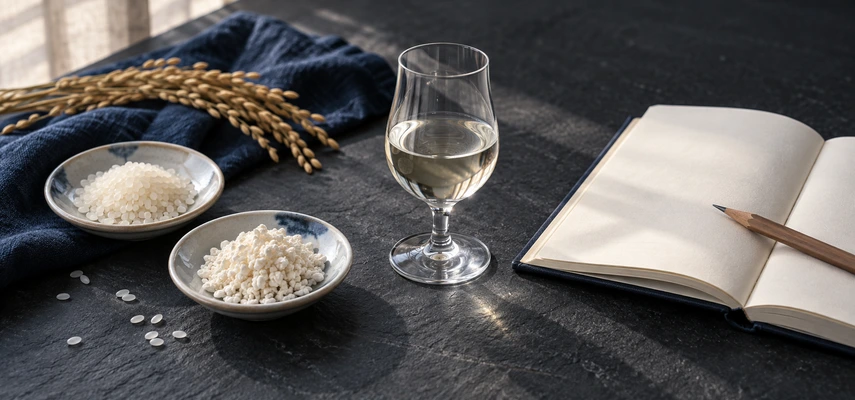

A grape arrives with sugar ready for yeast. A rice grain arrives with a problem: its energy is mostly locked in starch. To understand and describe sake, start with the tiny partnership that opens that lock. Kōji supplies enzymes that release sugars; yeast turns those sugars into alcohol. The quiet-looking drink in the glass has a surprisingly busy origin.
This is the first lesson in The TFE Guide to WSET Level 1 Sake, an independent study resource without WSET endorsement. The goal is practical understanding: explain what made the drink, observe it in a sensible order, and connect a description to production without treating every aroma as proof of a particular recipe.
Understand sake as a fermented drink
Sake is a rice-based fermented alcoholic beverage. It is often called rice wine, but that nickname conceals the central production difference. Grapes already contain fermentable sugar. Rice needs starch conversion before its material becomes useful to ordinary brewing yeast. Sake is brewed, not distilled, even when a permitted style includes a small addition of distilled alcohol.
Consider starch a long necklace and fermentable sugars its smaller pieces. Yeast cannot simply swallow the whole necklace. Enzymes cut it into manageable sections. The comparison is deliberately simple, but it preserves the division of work: breaking down starch and producing alcohol are different jobs.
Beer also starts with a starchy grain. In conventional beer brewing, malt enzymes act during mashing before the sugary liquid is fermented. In sake’s main mash, starch conversion and alcoholic fermentation can proceed together. This is multiple parallel fermentation: two transformations overlapping, rather than two names for the same transformation. The JSS production overview explains that partnership.
Five ingredients, five different functions
Steamed white rice supplies starch. Preparation makes it suitable for the organisms and enzymes that follow. Rice therefore does more than lend a faint grain association to the finished drink: it provides the raw material from which fermentation can build alcohol.
Kōji means steamed rice cultivated with a selected mould, usually Aspergillus oryzae in sake production. Its enzymes break starch into fermentable sugars. Kōji is not the yeast that produces the alcohol. Calling both organisms simply fermentation bugs is rather like giving a baker and a delivery driver the same job description.
Yeast carries out alcoholic fermentation, converting sugar into alcohol and carbon dioxide. It also helps create aroma compounds. A pear-like impression can therefore arise without anyone putting pears into the brewery tank. Aroma is evidence of a sensory resemblance, not an ingredient list.
Water provides the medium for brewing and is used in rice preparation. It may also be added later to dilute the sake. Clean water matters, but the beginner does not need to memorize water chemistry before understanding the process. First remember that water participates throughout production, rather than appearing only at bottling.
High-strength distilled alcohol is optional across sake production and permitted in certain classifications. It can influence aroma expression and the balance of the finished drink. Junmai categories prohibit its addition. Added distilled alcohol does not turn the entire drink into a distilled spirit, just as adding one ingredient does not erase how the base beverage was made.
Describe sake before trying to identify it
Observation comes before naming a grade. A delicate fruity sake might suggest a ginjō style, but sensory impressions alone cannot certify its polishing ratio or whether distilled alcohol was added. Labels and production information answer those questions. The glass answers a different question: what is this particular sake like?
Use four passes: appearance, aroma, palate and finish. This is an original learning sequence, not a reproduction of WSET’s protected tasting sheet. The official specification defines the qualification’s scope; the descriptions here explain how to practice the ideas in ordinary language.
Keep separate notes for things that are easy to muddle. Clear is a statement about clarity, not color. Fruity describes an aroma or flavor resemblance, not sweetness. Full-bodied describes weight, not necessarily high alcohol. Each observation earns its own line before the observations are brought together.
Appearance: clarity, color and movement
Look against a pale background. Is the liquid clear or cloudy? Is it almost colorless, pale yellow or deeper gold? These are independent observations: a golden liquid can be perfectly clear, and a pale liquid can contain suspended rice particles.
Cloudiness is not automatically a fault. Nigori is a specialty style that retains fine rice material after coarser separation. Nor are bubbles automatically a problem: sparkling sake deliberately contains carbon dioxide. Compare the observation with the intended style before deciding that something has gone wrong.
A simple written note might read: clear, pale yellow, no visible bubbles. Another might read: cloudy white, fine suspended particles, persistent bubbles. These are hypothetical examples, not descriptions of two specific commercial bottles. Neither note, by itself, tells whether its author will enjoy the drink.
Aroma: familiar comparisons beat impressive vocabulary
Smell gently before tasting. Begin with broad families. Fruity and floral notes might recall pear, melon, banana or flowers. Grain and cereal impressions might suggest cooked rice or steamed grain. Nut aromas can appear in some styles, particularly with maturation. Lactic or dairy associations may recall yogurt or fresh cream.
These terms describe similarities. A yogurt-like note does not prove that milk was added, and a nutty aroma does not mean the drink contains nuts. The JSS sensory introduction is useful background for separating these impressions.
Then consider intensity. Does the aroma seem restrained, moderate or pronounced? Avoid reaching for a dozen precise fruits when one accurate broad description will do. Two people may choose different familiar examples while agreeing that the sake has a delicate fruity character. Consistency of observation matters more than winning a vocabulary contest.
Palate: sweetness, acidity, umami and texture
Sweetness is the perception of sugar; acidity supplies a tart or mouthwatering impression. They interact, but they are not opposite ends of a single switch. A sake can show noticeable sweetness and noticeable acidity together. Judge each before describing the balance.
Umami is a savory taste. Think of the savory impression in a light broth, rather than assuming the sake literally tastes like soup. It is distinct from sweetness, saltiness and aroma intensity. Some sakes make that savory dimension particularly easy to notice; others emphasize a lighter, more delicate impression.
Texture covers how the liquid feels. It might seem light, rounded, creamy or more substantial. Rice particles can contribute a textured sensation; bubbles can add a lively prickle. Alcohol may create warmth. These sensations can coexist, so calling everything smooth leaves useful information on the table.
Flavor combines taste with aromas perceived while drinking. A fruity flavor does not establish sweetness any more than a fruity smell does. Try this imaginary comparison: one sample smells of melon but tastes fairly dry; another has little fruit aroma but obvious sweetness. Those observations are compatible, because aroma and sugar are different dimensions.
Finish describes what remains after the sip or after spitting. Does the impression fade quickly or persist? Is the lingering character fruity, savory, sweet or warming? A long finish is not a substitute for balance or personal enjoyment. Describe its character as well as its duration.
Grades, specialty styles and signs of trouble
Sake classifications describe regulated production choices. The six principal premium grades studied here are junmai, honjōzō, ginjō, junmai ginjō, daiginjō and junmai daiginjō. Futsū-shu is the basic category. More detailed rules follow later; for now, recognize that a grade supplies production information rather than a promise that every reader will prefer it.
Nigori, sparkling, nama and koshu are specialty styles. Nama means unpasteurised; koshu refers to matured sake. These descriptions can overlap with grade information. A bottle can therefore answer several questions at once: how it was classified, whether it was pasteurised, and what texture or maturation character it presents.
Watch for oxidation, a generally tired or out-of-condition character, and nama-hine, an undesirable deterioration associated with unpasteurised sake. Do not diagnose every unusual aroma as a fault. Intentional nutty maturation in koshu differs from an accidentally stale bottle. The producer’s intended style and storage history provide essential context.
Study the examination without inventing a tasting test
Level 1 covers three learning outcomes: ingredients and production; categories, grades, specialty styles and labels; and storage and service, including faults and pairing. The theory examination has 30 multiple-choice questions in 45 minutes under closed-book conditions. Each correct answer earns one mark, with no negative marking. The passing threshold is 70%, or 21 out of 30.
The question distribution is 10 for production, 15 for categories and styles, and 5 for storage and service. Classification therefore deserves serious revision time. There is no separately assessed tasting examination. Readers who do not consume alcohol can study the theory, practice describing familiar food aromas, and compare clearly identified hypothetical notes.
An optional comparison set follows the recommended sample groups: futsū-shu or honjōzō; junmai; ginjō or junmai ginjō; daiginjō or junmai daiginjō; nama-zake; nigori; sparkling sake; and koshu. Nama-zake is another name for unpasteurised nama. These are learning comparisons, not a requirement to buy or consume all eight samples. Written profiles can support readers who do not taste alcohol.
Judge flavor intensity separately as light, medium or pronounced. A light texture can carry pronounced flavor, so intensity and weight should not share one score. If an aroma does not fit fruit, flowers, grain, nuts or dairy, describe another clear resemblance in an other-aromas note rather than forcing it into the wrong family.
One-page revision summary
Rice supplies starch; kōji enzymes make sugars available; yeast produces alcohol. Water participates throughout brewing, and distilled alcohol is an optional permitted addition outside junmai categories. Observe clarity and color separately, then aroma, sweetness, acidity, umami, texture and finish. Check intended style before calling cloudiness, bubbles or maturity a fault. Learn the 30-question, 45-minute, 21-to-pass format and the 10/15/5 weighting. Understanding the chain of causes makes the Japanese vocabulary much easier to remember.
Continue your sake studies
Knowledge check: 12 original practice questions
Independent TFE questions, not official WSET examination items. Choose one answer per question; explanations follow separately.
1. Why does rice need an extra conversion step before its starch can support alcoholic fermentation?
- Its starch must become fermentable sugar
- Its starch is already alcohol
- Rice must be distilled first
- Water converts starch directly into yeast
2. Which ingredient performs alcoholic fermentation?
- Water
- Yeast
- Plain rice starch
- The bottle closure
3. What does kōji contribute to the process?
- A compulsory distilled spirit
- Grape sugar
- Enzymes that break down starch
- The examination answer key
4. What does multiple parallel fermentation describe?
- Two bottles served together
- Distillation and bottling together
- Only water dilution
- Starch conversion and alcoholic fermentation overlapping
5. Which statement about distilled alcohol is accurate?
- It is optional in sake production and prohibited in junmai categories
- It is required in all sake
- It makes all sake a distilled spirit
- It replaces yeast in fermentation
6. A sake smells fruity but tastes fairly dry. What follows?
- The observation is impossible
- Fruity aroma does not establish sweetness
- Fruit must have been added
- The sake must be sparkling
7. Which note describes clarity?
- Sweet
- Floral
- Cloudy
- Savory
8. Which term refers to savory taste?
- Polishing
- Pasteurisation
- Clarity
- Umami
9. Why are visible bubbles not automatically a fault?
- Sparkling sake intentionally contains carbon dioxide
- All sake must bubble
- Bubbles prove the bottle is old
- Bubbles measure polishing ratio
10. How many examination questions address categories, grades, styles and labels?
- 5
- 15
- 10
- 30
11. What is the stated passing mark out of 30?
- 15
- 20
- 21
- 29
12. Which statement describes assessment accurately?
- A separately graded blind tasting is compulsory
- Only producers can sit the theory examination
- Incorrect answers subtract marks
- The theory examination is closed book and lasts 45 minutes
Answers and explanations
1. A — Its starch must become fermentable sugar. Kōji enzymes release sugars from rice starch; yeast then ferments those sugars. Mapping: LO1.
2. B — Yeast. Yeast converts fermentable sugars into alcohol and carbon dioxide. Mapping: LO1.
3. C — Enzymes that break down starch. Kōji-grown mould supplies enzymes; it is distinct from the alcohol-producing yeast. Mapping: LO1.
4. D — Starch conversion and alcoholic fermentation overlapping. The two transformations can proceed concurrently in sake main fermentation. Mapping: LO1.
5. A — It is optional in sake production and prohibited in junmai categories. The permitted addition varies by classification; the base beverage remains fermented. Mapping: LO1.
6. B — Fruity aroma does not establish sweetness. Aroma character and perceived sugar are separate sensory dimensions. Mapping: LO2.
7. C — Cloudy. Cloudiness concerns suspended material and visual clarity, rather than taste or aroma. Mapping: LO2.
8. D — Umami. Umami describes a savory taste, distinct from sweetness, acidity and aroma. Mapping: LO2.
9. A — Sparkling sake intentionally contains carbon dioxide. The observation must be compared with intended style; sparkling sake deliberately has bubbles. Mapping: LO2.
10. B — 15. Learning Outcome 2 receives 15 of the examination’s 30 questions. Mapping: exam.
11. C — 21. Seventy percent of 30 is 21; each correctly answered question earns one mark. Mapping: exam.
12. D — The theory examination is closed book and lasts 45 minutes. The qualification uses a 45-minute closed-book multiple-choice examination, without negative marking. Mapping: exam.












