










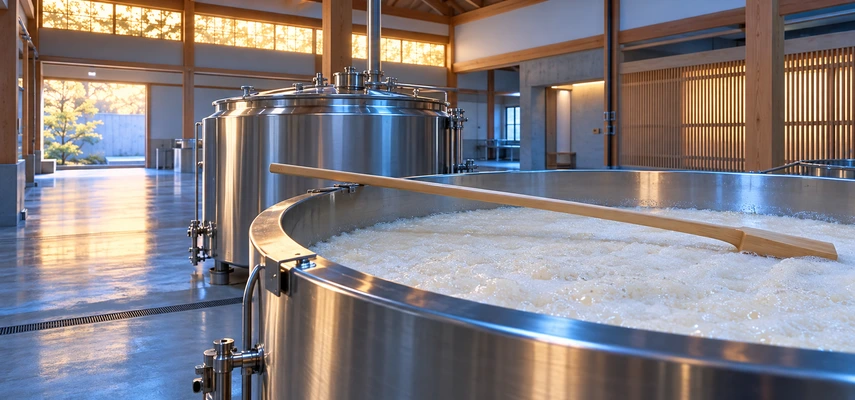

A tank can be busy making sugar and using it up at the same time. That is the central trick of sake fermentation. Kōji enzymes release fermentable sugars from rice starch while yeast converts available sugar into alcohol and carbon dioxide. The two jobs overlap, so a snapshot of the sugar supply does not tell the whole story.
The brewer must manage that partnership rather than merely wait for a sweet liquid to become alcoholic. A fermentation starter establishes a useful yeast population. The main mash increases the scale. Temperature then helps shape the pace and character of what happens, with consequences that eventually reach the glass.
Sake fermentation begins with the right food
Yeast needs fermentable sugar. Rice supplies starch, which requires enzymatic breakdown before it can provide that food. Kōji carries the enzymes; yeast performs alcoholic fermentation. Those are distinct functions even when the organisms and their products operate within the same brewing system.
This distinction prevents a common misunderstanding: kōji does not become yeast, and yeast does not simply ferment intact rice starch. The brewer creates conditions in which an enzyme supply can release sugars and a living yeast population can use them. Both sides matter to the outcome.
Think of a workshop supplied by a neighboring cutting room. The cutting room produces usable pieces while the workshop turns them into finished objects. A large stockpile is not essential if supply and use continue together. The analogy explains the overlap without suggesting that the two rooms perform the same task.
What yeast produces
During alcoholic fermentation, yeast converts sugar into alcohol and carbon dioxide. The alcohol remains in the liquid. Carbon dioxide can escape during brewing; its production does not mean every finished sake must be sparkling. Whether bubbles remain in the packaged drink is a separate production decision.
Yeast also contributes compounds that affect aroma and flavor. Fruity or floral impressions can emerge even though no fruit or flowers were added. Different cultures and conditions can produce different expressions. The ingredient list therefore cannot be reconstructed simply by matching an aroma with a familiar food.
The JSS ingredient and fermentation overview identifies yeast’s role. For Level 1, hold onto the clear mechanism: sugar goes in; alcohol, carbon dioxide and flavor-related products come out. More advanced cell chemistry is unnecessary for explaining why fermentation changes the mash.
Why make a fermentation starter?
A starter is a smaller preparation used to establish a strong, suitable yeast population before the main fermentation. In sake, the term shubo is often used. Its ingredients include steamed rice, kōji, water and yeast. The starter gives the brewer an active culture ready to work at a larger scale.
Imagine inviting a single baker to supply a whole city without first arranging a bakery. The issue is not whether the baker knows how to make bread; it is whether there is enough organized capacity for the task. The starter addresses a related scale problem by building the yeast population under controlled conditions.
The starter is not a finished miniature bottle of sake that simply gets diluted into the final drink. It is a working biological preparation. Its condition affects how reliably the main fermentation begins. Level 1 study asks for its purpose, not a catalogue of every traditional and modern starter method.
Starter and main fermentation are different stages
The main fermentation uses the established starter along with further steamed rice, kōji and water. This creates the larger mash, often called moromi. The increased material supplies starch and water while the kōji brings enzymes and the starter brings an active yeast population.
Brewers build the mash carefully rather than assuming every ingredient can be dumped into a vessel with identical results. Traditional main-mash construction commonly uses staged additions. The relevant beginner principle is controlled expansion: the yeast population and brewing environment need to remain suitable as the amount of material grows.
The JSS professional brewing account distinguishes the starter from the main mash. Learn those two purposes before adding more terminology. Starter means establishing the working yeast culture; main fermentation means transforming the larger brewing mixture toward sake.
Multiple parallel fermentation, without the fog
Multiple refers to more than one transformation. Parallel means that they proceed alongside one another. Kōji enzymes break starch into sugars, while yeast converts sugars into alcohol and carbon dioxide. They need not finish one entire batch of starch conversion before alcoholic fermentation can begin.
The word fermentation in this conventional brewing phrase covers the combined process. Strictly speaking, enzymatic starch conversion is not the same biological action as alcoholic fermentation. For study purposes, explain both transformations explicitly rather than relying on the label to do all the teaching.
Compare conventional beer brewing: starch conversion largely happens during mashing before yeast ferments the resulting sugary liquid. Compare grape wine: the fruit already contains sugar. Sake’s mash continues releasing sugar while fermentation proceeds. These comparisons concern the central production pattern, not a claim that every beverage has only one possible method.
Temperature is a control, not a quality score
Fermentation temperature affects yeast activity and the development and retention of aroma compounds. Within suitable brewing conditions, a relatively warm fermentation generally proceeds more quickly than a cooler one. Cooling can slow the process and support the development of delicate fruity and floral styles.
Ginjō production is commonly associated with carefully controlled cool fermentation. However, low temperature alone does not turn any mash into ginjō or guarantee a superior drink. Rice preparation, kōji, yeast selection and the rest of production still matter. Classification also involves controlled requirements beyond one temperature choice.
A thermostat is therefore closer to a musical tempo control than a quality meter. Faster or slower can serve different intentions. The useful study question is what the brewer is trying to achieve and how the conditions support that goal, rather than which temperature sounds more prestigious.
Relatively warm fermentation and style
Warmer fermentation can suit less overtly delicate, fuller or more straightforward styles. That is a broad relationship, not a guarantee that every warmer-fermented sake will taste identical. Yeast strain and ingredient treatment continue influencing the result, and actual brewing temperatures are managed within suitable ranges.
Avoid equating warm fermentation with spoiled sake. Controlled brewing warmth differs from leaving a finished bottle in a hot shop window. The first is a production choice applied to an active mash; the second is a storage problem affecting a finished product. Similar temperature words can describe very different situations.
Nor does warm fermentation mean the drink must be served hot. Fermentation temperature and service temperature belong to different stages. A brewer’s production setting does not impose the customer’s serving vessel or temperature. Keeping the stages distinct removes a surprisingly persistent source of confusion.
Cool fermentation and delicate aromas
Cooler fermentation commonly proceeds more slowly and is associated with delicate fruity and floral expression, especially in ginjō styles. The brewer seeks a particular balance, not simply the coldest tank possible. Yeast must remain able to carry out its work effectively.
The word cool is relative to brewing practice, not an instruction to freeze the mash. There is no single universal number that accurately describes every sake fermentation. At Level 1, understanding the relationship between relatively cool conditions and typical style is more useful than inventing a mandatory temperature threshold.
A hypothetical pair makes the distinction clearer. One sake has restrained grain character and a rounded palate; another is light with pronounced pear-like aroma. Cooler fermentation may help explain the second style, but tasting notes alone cannot prove either tank’s exact temperature. Production records provide facts that sensory inference cannot certify.
Why sugar release does not guarantee sweetness
It is tempting to reason that more sugar released must mean sweeter sake. Yet yeast is consuming that sugar while the enzymes supply it. The final amount remaining depends on the whole process. Measuring the supply without considering use is like estimating a reservoir’s level from rainfall while ignoring the outlet.
Likewise, stronger fruit aroma does not necessarily mean more residual sugar. Aroma compounds and sugar produce different sensations. A fruity sake can taste fairly dry; a less aromatic sake can taste sweeter. This separation will help both examination answers and real-world descriptions.
Fermentation also affects alcohol concentration, but the bottled strength may later be adjusted by optional water dilution. Permitted alcohol addition is another separate finishing decision. Do not treat every number on the finished label as a direct unchanged measurement of the mash at its busiest moment.
What happens after fermentation
When brewing has reached the intended stage, the liquid is separated from much of the remaining solid material. Further choices may include permitted distilled alcohol addition, filtration, dilution, pasteurisation and bottling. Those operations change the finished drink in ways that fermentation alone cannot explain.
This transition is why the production chain should be learned as connected purposes. Rice preparation supplies suitable material; kōji prepares sugars; the starter establishes yeast; main fermentation produces alcohol and flavor; finishing prepares the sake for its intended style and sale. Each stage answers a different question.
One-page revision summary
Yeast converts fermentable sugar into alcohol and carbon dioxide. A fermentation starter establishes a suitable yeast population; the main mash expands the working system with rice, kōji and water. Multiple parallel fermentation combines continuing starch conversion with alcoholic fermentation. Relatively cool fermentation often supports slower, delicate fruity styles; warmer conditions can serve other styles. Neither temperature nor aroma alone proves quality, final sweetness or a legally complete grade.
Continue your sake studies
Knowledge check: 10 original practice questions
Independent TFE questions, not official WSET examination items. Choose one answer per question; explanations follow separately.
1. What is the main purpose of a sake fermentation starter?
- Establish a suitable yeast population
- Wash bottled sake
- Polish rice to 50%
- Replace all water
2. What is moromi?
- A polishing percentage
- The main fermenting mash
- A serving box
- A final fault category
3. Which pairing of function and agent is correct?
- Yeast polishes rice
- Water distils starch
- Kōji enzymes release sugars; yeast ferments them
- Bottle glass creates enzymes
4. What does parallel refer to?
- Identical bottle shapes
- Two breweries on one road
- Serving two cups
- Overlapping starch conversion and alcoholic fermentation
5. Which products arise from yeast alcoholic fermentation?
- Alcohol and carbon dioxide
- Only polished rice
- Only water and bran
- Glass and cork
6. What is a typical association of cooler fermentation?
- Mandatory distillation
- Slower fermentation supporting delicate fruity styles
- Guaranteed sweetness
- Compulsory hot service
7. Does fruit aroma prove added fruit?
- Always
- Only in clear sake
- No; fermentation can create fruity aroma compounds
- Yes if the sake is dry
8. Why does sugar release not alone establish final sweetness?
- Yeast cannot use sugar
- All sugar is rice bran
- Sake cannot be sweet
- Yeast consumes sugar while enzymes release it
9. Which temperature statement is accurate?
- Fermentation temperature and serving temperature are separate decisions
- Warm fermentation requires hot service
- Cool fermentation means frozen sake
- One temperature guarantees all grades
10. How does conventional wine fermentation differ at the starting point?
- It never uses yeast
- Grapes already supply fermentable sugars
- It requires rice kōji
- It is always distillation
Answers and explanations
1. A — Establish a suitable yeast population. The starter builds an active culture before the larger main fermentation. Mapping: LO1.
2. B — The main fermenting mash. Moromi names the larger mash in which main sake fermentation takes place. Mapping: LO1.
3. C — Kōji enzymes release sugars; yeast ferments them. The two complementary jobs remain distinct despite overlapping in the mash. Mapping: LO1.
4. D — Overlapping starch conversion and alcoholic fermentation. The processes can proceed at the same time in the main fermentation. Mapping: LO1.
5. A — Alcohol and carbon dioxide. Yeast uses sugar and produces alcohol and carbon dioxide during fermentation. Mapping: LO1.
6. B — Slower fermentation supporting delicate fruity styles. Cool fermentation is commonly linked to slower development and delicate ginjō-style aromas. Mapping: LO1.
7. C — No; fermentation can create fruity aroma compounds. A sensory resemblance does not establish the identity of ingredients added. Mapping: LO1.
8. D — Yeast consumes sugar while enzymes release it. Supply and consumption both affect what remains in the finished drink. Mapping: LO1.
9. A — Fermentation temperature and serving temperature are separate decisions. Production conditions do not dictate a single required service temperature. Mapping: LO1.
10. B — Grapes already supply fermentable sugars. Grape sugar is already available, whereas rice starch needs enzymatic conversion. Mapping: LO1.











