










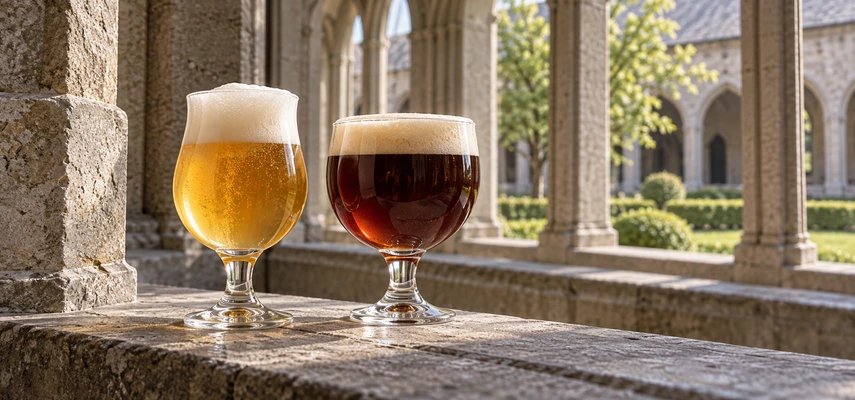

The dark beer is called dubbel. The pale one is called tripel and may be stronger. Belgian abbey ales quickly unsettle the idea that color and power must rise together. Then Trappist appears on a label and adds a different question: who made the beer, under what relationship to a monastery?
This lesson separates those ideas. Dubbel and tripel describe beer styles with useful sensory and production expectations. Trappist concerns monastic provenance and associated requirements, not one universal flavor. The Level 2 specification deliberately places the styles and the related labeling term together without making them synonyms.
Abbey ale yeast makes fermentation visible in flavor
Abbey ale yeast can create fruity esters and spicy phenolic expression that become central to the finished beer. Banana, pear, dried fruit or pepper-like associations may occur in different combinations. The balance depends on strain, wort and fermentation conditions rather than one mandatory aroma for every abbey-associated beer.
Lallemand’s abbey-strain example demonstrates how conditions influence a particular culture’s expression. It is a useful production example, not proof that all monasteries share one strain or follow one schedule.
Fermentation character can combine with malt-derived aromas so closely that individual causes become difficult to identify from a tasting note alone. Describe the impression first, then use recipe and culture information to support an explanation. Dried fruit need not mean actual dried fruit was added.
Dubbel: dark fruit and developed malt
Dubbel commonly appears deep amber to copper-brown, often clear with ruby highlights and a persistent cream-to-tan head. Aroma can combine caramel, toast or bread crust with dark-fruit-like esters and gentle spice. Strong burnt roast is not its defining grain signature.
The palate is malt-rich but should retain a sufficiently attenuated finish. Bitterness is generally low to moderate, supporting the beer without taking the role it would in an IPA. Body is medium to medium-full, carbonation medium-high, and alcohol can provide integrated warmth rather than a harsh bite.
Pale malt with darker or caramel contributions and possibly darker brewing sugars helps explain the color and aromatic depth. Abbey-type fermentation contributes another layer of fruit and spice. The beer’s richness comes from those interacting choices, not simply leaving a large amount of ordinary sugar unfermented.
Compared with a British brown ale, dubbel generally places more emphasis on Belgian fermentation expression and strength. Compared with a dark imperial stout, it lacks the same defining intense roast. Brown appearance therefore does not establish a shared malt treatment or yeast identity.
Tripel: pale does not mean modest
Tripel is typically clear deep yellow to gold with a substantial white head. Aroma combines pale grain with fruity esters, spice and sometimes subtle traditional hop detail. It is a stronger beer whose appearance can seem deceptively delicate.
Bitterness is moderate enough to help balance the strength, while a dry finish and lively carbonation support drinkability. Body is commonly medium-light to medium despite substantial alcohol, which should be smooth rather than hot. The beer can feel remarkably lifted for its strength without becoming thin or flavorless.
Pale base malt and a proportion of readily fermentable sugar can build alcohol potential without proportionally increasing less-fermentable malt material. An appropriate yeast and well-managed fermentation then help achieve dryness while creating the characteristic fruit-and-spice pattern.
Compared with dubbel, tripel is generally paler and often stronger, with less dark caramel character and a more obviously dry, brisk presentation. Compared with a pale strong lager, the distinctive yeast-derived expression helps explain a different sensory identity even when the colors and strengths overlap.
Sugar can lighten the impression of a strong beer
The apparent paradox is worth revisiting. Fermentable sugar added to wort can be consumed by yeast, so it does not necessarily remain as sweetness. When it replaces part of a malt contribution, the recipe can reach substantial alcohol with relatively less residual grain-derived material.
Consequently, tripel does not need to be thick simply because it is strong. Malt quantity, sugar contribution, wort composition and attenuation jointly influence the result. A brewing sugar is a functional ingredient, not an automatic confession that the brewer abandoned tradition or quality.
Darker sugar products can contribute another aromatic and color dimension in some dubbel recipes. Their composition and dose vary, and neither style mandates one universal commercial syrup. Use reliable producer information before assigning a specific product to the beer.
Dark fruit, spice and sweetness need separate notes
Raisin-like, plum-like or toffee-like aroma can suggest sweetness before the actual palate is assessed. Fermentation may still yield an appropriately dry finish. Record the aromatic association and the taste separately so one does not become an invented measurement of the other.
Likewise, spice-like phenols do not prove spices were added. A producer may use additions in a particular beer, but the style’s yeast can generate important spicy expression on its own. The word Belgian is not a license to invent coriander in every recipe.
Alcohol warmth and carbonation also shape the experience. A tripel’s lively gas can lift aroma and texture, while a dubbel’s richer grain impression can make its balance feel rounder. Evaluate the combination rather than judging every strong ale against one preferred mouthfeel.
Trappist answers a provenance question
The International Trappist Association’s current FAQs explain the relationship between Trappist products and the Authentic Trappist Product label. The criteria concern production in the monastery’s immediate environment, monastic supervision, and the appropriate use of income for the community, order and charitable purposes.
However, those are not a sensory recipe for dark beer, a guarantee that every beer is dubbel, or a requirement that every brewery task be performed personally by a monk. Supervision and a meaningful monastic relationship matter; the label cannot be inferred from a monk-like illustration on a commercial bottle.
Westmalle’s own explanation provides a producer example of the requirements. Trappist beers can take different styles, and dubbel or tripel can be brewed outside a Trappist production relationship. Keep the style and provenance statements in separate columns when studying labels.
Abbey imagery is not proof of Trappist status
Abbey ale is a broad expression in beer culture and commerce. A brand may have a historical, licensed or stylistic connection with an abbey, but that does not by itself establish the Trappist relationship or an ATP authorization. The exact producer and claim need checking.
Therefore, avoid identifying authenticity from the shape of the bottle, an old building on the label or a solemn-looking typeface. Those are design choices. The relevant association’s information and the producer’s verified account provide stronger evidence.
This is a general label-reading lesson too. A beer’s style name, production method, brand history and certification can each be true while answering different questions. Combining them into one romantic story can make the description less accurate rather than more interesting.
Double and triple are not arithmetic instructions
Dubbel and tripel have brewing-history associations, but modern style use does not prescribe exactly twice or three times the alcohol of some universal base beer. There is no single reference beer from which every producer must calculate its labels.
The useful contemporary contrast is the actual profile: darker rich grain and fruit in dubbel, pale strong dry fruit-and-spice expression in tripel. Knowing those relationships prepares you better than searching for a numerical rule that fails on real labels.
Nor should tripel be treated as three times the sweetness, three fermentations or three yeast strains by definition. A particular producer may describe particular methods, but that account should not become a universal style requirement without evidence.
Conditioning and service support the intended result
Bottle conditioning can contribute natural carbonation and further development in relevant examples. It is a production option to verify, not an assumption that every Belgian-looking bottle follows an identical refermentation protocol. Sediment presence and pouring preference depend on the beer and producer guidance.
These stronger beers still need appropriate storage and careful opening. High carbonation and substantial aroma make clean glassware and controlled pouring useful. Neither a decorative chalice nor an abbey image compensates for a stale or badly handled sample.
For study without drinking, compare reliable written notes and mark grain, fermentation, hops, alcohol and texture separately. Then read a producer’s provenance explanation and identify which statements concern style and which concern Trappist criteria. Optional tasting is educational, never a required practical examination.
Read a hypothetical label in two passes
Suppose a brewery describes a golden ale as tripel but makes no monastic claim. The style description can still tell you to investigate strength, dryness, fermentation character and carbonation. Therefore, lack of a Trappist claim does not by itself invalidate the sensory style name.
By contrast, suppose a verified monastery product carries an ATP mark but the front label does not say dubbel or tripel. The provenance evidence does not tell you which of those profiles to expect. You still need the producer’s style description or the actual sensory information. This two-pass method keeps authenticity from becoming an unsupported tasting prediction and prevents style familiarity from becoming invented certification.
One-page revision summary
Dubbel typically combines darker developed malt with fruity, gently spicy fermentation and a rich but attenuated palate. Tripel combines pale malt, strong alcohol potential, characteristic fermentation expression, a drier finish and lively carbonation. Their names are not arithmetic formulas.
Trappist and Authentic Trappist Product concern verified monastic production relationships and requirements rather than a single style. Keep recipe, sensory profile and provenance separate, and the labels become far easier to read accurately.
Continue your beer studies
Explore the related lessons on brewing adjuncts alongside beer yeast alongside beer fermentation to extend the ingredient, process or sensory reasoning in this article.
Knowledge check: 10 original practice questions
Independent TFE questions, not official WSET examination items. Choose one answer per question; explanations follow separately.
1. Which comparison best separates typical dubbel and tripel?
- Tripel must be darker
- Tripel is generally paler, often stronger and drier in presentation
- Dubbel must be roast-dominant
- Both must have identical malt character
2. What does Trappist principally add to a beer description?
- A mandatory caramel recipe
- A fixed bitterness level
- A monastic provenance and production relationship
- A requirement for dark color
3. Why can fermentable sugar help a tripel finish relatively dry?
- Yeast can consume it, supporting strength without the same residual malt proportion
- All sugar remains sweet
- It prevents alcohol formation
- It removes every ester
4. Does a spicy aroma prove added spices in an abbey-style ale?
- Yes, yeast cannot create spice
- Only if the beer is pale
- Only if served in a chalice
- No, suitable yeast can create spicy phenolic expression
5. Which statement about dubbel and Trappist is accurate?
- Dubbel can be brewed outside a Trappist production relationship
- Every dubbel is automatically ATP-certified
- Every Trappist beer must be dubbel
- Brown color proves monastery supervision
6. Which is central to the ATP criteria described here?
- A required hop cultivar
- Monastic supervision and appropriate use of income
- A mandatory alcohol percentage
- A universal three-stage fermentation
7. What is a typical tripel mouthfeel comparison?
- Always thick and syrupy
- Mandatory stout-like roast
- Relatively lifted body and lively carbonation despite strength
- No perceptible alcohol under any conditions
8. Why is a monk illustration insufficient evidence of Trappist status?
- Monasteries never brew beer
- All abbey imagery is prohibited
- Every illustrated beer is certified
- Packaging design does not establish the required production relationship
9. What should dubbel’s dried-fruit-like aroma be treated as initially?
- A sensory comparison, not proof of added raisins
- Proof of grape fermentation
- A universal oxidation fault
- A measurement of residual sugar
10. Which interpretation of tripel is accurate?
- Exactly three fermentations are mandatory
- It is a style name rather than a universal multiplication or process formula
- It must use three yeast strains
- It must contain three times the sugar of every dubbel
Answers and explanations
1. B — Tripel is generally paler, often stronger and drier in presentation. The styles differ in grain expression, appearance and balance. Tripel can be stronger despite its pale color and comparatively lifted texture. Mapping: LO3 AC1.
2. C — A monastic provenance and production relationship. Trappist terminology concerns the verified monastic relationship. It does not identify one universal sensory style or grain bill. Mapping: LO3 AC1.
3. A — Yeast can consume it, supporting strength without the same residual malt proportion. Readily fermentable sugar can support alcohol and an attenuated balance when used appropriately. Fermentation determines what remains. Mapping: LO3 AC2/AC3.
4. D — No, suitable yeast can create spicy phenolic expression. Abbey-type fermentation can contribute spice-like aromas. Actual ingredient additions require recipe or producer evidence. Mapping: LO3 AC2.
5. A — Dubbel can be brewed outside a Trappist production relationship. Style and provenance are different claims. A sensory style name does not automatically establish monastic origin or certification. Mapping: LO3 AC1.
6. B — Monastic supervision and appropriate use of income. ATP criteria concern production location, supervision and the monastic/charitable purpose of income rather than one flavor specification. Mapping: LO3 AC1.
7. C — Relatively lifted body and lively carbonation despite strength. Tripel can combine substantial alcohol with an attenuated, brisk presentation. Strength does not require the heaviest body. Mapping: LO3 AC1/AC3.
8. D — Packaging design does not establish the required production relationship. A visual theme is not provenance evidence. Check the relevant association and verified producer account for the actual claim. Mapping: LO3 AC1.
9. A — A sensory comparison, not proof of added raisins. Malt and fermentation can produce dried-fruit associations. Ingredient declarations and sweetness need separate evidence. Mapping: LO3 AC1/AC2.
10. B — It is a style name rather than a universal multiplication or process formula. Modern style identity rests on its profile and production tradition. Exact numerical or fermentation-count rules are not universal requirements. Mapping: LO3 AC1.












