










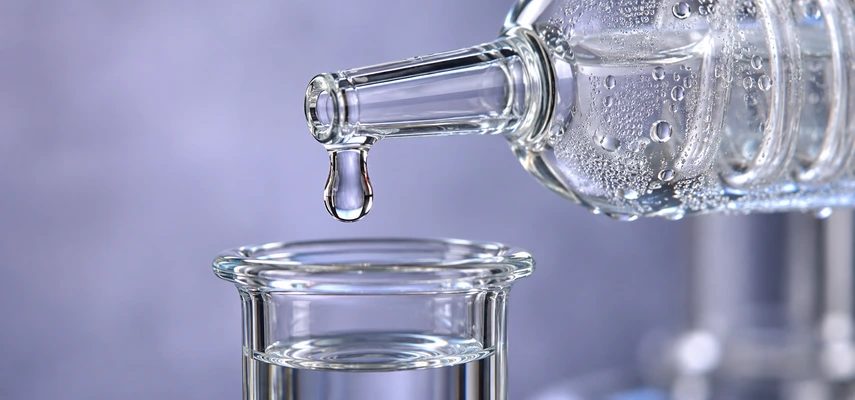

A still is often explained as a queue: heat the mixture, let the lowest-boiling ingredient leave first, then wait for the next one. It is a tidy story. Unfortunately, distillation science is more interesting than that. A fermented liquid contains interacting components, and the vapor leaving it is also a mixture.
That distinction matters whenever you explain spirit strength or aroma. Distillation concentrates ethanol and changes the balance of congeners, but those tasks aren’t identical. This lesson follows the relationships between liquid, vapor, condensation and collection. Pot and column equipment receive their own lessons; here the aim is to understand the separation they help manage.
Distillation science starts with two phases
A liquid contains molecules moving with different energies. Some can leave its surface and enter the gas phase, even below its boiling temperature. Vaporization describes that change of phase. Boiling occurs when vapor formation takes place throughout the liquid as bubbles, under conditions where its vapor pressure matches the surrounding pressure.
Vapor is a gaseous phase, not a cloud of tiny visible liquid droplets. A visible mist contains droplets suspended in gas. This distinction is useful because a still relies on phase change and separation; physically carrying liquid droplets along with vapor is a different phenomenon. Don’t use a picture of dramatic white fog as a chemical definition.
Condensation is the reverse phase change, from vapor to liquid. Cooling a vapor stream can produce collected distillate. The condenser doesn’t create ethanol that wasn’t previously present. It changes the phase of material reaching it. Fermentation supplies alcohol; distillation reorganizes the mixture, and condensation makes the selected vapor available as liquid.
Volatility is a relationship within conditions
Volatility describes a substance’s tendency to enter the vapor phase. The comparison depends on temperature, pressure and the mixture. Ethanol is more volatile than water over the ordinary lower-strength range relevant to initial spirits distillation, so the vapor can contain a higher proportion of ethanol than the liquid from which it forms.
But water also enters the vapor. It doesn’t wait until a separate pure-water boiling point is reached. Likewise, a congener’s behavior in an ethanol-water mixture cannot be predicted reliably from its pure boiling point alone. Interactions and changing composition matter. The useful question is how the compound distributes under the actual conditions in the still.
For study purposes, distinguish “more volatile than” from “the only substance present.” The first describes a tendency toward enrichment; the second claims purity. Confusing them produces incorrect accounts of both strength and cuts. A spirit collected at high alcoholic strength can still contain water and aroma-active compounds, including small quantities with significant sensory effects.
Vapor and liquid can have different compositions
Vapor-liquid equilibrium describes a condition in which the phases exchange molecules without a net change in their equilibrium compositions. It doesn’t mean the phases contain identical proportions. Their different compositions are central to separation. At suitable conditions, condensing an ethanol-enriched vapor gives a liquid stronger than the starting fermentation medium.
Purdue University’s distillation explanation develops this relationship and the role of repeated separation. Its application concerns fuel alcohol, so its production objective shouldn’t be confused with beverage quality. The phase behavior is useful here; the idea that the most concentrated or purified product is necessarily the best-tasting spirit is not.
Imagine a hypothetical fermented liquid and its vapor. If the vapor has a higher ethanol proportion, collecting and condensing it raises alcoholic strength relative to the starting liquid. This illustration needs no invented universal output percentage. Actual compositions depend on the feed, pressure, equipment and operation. A conceptual explanation should make those dependencies clearer, not hide them behind a suspiciously exact number.
Concentration and selection ask different questions
Concentration concerns increasing the proportion of a component, especially ethanol in this context. Selection concerns which components and proportions the distiller retains in the desired product. A producer may seek a stronger spirit while retaining characteristic aromas. Another may pursue a much less distinctive base for a different use. The objectives can demand different separation strategies.
Congeners are compounds accompanying ethanol and water that can affect character. Fermentation supplies many, while later stages can also alter the mixture. Some contribute fruit, cereal or other desirable impressions; some may be unwelcome in particular proportions. Calling every congener an impurity substitutes a production preference for a definition.
Two distillates of equal strength can therefore have different aromas. Their ethanol concentration doesn’t describe every trace compound. Conversely, similar aroma intensity doesn’t prove identical strength or composition. When asked about style, explain what happens to relevant compounds rather than stopping at “more alcohol.” Stronger and more aromatic are separate descriptions, even when production choices influence both.
Fractions describe parts of a changing separation
A fraction is a portion of material separated or collected during a process. In batch spirits distillation, producers distinguish portions of the run, commonly described as heads, heart and tails. These portions differ in composition. They are not pure bottles of one molecule each, and their boundaries are operational choices rather than universal fixed chemical walls.
As a batch proceeds, the liquid remaining in the still changes. The vapor and collected distillate also change. A producer decides what to collect for the intended spirit and how to handle other portions. The next lesson examines that management in detail. For now, remember that collection over time is one way to select from a changing mixture.
Continuous equipment uses other arrangements, including withdrawals from selected locations within a working system. Don’t force every column into a batch timeline or describe every pot still as a miniature continuous column. They share separation principles, but their operating patterns differ. Equipment design translates the science into practical opportunities for concentration and selection.
Reflux returns liquid to the separation
Reflux is liquid that returns within the still after vapor has condensed. It can arise through heat loss on cooler surfaces or through deliberately managed equipment. Rising vapor and returning liquid can come into contact, supporting further separation. Reflux isn’t simply extra product waiting to be bottled; it participates again in the working system.
Consider two otherwise comparable arrangements with different amounts of effective reflux. Greater contact and repeated separation can alter ethanol enrichment and the balance of congeners reaching collection. The result depends on how the equipment operates. “More reflux makes better spirit” skips the intended style, the compounds involved and the actual sensory outcome.
Nor is reflux just a property of a tall neck. Shape, heat transfer, vapor flow and the behavior of returning liquid all matter. The Glasgow Distillery’s production account links its equipment choices with its style objectives. Use a producer example to illustrate a mechanism, while retaining the distinction between one operating system and a universal rule.
Rectification describes repeated separation
Rectification involves repeated vaporization and condensation that improves separation between components. Plates or packing can provide contact opportunities in appropriate equipment. A rectifying system can enrich ethanol and change the composition of accompanying compounds. The important point is repeated phase contact and separation, rather than merely passing liquid through a tall empty tube.
Kothe’s equipment description offers a practical example: its rectifying still uses a column with adjustable liquid levels on plates. That is a manufacturer describing a means of control. It doesn’t establish that every plate arrangement gives the same result, or that operating every available stage always suits the producer’s desired spirit.
Highly rectified spirit has undergone extensive separation. Neutral spirit describes a product with little distinctive source-derived aroma and flavor in its intended context. The terms are related, but one emphasizes processing while the other emphasizes character. A highly separated base may be useful for vodka or botanical flavoring; neutrality isn’t a universal quality target for all spirits.
More stages don’t mean unlimited purity
Ethanol-water behavior includes an azeotrope, a composition at which ordinary equilibrium distillation no longer enriches ethanol in the usual way because vapor and liquid have the same composition. The exact value depends on conditions and how concentration is expressed. Avoid copying a percentage without checking whether it represents mass, volume or mole fraction.
The broader lesson is enough for this introduction: distillation follows physical constraints. Adding stages doesn’t provide an unlimited route to pure ethanol. Beverage distilling also has goals beyond maximum strength. A producer may deliberately retain compounds that another system would remove, because the intended spirit needs their contribution. Effective separation serves the product rather than becoming an end in itself.
Build explanations that survive a second question
Suppose someone says a spirit is lighter because it experienced more rectification. Ask what “lighter” means: less intense source-derived aroma, a different balance of compounds, or simply a sensory impression? Then describe how repeated separation could change the relevant composition. Finally, qualify the result according to the starting material and collection strategy.
Now test the reverse claim: does a fruity aroma prove little rectification? No. The starting fermentation may have differed, the selected compounds may remain perceptible at low concentrations, or later processing may have contributed. Production can explain observations without making every observation a unique fingerprint. That distinction is central to careful blind-tasting reasoning.
What to remember
Follow the mixture through vaporization, phase contact, condensation and collection. Distinguish concentration from selection, reflux from finished distillate, and rectification from a guarantee of quality. Use volatility in context and avoid the pure-boiling-point queue. When the mechanism is clear, equipment diagrams become easier to read and style explanations become much harder to bluff.
Written practice: original TFE exercises
These suggested marks and indicative points are independent teaching guidance, not official WSET marking schemes.
Exercise 1: 5 suggested marks
Explain how reflux can contribute to further separation in a working still. Mapping: LO1 explain: marked reflux and rectification.
Indicative marking points:
- Some vapor condenses within the still.
- Condensate returns as liquid.
- Returning liquid can contact rising vapor.
- Repeated vaporization and condensation contribute to rectification.
- Further separation changes ethanol and congener proportions, depending on operation.
Model answer: Some rising vapor condenses and returns as liquid within the still. The returning liquid can contact rising vapor, allowing repeated vaporization and condensation and further separation. This contributes to rectification, changing the proportions of ethanol and accompanying compounds reaching collection. The result depends on the operating system and collection choices.
Why it works: It traces condensate movement through the repeated-separation mechanism to a composition consequence, rather than assuming a fixed flavor or guaranteed quality.
Common mistake: Saying reflux always removes all congeners mistakes a controllable separation process for complete and universally desirable purification.
Exercise 2: 5 suggested marks
Describe five distinctions between concentration, selection, fractions, highly rectified spirit and neutral spirit. Mapping: LO1 state/describe.
Indicative marking points:
- Concentration increases the proportion of a component such as ethanol.
- Selection concerns retained components and proportions.
- A fraction is a separated or collected portion.
- Highly rectified describes extensive repeated separation.
- Neutral describes little distinctive source-derived character in context.
Model answer: Concentration increases a component proportion, such as ethanol. Selection concerns the components and proportions retained for the product. A fraction is a separated or collected portion. Highly rectified spirit has undergone extensive repeated separation, while neutral spirit has little distinctive source-derived character in its intended context.
Why it works: It assigns each term its own meaning, separating process descriptions from product character and avoiding claims that the terms are interchangeable.
Common mistake: Defining every term as pure alcohol erases both residual mixture composition and the difference between production and sensory character.
Knowledge check: 10 original practice questions
Independent TFE questions, not official WSET examination items. Choose one answer per question; explanations follow separately.
1. Which statement distinguishes concentration and selection?
2. What is reflux?
3. Which description of vapor is correct?
4. What does an azeotrope demonstrate?
5. Why is the pure-boiling-point queue misleading?
6. What is a distillation fraction?
7. Which conclusion follows from a neutral character?
8. Which statement about equal-strength spirits is correct?
9. What is rectification?
10. What does condensation do?
Answers and explanations
- C — Ethanol enrichment and retained compound balance are different objectives.. A stronger distillate can retain different congener proportions, so strength alone does not describe the selection achieved. Mapping: LO1.
- D — Condensed liquid returning within the still. Returning condensate participates in the separation environment rather than being identical to finished collected product. Mapping: LO1.
- B — A gaseous phase of material. Vapor is gaseous material; visible mist contains liquid droplets and should not be used as a definition of vapor. Mapping: LO1.
- A — A limit to ordinary equilibrium enrichment at specified conditions. At the azeotropic composition, vapor and liquid share the same composition, constraining ordinary distillation enrichment. Mapping: LO1.
- A — Mixture behavior and changing composition affect what enters vapor.. Ethanol, water and congeners can enter the vapor together in changing proportions rather than leaving as isolated pure substances. Mapping: LO1.
- C — A separated or collected portion of material. Fractions differ in composition but need not consist of a single isolated compound. Mapping: LO1.
- A — It describes a sensory target rather than universal superiority.. Different spirits need different retained character, so neutrality should be assessed in relation to the intended product. Mapping: LO1.
- B — They can contain different congener balances.. Alcoholic strength describes ethanol concentration, not the identity and proportions of every aroma-active component. Mapping: LO1.
- C — Repeated separation through vaporization and condensation. Repeated phase change and contact help separate components; equipment and operating conditions determine the practical result. Mapping: LO1.
- B — Changes vapor into liquid. A condenser recovers liquid from a vapor stream; the alcohol originated in earlier production stages. Mapping: LO1.
Continue exploring this series
3. Alcoholic Fermentation Explained: Yeast, Nutrients, and Flavor Compounds
6. Pot Still Distillation Explained: Design, Heating, Cuts, and Flavor
7. Column and Hybrid Stills Explained: Plates, Reflux, and Continuous Distillation
8. How Distillers Manage Flavor: Sulfur, Esterification, Pressure, and Distillation Choices
26. Vodka Explained: Neutral Spirits, Raw Materials, and Production Choices
30. How to Explain Spirits Production: Advanced Cause-and-Effect Case Studies
4. Fermentation Methods Explained: Liquid, Solid-State, Sequential, and Parallel Fermentation
50. WSET Level 3 Spirits Exam: Complete Revision Guide and Practice Examinations












