










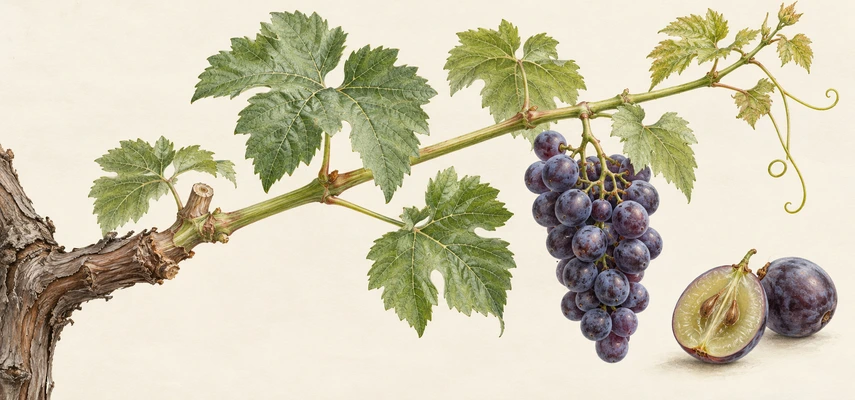

A grapevine can lose most of its visible growth in winter pruning and return with a crop the following summer. What survives, and where does the new fruit come from? Grapevine anatomy answers those questions by separating the lasting framework from the organs renewed each year.
For Diploma study, the useful question is what each part does. Roots influence access to water and nutrients. Leaves supply carbohydrates. Shoots position leaves and bunches. The berry packages water, sugars, acids, phenolics and aroma potential into tissues that respond differently in the winery. Knowing the parts turns a vineyard decision into an explanation of wine style, quality and cost.
The official D1 specification names main shoots, one-year-old wood, permanent wood and roots. It also requires understanding grape components and their development. Here the emphasis is the physical system; the seasonal sequence and management techniques receive their own lessons.
Grapevine anatomy: a framework with renewable parts
A vine is a woody perennial. Its trunk and retained older branches persist, while new shoots grow from buds. The familiar vineyard shape is created by training and pruning; it is not the only shape the plant can take. Distinguishing age from function avoids a common confusion: a branch may support fruiting shoots without directly being the green structure carrying this year’s bunches.
Permanent wood includes the trunk and older retained arms or cordons. The trunk connects the root system with the above-ground framework. A cordon is an older extension, often trained horizontally. These structures provide support and contain conducting and storage tissues. “Permanent” describes their intended role; injury, disease or a change of system can require replacement.
One-year-old wood developed as a shoot during the previous growing season. After maturation and leaf fall, it is called a cane. Retained buds on that wood can give rise to the new season’s fruit-bearing shoots. A spur is a short retained portion of cane. It is not a different botanical organ manufactured by a spur-pruned vine.
Main shoots are current-season growth. Their nodes carry leaves, buds and, at appropriate positions, clusters or tendrils; the internodes are the stem sections between nodes. Laterals can grow from the leaf axils. North Carolina State Extension’s anatomy account provides the structural basis for these distinctions.
This vocabulary matters when reading a question about pruning. Keeping a cane changes which buds remain available. Removing a green shoot changes the current canopy. Cutting an old cordon changes the framework. Those operations cannot be substituted for one another simply because each removes part of the vine.
Buds connect this crop with the next
A dormant compound bud contains primary, secondary and tertiary growing points. The primary commonly produces the more fruitful shoot. Secondary growth may provide some recovery after damage, but a replacement shoot does not guarantee replacement of the lost crop.
The structure also gives the vine a two-season memory. Developing buds can contain the beginnings of next year’s flower clusters. Conditions during bud development can therefore affect future fruitfulness, while the following season affects the flowers, fruit set and crop that actually develop. This is a biological connection between vintages, not evidence that one event determines yield on its own.
The British Columbia Wine Grape Council’s development guide explains those bud and shoot relationships. In an evaluative answer, distinguish retained bud numbers from fruitful shoots and final harvested yield. Damage, bud fruitfulness, fruit set, berry growth and later losses intervene between the three.
Roots: access, anchorage and reserves
The root system has an older structural framework and finer absorbing roots. Its distribution responds to soil conditions and resource availability. A tidy diagram with roots evenly spaced beneath the canopy is a useful drawing convention, not a reliable description of a real vineyard.
Roots anchor the plant and take up water and mineral nutrients. They also store reserves that help support renewed growth. Cornell’s account of grapevine roots describes these storage, uptake and regulatory roles, as well as the flexibility of root growth.
Consequently, “deep roots” is not a complete quality explanation. Ask whether the explored soil contains accessible water, whether roots can function there and what the vine needs at that time. A shallow, active root system in a suitable setting cannot be dismissed by depth alone. Nor does an impressive old trunk reveal the current distribution of absorbing roots.
On a grafted vine, the rootstock supplies the root system and lower portion; the scion supplies the selected fruiting variety above the union. Their combination matters, but grafting does not turn the scion’s berries into the rootstock variety. Detailed rootstock selection belongs to vineyard establishment, where soil conditions and pest risks can be evaluated together.
Leaves and transport: supplying a growing crop
Leaves use light energy to make carbohydrates from carbon dioxide and water. These carbohydrates support growth and contribute to reserves and berry sugar accumulation. Leaves therefore have a productive role beyond shading the fruit. Removing them changes both the canopy environment and the vine’s capacity to supply its developing organs.
Stomata permit gas exchange but also allow water loss. Xylem carries water and dissolved minerals through the plant; phloem transports assimilates toward tissues that need them. Growing shoots, developing berries and storage organs can act as sinks. The Council’s basic physiology guide connects these processes with vine growth.
For a hypothetical comparison, consider two vines with similar crops but different amounts of healthy, well-exposed leaf area. Their ability to support ripening may differ even if the bunch counts match. However, counting leaves alone does not measure functional photosynthesis: leaf condition, light, water and temperature also matter. “More foliage” is not a sufficient management objective.
This is why yield per vine needs context. A particular crop weight represents a different demand on a large, healthy vine than on a weak or damaged one. Vineyard density also changes how per-vine yield relates to yield per hectare. The meaningful question is whether the vine can mature the intended crop to the required composition.
A grape berry contains several different working zones
The berry’s skin, pulp and seeds differ in structure and composition. They are not interchangeable containers of grape juice. Breaking the berry releases some materials readily, while extracting others depends on the process and its conditions.
The pulp provides much of the juice, containing water, dissolved sugars and acids. Skin tissues contain important phenolics and aroma-related compounds. Seeds provide another source of phenolics, including tannins. The exact distribution varies with variety and development; the practical distinction is that tissue contact and extraction influence what reaches the wine.
The Australian Wine Research Institute’s juice-extraction study shows why the internal arrangement matters even in analysis. Different extraction approaches can affect measured juice parameters. A sample is therefore partly a product of how it was prepared, not just a transparent window into the entire berry.
On a narrow screen, scroll the table sideways to read all columns.
| Component | Why it matters to the wine | Qualification to remember |
|---|---|---|
| Water | Influences berry volume and the concentration of dissolved materials | Concentration can change through water balance as well as substance accumulation |
| Sugar | Supplies fermentation substrate or remaining sweetness | High grape sugar does not guarantee a sweet finished wine |
| Acids | Contribute freshness, balance and chemical conditions | Acid amount, acid composition and pH are related but different measurements |
| Colour compounds | Provide potential pigment, especially from black-grape skins | Grape colour alone does not dictate the extraction or final wine colour |
| Tannin | Contributes structure and astringency after extraction | Quantity alone does not establish desirable texture |
| Aroma compounds and precursors | Provide direct aroma and material that can form aroma later | Grape smell is not the complete future wine aroma |
Grape development changes the contents as well as the size
Early berries are growing organs rather than miniature ripe grapes. Cell division and expansion contribute to their development. During ripening, sugar accumulation, acid changes, softening and changes in colour and aroma potential do not all proceed at one identical rate.
Glucose and fructose are the principal grape sugars relevant to alcoholic fermentation. Tartaric and malic acids are important grape acids; malic acid can be metabolised during ripening. In black varieties, anthocyanins contribute skin colour. Tannins and other phenolics develop in different tissues and affect the extraction decisions available later.
These compositional distinctions are discussed in the grape-development material linked above and in Texas A&M’s account of berry ripening. The important study distinction is accumulation versus concentration. A berry losing water can show a higher sugar concentration without a corresponding increase in sugar arriving from leaves.
Aroma precursors add another layer. Some grape-derived material does not initially smell like the aroma compounds it can later produce. Fermentation and subsequent transformations can release or generate aroma-active compounds. The AWRI’s research on flavour precursors also explains why interactions among components matter to perception.
Avoid judging aroma and flavour ripeness from a single sugar reading. The growing environment, variety and season influence the balance of components, while the intended wine determines which balance is useful. Grapes for a fresh dry wine and grapes selected for a concentrated sweet style need not meet the same target. Specific sweet-wine harvesting methods follow later in the series.
From vine health to style, quality and cost
An anatomical explanation should travel far enough to answer the question. If damaged roots restrict the functioning canopy, simply writing “roots absorb water” stops too soon. Explain the possible constraint on leaf activity and crop development, then identify what information is needed to evaluate its severity. Root, shoot and fruit health are connected, but their effects depend on timing and extent.
Likewise, skin composition creates potential rather than a finished wine. A producer can extract different proportions of skin and seed material. Fruit health, maturity and the desired style determine whether greater extraction is helpful. A high concentration of extractable tannin is not a compulsory instruction to extract all of it.
The commercial consequences are also conditional. A crop that fails to reach the required composition may need different handling or enter a different product. Vine replacement and extra management add costs; lost saleable yield can increase cost per unit. Whether the wine commands a higher price still depends on buyers and market conditions.
Follow the anatomy through the grapevine growth cycle before linking it to management. vineyard establishment determines the plant material, while vine training and pruning and canopy management change retained wood and leaf area. Connect irrigation and vine nutrition with the roots’ supply function and harvest decisions with the fruit produced. Use Diploma units and assessment to place these explanations in the taught-unit assessment framework.
Original Diploma practice and outline answers
These questions and indicative points are original TFE exercises, not official WSET questions or marking schemes. Explain the connections rather than reproducing the component table from memory.
Question 1: distinguish the parts before evaluating removal
A grower removes green shoots in spring and retains selected canes in winter. Explain how the plant material and immediate consequences differ.
Indicative points: Identify current-season shoots; identify one-year-old canes; connect green-shoot removal to leaves and possible clusters; connect winter retention to buds and future shoots; distinguish both from permanent framework.
Outline answer: Green shoots are the current canopy’s developing structures and may carry leaves and clusters. Removing them changes the present season’s leaf area and crop distribution. Retained canes are matured growth from the preceding season; their buds can provide the following crop’s shoots. Both decisions affect production, but through different structures and at different times. Neither is the same as removing an old trunk or cordon.
Question 2: test a yield claim
Two hypothetical vines carry equal fruit weights. One has a healthy functioning canopy and roots; the other has substantial damage. Evaluate the claim that their quality potential is therefore equal.
Indicative points: Equal crop is equal demand only in a limited sense; supply capacity differs; roots and leaves support production; timing and severity matter; no automatic quality ranking without evidence of fruit composition.
Outline answer: Fruit weight alone does not describe each vine’s capacity to mature it. Damage may limit resource uptake or functional leaf area, constraining development relative to the crop. However, the effect depends on when damage occurred, how extensive it is and other conditions. Measure relevant fruit maturity and health before concluding how the grapes or resulting wine will differ.
Question 3: separate grape composition from finished style
A student argues that dark, sugar-rich berries must produce a deeply coloured sweet wine. Explain two missing steps in that argument and one further compositional consideration.
Indicative points: Pigment must be extracted; sugar can be fermented to alcohol; sweetness depends on remaining fermentable sugar and production choices; acids, tannins and aroma potential also affect balance and style.
Outline answer: Dark skins provide pigment potential, but the degree of skin contact and extraction influences how much colour reaches the wine. Sugar provides fermentation substrate, so substantial grape sugar can yield a dry wine if fermentation consumes it. Acidity, tannins and aroma-related compounds also matter; neither berry colour nor sugar alone describes the possible finished style.
A useful anatomical test
Sketch the vine and one berry without copying a labelled diagram. For each part, add a function, then a possible consequence if that function changes. That last arrow turns identification into Diploma reasoning. It also provides the foundation for the seasonal growth cycle, when the same organs change their priorities as the crop develops.












