










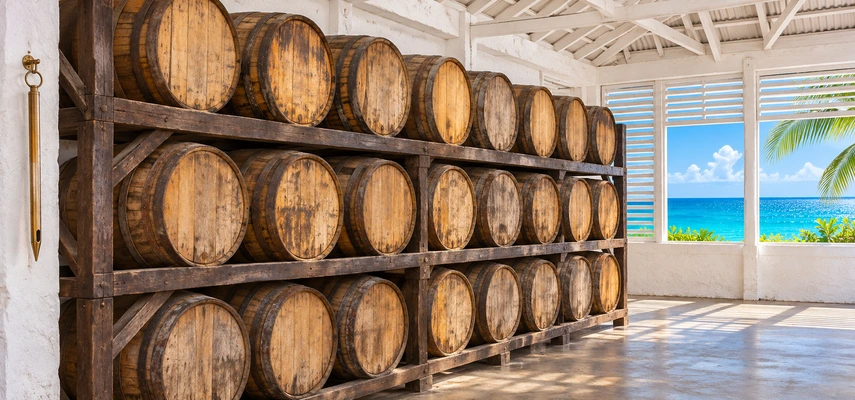

Caribbean rum can be grassy, floral, delicately fruity, densely aromatic, oak-driven or some interesting combination of those things. That range is not an accident. Producers work with different cane materials, fermentations, still systems and maturation strategies. Even within one island, two distilleries can make very different decisions.
The useful starting point is therefore the production route, not a white-gold-dark shelf classification. Color can reflect several operations and does not reveal whether the spirit came from a pot, a column or both. This lesson connects the main equipment choices with Jamaica, Cuba, Martinique and Guadeloupe, then follows their spirits through wood and blending.
Caribbean rum is a family of traditions
The Caribbean includes many production areas with distinct histories and legal frameworks. Colonial-language groupings can help organize an introduction, but they do not supply a universal recipe. A so-called English tradition does not require every Jamaican rum to be intensely funky, and a French-speaking origin does not automatically prove fresh cane juice was used.
Instead, establish the raw material, fermentation, separation and post-distillation history. The previous lesson compared juice, syrup and molasses and explained how microbial conditions affect the feed. Those choices remain active here. A still receives a particular fermentation product, not an abstract material called island character.
Legal identity also needs its own check. A general rum category, a geographical indication and a producer’s individual recipe are different levels of information. Martinique’s AOC framework is especially important in studying rhum agricole. Guadeloupe has its own geographical framework; it is not simply an extension of the Martinique AOC.
A double retort system adds staged contact
A familiar Caribbean arrangement places two retorts between a pot and the final condenser. The retorts contain suitable alcoholic charges. Vapor from the heated pot enters the first charge, transferring heat and interacting with its liquid; enriched vapor then passes through the next stage before final condensation. The arrangement supports further concentration within the run.
The technical interview with distiller Mike Delevante describes the roles of low-wines and high-wines retorts. Their starting charges and the system’s operation affect the vapor ultimately recovered. They are working parts of the separation process, not passive containers simply catching two batches of finished rum.
The connected system can achieve a different concentration and congener balance from one simple pot run. It should not be described as literally identical to independently charging and emptying the same pot three times. Heat transfer, liquid composition and contact occur in the connected apparatus, providing a particular set of controls for the distiller.
Pot character still depends on the feed and operation
A double-retort pot system can produce an expressive spirit, but the apparatus does not manufacture a fixed tropical-fruit profile irrespective of the fermentation. Feed composition, retort charges, heating and fraction management influence the result. The useful explanation follows what is retained, changed or excluded, rather than assigning one compulsory flavor to copper.
For example, an acid-rich, expressive fermentation offers different aroma possibilities from a relatively restrained wash. Managing those materials through the same broad equipment type can still produce different spirits. A pot label therefore gives useful context without telling you the whole production story or the quality of the outcome.
Also separate intensity from balance. A pronounced spirit can be valuable for a particular release or blend, while another target needs more restraint. The distiller’s job is not always to maximize every congener. It is to create material appropriate to its next use, whether that is immediate preparation, maturation or component selection.
Columns can preserve character or seek greater rectification
Columns provide repeated contact between rising vapor and descending liquid. Their arrangement, working stages, reflux and withdrawals influence composition. A relatively characterful cane-spirit column and a more extensive rectifying system do not produce identical liquids simply because both operate continuously. The design and working target matter.
In Martinique’s agricole tradition, Creole-type columns separate fermented cane juice while retaining a distinctive aromatic contribution. Rhum J.M describes its own columns and fresh-juice fermentation as a connected system. Its particular working strength is a producer example, while the regional framework establishes the permitted production conditions.
Other column arrangements can make more highly rectified, relatively light distillates. Those can have a useful role in a blend, supplying a different contribution from an assertive component. Light does not necessarily mean defective, just as powerful does not necessarily mean complex. Evaluate what the producer needs from the component and how the finished spirit performs.
Jamaica offers more than one ester level
Jamaica is strongly associated with characterful molasses-based rum, extended fermentations in some traditions and double-retort pot systems. These are central study connections. They should not become a claim that every Jamaican producer uses identical organisms, the same fermentation duration or one fixed proportion of pot distillate.
Hampden identifies extended fermentation and pot distillation as foundations of its own approach. That is a concrete route toward pronounced ester-associated character. The lesson is the link between fermentation material and subsequent separation, rather than the assumption that an island name creates a fruity aroma without any production mechanism.
Appleton describes a different selection system, combining pot and column distillates. Its example shows why pot versus column need not be an either-or decision at the bottle level. Components can contribute different sensory roles, and the blender can use them together to achieve a coherent target.
Cuba highlights bases, maturation and repeated selection
Cuban traditions are often discussed through relatively light styles and the skilled preparation of different bases. Fermentation and separation can supply components with different intensities, while maturation, filtration and blending develop the final relationship. A light presentation is therefore an achieved style, not evidence that the producer skipped flavor development.
Havana Club’s production account describes selecting bases and combining periods of maturation with further blending. A component can be selected for its contribution to the current release or returned to wood for future development. The stock system extends beyond emptying one barrel and adding a label.
Do not turn that example into an unverified formula for every Cuban rum. The useful principle is staged management: different bases, vessel histories and selection decisions can build a consistent result. A blender’s control over the relationship among components can matter as much as the original degree of separation in the still.
Martinique and Guadeloupe connect juice with aromatic style
Fresh cane juice supplies a different fermentation medium from molasses. Its handling, fermentation and column separation can preserve herbal, vegetal, floral or fruit-related character in the resulting spirit. Those are useful associations for many agricoles, but not an instruction that every example must taste like freshly cut grass.
Martinique’s AOC applies a particular origin and production framework. Guadeloupe also produces important fresh-juice rums, with Damoiseau describing its own route from cane preparation through fermentation and separation. The island also belongs to a broader production context that should not be reduced to one universal raw material or equipment arrangement.
Compare white and matured presentations separately. A rested unaged agricole can emphasize a fresh aromatic balance, while oak maturation introduces additional wood-derived and developed character. Absence of amber color is not evidence that the spirit was never rested, selected or adjusted to its final strength. White is a presentation category, not a complete history.
Tropical maturation changes the pace and the balance
Warm conditions can increase evaporation and accelerate some interactions between spirit and wood. Barrel size, activity, previous use, warehouse environment and time still affect the result. A tropical location does not impose one universal annual loss or make every year equivalent to a fixed number of years elsewhere.
More rapid extraction can be useful or excessive. Vanilla, spice and oak structure may complement fruit, or wood can dominate the spirit and dry the finish. Evaporation also changes the remaining material. The cellar manager must follow the actual cask rather than assume that a warm warehouse automatically produces maturity on schedule.
That is why climate belongs in a mechanism-based answer. Name the environmental difference, connect it with evaporation or interaction, then explain the possible consequence for style. Do not stop at tropical aging makes it better. Quality depends on the resulting relationship among spirit character, wood, alcohol and development.
Final preparation can change more than strength
Blending can combine complementary components or compensate for variation. Water adjustment changes the final alcohol-water environment, influencing aroma release and texture. Filtration can remove selected material; some treatments can reduce color as well as other components. A pale rum may therefore have a more complicated history than its appearance suggests.
Coloring and sweetening must be discussed under the applicable category and origin rules. A dark appearance alone cannot establish a long age, and a sweet-associated aroma does not prove measured sugar. If a question supplies an actual permitted addition, explain its contribution specifically. Avoid turning a possible operation into an accusation about every producer.
What to remember
Trace the fermented feed through a working still system, then follow storage, maturation, blending and final preparation. Know the double-retort mechanism and the regional examples without replacing them with island stereotypes. For quality, assess balance, persistence, complexity and integration in the actual rum. The color tells you where to start looking, not where to stop thinking.
Written practice: original TFE exercises
These suggested marks and indicative points are independent teaching guidance, not official WSET marking schemes.
Exercise 1: 5 suggested marks
Explain how charged retorts can support further concentration between a pot and the final condenser. Mapping: LO2 explain: pot stills with double retorts.
Indicative marking points:
- The pot produces hot vapor.
- That vapor enters an alcoholic retort charge.
- Heat and contact support further vaporisation from the charge.
- A subsequent retort provides another stage with its own charge.
- The resulting enriched vapor is finally condensed into distillate.
Model answer: Hot vapor from the pot enters an alcoholic retort charge and transfers heat while contacting the liquid. Further vaporisation supplies enriched vapor to the next retort stage, whose own charge influences the process. The vapor leaving the connected stages is finally condensed as distillate.
Why it works: It identifies the energy source, liquid contact, serial stages and final recovery.
Common mistake: Calling the retorts empty collection jars omits the active charges and heat transfer.
Exercise 2: 5 suggested marks
Explain why warm maturation conditions do not guarantee better-balanced rum. Mapping: LO2 explain: storage and maturation.
Indicative marking points:
- Warmth can accelerate some spirit-wood interactions.
- Wood extraction can become pronounced.
- Wood may dominate fruit or produce excessive drying structure.
- Evaporation can also change the remaining spirit.
- Cask assessment and management are needed to achieve the intended balance.
Model answer: Warmth can accelerate some interactions and make wood contribution pronounced, potentially dominating fruit or creating excessive drying structure. Evaporation also changes the remaining spirit. Regular assessment and cask management are therefore needed; warmth creates a different development environment rather than a guarantee of balance.
Why it works: The response connects climate to specific mechanisms and possible imbalance before identifying the control requirement.
Common mistake: Using a universal tropical-to-cool-climate age multiplier substitutes a slogan for the actual cask history.
Knowledge check: 10 original practice questions
Independent TFE questions, not official WSET examination items. Choose one answer per question; explanations follow separately.
1. What does Appleton’s described use of pot and column components demonstrate?
2. Which is a useful connection for many Martinique agricoles?
3. Which basis best supports quality assessment?
4. Which statement about columns is accurate?
5. What might filtration explain about a pale rum?
6. What can tropical warmth influence during maturation?
7. Why might a Cuban-style blend use differently prepared bases?
8. Why is a double-retort run not simply three identical separate pot runs?
9. How should the Martinique AOC be applied to Guadeloupe?
10. What is the main function of charged retorts between pot and condenser?
Answers and explanations
- A — Both can contribute to one blended style. Component selection can combine different sensory contributions in a final release. Mapping: LO2.
- C — Fresh juice fermentation and characterful column separation. The raw material and column process form a linked production route under the applicable framework. Mapping: LO2.
- A — Balance, persistence, complexity and integration. Style and analytical measurements provide context rather than an automatic score. Mapping: LO2.
- C — Different designs and settings can retain different character. Separation target and operation matter beyond the equipment label. Mapping: LO2.
- A — It may have had a more complex maturation or preparation history. Appearance alone does not reveal every processing stage. Mapping: LO2.
- A — Evaporation and spirit-wood interaction. Climate affects mechanisms but does not provide a guaranteed conversion between years in different locations. Mapping: LO2.
- A — They can supply complementary contributions. Selection and staged preparation help create a target relationship among components. Mapping: LO2.
- A — The connected stages exchange heat and material during one system run. The process arrangement differs from repeated independent charging and emptying. Mapping: LO2.
- C — It should not be assumed to be the same framework. Each origin framework needs its own identity and conditions checked. Mapping: LO2.
- A — Additional heat-driven contact and concentration. Vapor interacts with alcoholic charges before final condensation, influencing concentration and retained composition. Mapping: LO2.
Continue exploring this series
3. Alcoholic Fermentation Explained: Yeast, Nutrients, and Flavor Compounds
6. Pot Still Distillation Explained: Design, Heating, Cuts, and Flavor
7. Column and Hybrid Stills Explained: Plates, Reflux, and Continuous Distillation
9. Oak Maturation Explained: Barrels, Oxygen, Evaporation, and Flavor Development
10. Spirits Finishing Explained: Blending, Filtration, Sweetening, Coloring, and Packaging
21. Sugar Cane Spirits Explained: Juice, Syrup, Molasses, and Fermentation
29. Spirits Quality Explained: How Production Decisions Affect Balance and Complexity
30. How to Explain Spirits Production: Advanced Cause-and-Effect Case Studies
32. Shōchū Explained: Honkaku Shōchū, Awamori, and Japanese Distillation
33. Baijiu Explained: Qu, Solid-State Fermentation, and China’s Major Styles
35. Other American Whiskeys Explained: Wheat, Malt, Corn, and Labeling Terms
23. Agave Spirits Explained: Growing, Cooking, Crushing, and Fructan Conversion
50. WSET Level 3 Spirits Exam: Complete Revision Guide and Practice Examinations












