










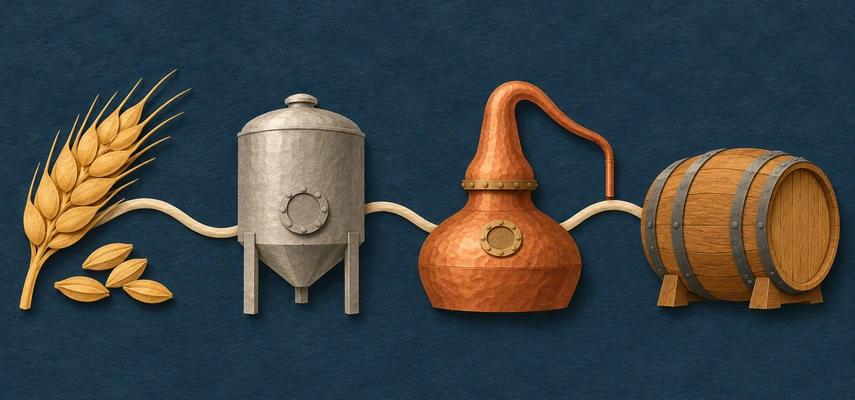

A strong explanation of spirits production needs a moving part. Something changes, a mechanism follows, and the composition or style changes as a consequence. Simply naming six production stages does not establish that relationship. Neither does saying that a choice creates more flavor without identifying what changes or why the resulting profile might suit the spirit.
The following cases are original teaching scenarios, not reports of trials at named distilleries. Each holds some conditions steady so that a particular relationship becomes easier to see. Real production involves interacting variables, but a controlled comparison is an effective way to practice reasoning before dealing with the whole system at once.
Build an answer around a changed decision
Use a simple sequence: decision, mechanism, consequence and relevant qualification. The qualification should identify a meaningful condition, not merely add perhaps to every sentence. If a cask comparison assumes similar spirit and storage conditions, say so. If the result depends on selecting different fractions, name the selection rather than attributing everything to the still shape.
Also separate explanation from evaluation. A change can produce a different composition without improving quality. More wood extraction might suit a robust spirit or overwhelm a delicate one. Establish the directional effect first, then relate it to the intended result. This keeps an answer useful without asking one production fact to prove more than it can.
Case one: heat reaches starch, but conversion is incomplete
A producer prepares a starch-rich material with sufficient heat to make its starch accessible, then obtains less fermentable sugar than expected. The first temptation is to say that it needs more yeast. That skips the problem. Yeast selected for ordinary alcoholic fermentation needs suitable fermentable sugars, rather than an unresolved mass of starch.
Physical access and enzymatic conversion are separate requirements. Gelatinisation can help expose starch to enzyme action, while suitable enzymes break starch chains down into smaller carbohydrates. If enzyme activity or the conversion conditions are unsuitable, access alone does not produce the required fermentable medium. Adding yeast cannot substitute for an incomplete preceding conversion.
An explanation should therefore investigate starch preparation and enzyme action before jumping to fermentation. Crisp’s account of making malt gives useful production context for controlled germination and drying. The teaching point is not that one malt schedule fits every grain, but that material preparation and enzyme availability have distinct jobs.
Case two: change the yeast, keep the ethanol target
Two fermentations use the same prepared liquid and are intended to reach a similar ethanol target. The maker changes the yeast selection. A weak explanation says the alcohol will taste identical because both batches contain ethanol. That ignores the other compounds produced during fermentation and the different behavior of the organisms under the chosen conditions.
Yeast selection can influence the range and relative amounts of fermentation-derived compounds. The resulting fermented liquids can therefore differ even if their measured alcoholic strengths are similar. Distillation then selects from those different starting mixtures. The difference need not disappear merely because the later equipment is unchanged.
Lallemand’s fermentation discussion supports treating yeast and conditions as flavor-management choices. Avoid inventing exact sensory results for an unspecified strain. The defensible conclusion is that the changed organism can change the starting composition and therefore the potential contribution to the resulting spirit.
Case three: increase reflux in a separation system
A producer increases reflux while aiming for greater rectification. Returned condensate contacts rising vapor, providing further vapor-liquid exchange. Repeated exchange improves separation between components, subject to the system’s design and operation. The collected composition can therefore move toward the intended more highly rectified profile.
The missing middle is often the contact between liquid and vapor. An answer that says more reflux means more purity gives a direction but leaves the mechanism vague. Explain the return of condensed liquid, the further exchange and the resulting separation. Then use a suitable style consequence, such as a reduced contribution from some fermentation-derived compounds.
Do not attach a universal quality verdict. A restrained vodka base and a characterful spirit have different targets. Greater rectification can suit one while reducing character valued in another. The change should be assessed against the intended composition, rather than treated as a ladder on which every producer ought to climb higher.
Case four: change pot-still cuts
In a batch pot distillation, the composition of the output changes over time. A maker normally retains a selected central portion, then decides to include more material from an adjacent fraction. The immediate consequence is a change in the retained mixture. Whether the new balance is desirable depends on the actual additional components and the spirit’s target.
This is more precise than saying a wider cut always gives a richer spirit. A wider selection can retain contributions previously excluded, but they may be attractive, distracting or overwhelming in different circumstances. Explain what the collection decision changes, then qualify the assessment using the observed composition rather than an unverified aroma prediction.
The Abertay research on wash, low wines and new make supports attention to distinct stages and their mixtures. Its laboratory findings should not be converted into universal commercial cut timings. The general lesson is that upstream composition and subsequent selection both matter.
Case five: change cask activity without changing age
Two similar spirits mature for the same period under comparable conditions. One enters a new cask, the other a previously used cask. Earlier fillings have removed some extractable wood components from the used vessel, and previous contents may supply an additional influence. The new fillings therefore need not receive the same contribution from their vessels.
The relevant comparison is cask history and activity, not a blanket rule that new is good or used is gentle. A used cask can retain considerable activity, and new wood can dominate a spirit if the relationship is unsuitable. Monitor the actual development and explain why the resulting balance differs even when the age is the same.
Annandale’s technical discussion of maturation gives production context for these vessel factors. Keep cask size, previous use and storage conditions distinct in an answer. If several change together, it becomes harder to attribute the observed difference to only one of them without further evidence.
Case six: redistill an aromatic macerate
A botanical macerate has visible color, aroma and bitterness. The producer redistills it and obtains a clearer liquid with a different sensory balance. Maceration extracted constituents with different properties; redistillation selects components transferring with vapor and condensate. It does not carry the entire dissolved composition forward unchanged.
Many pigments and some bitter contributions do not transfer in the same proportions as volatile aromatic compounds. This can explain a less colored distillate that remains aromatic. Do not claim all color is removed under every possible condition, or that every bitter sensation has one nonvolatile source. Identify the selection principle and its plausible consequence.
Heidolph describes separately prepared botanical components being distilled and blended in a producer application. That offers context for controlling contributions independently. In an answer, distinguish the extraction stage from the separation stage, then explain how blending can further adjust their relationship in the final recipe.
Check whether the question permits that kind of explanation
The specification includes detailed production knowledge that is not all eligible for explain-type written questions. Advanced distillation topics such as pressure, esterification and sulfur management require their prescribed descriptive understanding; their presence in a lesson does not erase the official exclusions. Agave distillation also needs its scope handled carefully.
Use the current specification’s topic-level symbols rather than assuming every production paragraph can become a written explanation question. The exercises below use marked eligible topics. Knowledge checks can still ask descriptive questions about other prescribed material. Good exam preparation practices the actual task rather than expanding the examination scope by accident.
Apply the chain to all eleven principal spirits
These short scenarios extend the six mechanisms above across the selected spirits. They are original teaching applications, not reports of controlled producer trials. Use the linked category lessons for the governing rules and fuller production accounts.
Scotch whisky: Compare similar new make entering a more active and a repeatedly used cask. Earlier fillings have removed some extractable components, so the two vessels need not contribute equal wood influence over equal time. Assess the resulting balance rather than predicting that the darker sample must be better.
Bourbon: Hold the corn threshold and other legal conditions constant while changing supporting grains. The prepared mash and fermentation feed change, potentially changing compounds available for distillation. Bourbon identity can remain constant while style changes; a minimum corn percentage is not a complete recipe or tasting prediction.
Rye whiskey: Compare two otherwise similar distillations with different collection boundaries. The output changes over a batch, so changing what is retained changes the mixture entering the cask. Explain that selection before predicting a sensory result. A wider retained range does not automatically improve rye character or balance.
Tennessee whiskey: Compare a particular producer’s spirit before and after its charcoal treatment. Adsorption can change selected components, whereas simple mechanical screening removes suspended particles. Keep the treatment’s actual conditions and the applicable Tennessee requirements attached to the example; this is not evidence that every charcoal contact produces an identical effect.
Cognac: Hold wine and equipment steady while changing the retained portion of the second pot distillation. Changing inclusions and exclusions changes the collected spirit’s composition before oak adds anything. The explanation concerns selection from the evolving output, not a claim that double distillation guarantees one fixed fruit aroma.
Armagnac: Compare suitable distillates placed in vessels with different previous use. The cask histories change the extraction and development relationship, potentially preserving more fruit in one expression or adding stronger wood influence in another. Continuous distillation does not prevent those later differences; equipment identity is only one part of the chain.
Rum: Compare a producer’s two fermentations with different yeast selections but similar ethanol targets. Yeasts can produce different accompanying compounds, giving distillation different starting mixtures. Follow those compounds through the chosen separation and maturation rather than assuming equal alcohol concentration establishes identical rum. The direction depends on the actual strains and conditions.
Tequila: Compare adequate cooking and hydrolysis with a treatment that leaves less suitable sugar available. Opening the agave structure and breaking carbohydrate bonds are different jobs. Less effective conversion can limit fermentable substrate even after material is extracted. This is a conversion explanation, not an excluded explain-type exercise about agave distillation.
Mezcal: Compare physical crushing arrangements after the same cooking treatment. They can differ in how effectively they expose and recover material for the fermentation medium. Describe the resulting input and relevant conditions; the crushing method alone does not establish smoke intensity, equipment category compliance or finished quality.
Vodka: Compare increased rectification with a less extensive separation, keeping the fermented feed comparable. Additional effective vapor-liquid exchange can reduce the contribution of some congeners in the recovered spirit. That may suit a restrained target, while final water and treatment still affect presentation. A larger advertised distillation count is not the mechanism.
Gin: Compare a colored botanical macerate used directly with a selected redistillate from that material. Distillation changes the proportions transferred, so aroma can remain while pigment or bitterness contributes differently. Botanical identity alone cannot establish the final balance. Collection, blending and reduction determine how the recovered contribution fits the recipe.
For each scenario, write the changed decision, the mechanism and a qualified consequence in separate clauses. If the question instead asks you to describe, give the relevant features or sequence without adding an unsolicited causal essay. Keep the syllabus’s topic-level eligibility restrictions in view.
What to remember
Start with a specific change and supply the missing mechanism before giving a style consequence. State the conditions that matter, distinguish increased intensity from improved quality, and avoid predicting exact aromas from insufficient evidence. A clear explanation is a chain the reader can follow, with each link doing a necessary job.
Written practice: original TFE exercises
These suggested marks and indicative points are independent teaching guidance, not official WSET marking schemes.
Exercise 1: 5 suggested marks
Explain why adequate starch access may still fail to yield sufficient fermentable sugar. Mapping: LO2 explain: starch conversion.
Indicative marking points:
- Starch access and conversion are separate requirements.
- Suitable enzymes must act on the accessible starch.
- Enzyme activity depends on appropriate processing conditions.
- Insufficient active conversion leaves less suitable sugar available.
- Yeast therefore has less fermentable substrate despite adequate physical access.
Model answer: Accessible starch still requires suitable enzyme action. If processing conditions leave insufficient active conversion, less suitable sugar becomes available. Yeast consequently receives less fermentable substrate even though the material was physically prepared adequately.
Why it works: It distinguishes two mechanisms and follows incomplete conversion into the fermentation input.
Common mistake: Adding more yeast is not a substitute for the preceding enzymatic conversion.
Exercise 2: 5 suggested marks
Explain why changing collection boundaries can alter a pot-distilled spirit without changing the wash. Mapping: LO1 explain: pot-still inclusions and exclusions.
Indicative marking points:
- A batch output changes in composition over time.
- Collection boundaries select which portions are retained.
- Widening a boundary includes material previously excluded.
- That material changes the retained composition.
- The sensory profile can therefore differ even with the same original wash.
Model answer: A batch output changes in composition over time. Changing collection boundaries alters which portions are retained, including material that was previously excluded. This changes the retained mixture and potentially its sensory profile despite the same original wash.
Why it works: It connects a defined selection decision to composition without claiming universal aroma results.
Common mistake: A wider collection is not automatically better; the included material must suit the intended spirit.
Knowledge check: 10 original practice questions
Independent TFE questions, not official WSET examination items. Choose one answer per question; explanations follow separately.
1. What provides further separation under reflux?
2. What determines explain-type written eligibility?
3. Does a wider cut always improve quality?
4. Why can equal-age spirits differ in wood contribution?
5. What is the purpose of holding some conditions steady in a teaching case?
6. Why can different yeast selections matter at similar ethanol strength?
7. What is missing from decision followed immediately by style claim?
8. What changes when a pot-still cut is widened?
9. Can accessible starch remain insufficiently fermentable?
10. What can redistillation change in a macerate?
Answers and explanations
- B — Returned liquid contacting rising vapor. Vapor-liquid exchange is the causal middle of the explanation. Mapping: LO1.
- D — The official specification topic-level scope. A technical subject is not automatically eligible for written explanation. Mapping: LO1.
- A — No the retained components must suit the target. Quality depends on the resulting composition and balance. Mapping: LO1.
- C — Cask history and activity can differ. Vessel use is independent of the elapsed time alone. Mapping: LO1.
- B — To isolate a particular relationship. Controlled comparisons help practice specific causal reasoning. Mapping: LO1.
- D — Other fermentation-derived compounds can differ. The fermented composition includes other compounds as well as measured ethanol. Mapping: LO1.
- B — The mechanism connecting them. The intermediate process makes a causal claim assessable. Mapping: LO1.
- A — The composition of the retained mixture. Additional collected fractions introduce different contributions. Mapping: LO1.
- C — Yes if suitable enzymatic conversion is incomplete. Physical access does not replace enzyme action. Mapping: LO1.
- D — The relationship of retained aromatic and other constituents. Selective volatile transfer changes the mixture. Mapping: LO2.
Continue exploring this series
1. How to Think Like a WSET Level 3 Spirits Student: Explaining Style, Quality, and Production
4. Fermentation Methods Explained: Liquid, Solid-State, Sequential, and Parallel Fermentation
5. Distillation Science Explained: Volatility, Congeners, Reflux, and Rectification
6. Pot Still Distillation Explained: Design, Heating, Cuts, and Flavor
7. Column and Hybrid Stills Explained: Plates, Reflux, and Continuous Distillation
9. Oak Maturation Explained: Barrels, Oxygen, Evaporation, and Flavor Development
11. How Grains Become Whisky: Malting, Mashing, Enzymes, and Starch Conversion
28. How Botanicals Flavor Spirits: Maceration, Percolation, and Redistillation
29. Spirits Quality Explained: How Production Decisions Affect Balance and Complexity
49. How to Answer WSET Level 3 Spirits Written Questions: Structure, Reasoning, and Marks
31. Irish, Canadian, and Japanese Whisky Explained: Production, Laws, and Styles
50. WSET Level 3 Spirits Exam: Complete Revision Guide and Practice Examinations












