











If Merlot is often called Cabernet Sauvignon‘s softer partner, how does it also make serious, structured wines in its own right? Merlot explained through ripening, fruit and production makes that apparent contradiction disappear. Softer is a comparison, not a promise that every Merlot will be light, simple or ready to drink immediately.
This is Article #9 of The TFE Guide to WSET Level 2 Wine, Part II: The Eight Principal Grape Varieties. We’ll compare Bordeaux’s Right Bank with the prescribed New World origins and explain Merlot’s role both alone and in blends. Its ability to complement Cabernet doesn’t reduce it to a supporting actor who never gets a proper line.
What WSET Level 2 expects you to know
LO3 requires the variety’s characteristics, growing conditions, production influences, ageing and regional comparisons. The current official specification names Pays d’Oc, Bordeaux, Saint-Émilion and Pomerol in France; California, Napa Valley and Sonoma in the USA; Central Valley in Chile; Stellenbosch in South Africa; Margaret River in Australia; and Hawke’s Bay in New Zealand.
Learn that complete set without assuming every wine from each region is pure Merlot. Some are blends in which Merlot contributes part of the style. Your task is to recognize the grape’s likely contribution and explain the resulting balance.
The grape: ripe fruit without a compulsory lack of structure
Merlot is a black variety associated with plum and other red- or black-fruit character, depending on ripeness and style. Compared with Cabernet Sauvignon, it commonly gives a softer tannin impression and less pronounced acidity, while still producing medium- to full-bodied reds. Those are relative tendencies, not the removal of tannin or acid.
Riper examples can show black plum, blackberry or more developed fruit impressions; fresher examples may emphasize red plum and red fruit. Very ripe conditions can push the style toward richer fruit and more alcohol. Don’t treat every ripe aroma as proof of sweetness: familiar still examples are generally dry.
The distinction between body and tannin matters again. A full-bodied Merlot can feel less grippy than a Cabernet of comparable weight. Conversely, a producer can make a structured Merlot with enough tannin to need time. Describing one component doesn’t automatically describe all the others.
Ripening explains why the partnership works
Merlot generally ripens earlier than Cabernet Sauvignon. In a season that makes Cabernet’s later ripening difficult, Merlot may reach suitable maturity sooner. That helps explain why a blend can offer useful flexibility in a variable climate rather than merely combining flavours after the important work is done.
Earlier ripening isn’t a universal advantage. In warmer conditions, sugar can accumulate rapidly and the producer still has to consider fruit, acidity and the intended style. A grape that reaches a target earlier doesn’t automatically make a better wine if picking decisions overshoot the desired balance.
Merlot can also bud relatively early, exposing vulnerable growth to spring frost. The timing of different stages matters: budburst and final ripening aren’t the same clock. A grower manages risks across the season rather than buying one simple “early grape” advantage.
Why soils and sites matter on the Right Bank
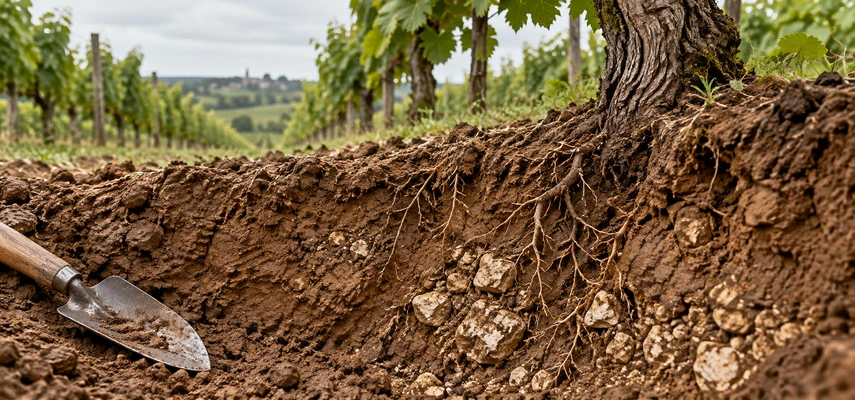
Clay and limestone-rich sites are important in the Right Bank discussion. Soil influences water availability, drainage and the root environment, helping explain why particular sites can suit Merlot. It doesn’t mean every Merlot vineyard must contain the same soil or that clay supplies a literal plum flavour.
The useful reasoning is physical: how does the site provide water, warmth and suitable conditions for ripening? A soil word should begin that explanation rather than replace it. Vineyard management and the particular season remain part of the result.
The Bordeaux wine body’s Merlot profile provides regional context for the variety, its growing conditions and its fruit-led contribution to blends.
This distinction also prevents the geographical shortcut “Right Bank equals one terroir.” Saint-Émilion and Pomerol include differences in site and production. Learn the broad Merlot association while retaining the possibility of variation within each name.
Bordeaux: origin, bank and blending
Bordeaux is the broad regional association. On the Right Bank, Saint-Émilion and Pomerol are especially important Merlot names. Blends can include Cabernet Franc and other varieties, so neither appellation should be translated automatically into “100 percent Merlot.”
Merlot can provide ripe fruit, body and a relatively rounded impression. Cabernet Franc or Cabernet Sauvignon can contribute different aromatic or structural elements, depending on the blend. The producer uses components to reach an intended balance, not to hide the identity of one grape.
Contrast this with the Cabernet-led Left Bank reference from Article #8. You are comparing typical roles in blends, not declaring a border beyond which either variety is forbidden. Bordeaux’s geography helps organize the lesson; it shouldn’t become an invented rule about every vineyard.
Saint-Émilion and Pomerol aren’t grape names
A label may emphasize the appellation without making the blend obvious. Recognizing Saint-Émilion and Pomerol therefore helps connect the wine with a Merlot-important context. If a question asks about the grape association, reading the place correctly can be more useful than expecting a prominent variety name.
Saint-Émilion has its own classification context; Pomerol shouldn’t be forced into an identical ladder. More broadly, don’t transfer every occurrence of Grand Cru or Classé from one Bordeaux area to another. Article #25 will make those term comparisons explicit.
For now, the durable fact is the grape-region relationship plus its stylistic logic. A potentially rich, structured Right Bank wine can be Merlot-led, even if your first encounters with Merlot were inexpensive, soft, early-drinking bottles.
Pays d’Oc: another French context
Pays d’Oc is the prescribed French PGI association outside Bordeaux. It provides a broader-origin context for varietally labelled Merlot, including accessible fruit-led styles. It’s important because it stops “French Merlot” from becoming a synonym for two prestigious Right Bank appellations.
The same grape can appear at different quality levels and prices, with different production aims. More specific origin, vineyard concentration and maturation choices can matter, but an origin name doesn’t tell you everything about the particular bottle. Start with the wine’s characteristics and use the label as supporting context.
Extraction, oak and maturation: don’t overwork the fruit
Merlot is normally fermented with skins to extract colour, tannin and flavour. Contact time, temperature and cap management influence the result. A producer seeking a supple style can choose differently from one building a more structured wine for maturation.
Oak can add secondary character such as vanilla, toast or spice, and can form part of the maturation plan. New oak gives a different potential impact from repeatedly used vessels. Strong wood flavours aren’t a direct measurement of Merlot’s inherent quality or a requirement for every serious example.
Malolactic conversion commonly forms part of red production, but obvious butter isn’t the central sensory reference. Blending can add complexity or consistency. Explain these options separately so that “oaked blend” doesn’t become a single undefined category that somehow answers every production question.
California, Napa Valley and Sonoma
California is the broad US origin, with Napa Valley and Sonoma also prescribed. Suitable warmth can support ripe plum and black-fruit character, fuller body and relatively high alcohol in richer examples. Cooler sites and differing harvest decisions produce variation within those origins.
Merlot can appear as a varietal wine or in blends. Don’t assume its softness relative to Cabernet means it is always less concentrated, cheaper or lower in alcohol. Those are separate features that need evidence from the particular wine.
The useful comparison with Bordeaux concerns the specified examples’ ripeness, body, acidity, tannin and production choices. An answer that says “New World Merlot is fruity” misses the fact that ripe fruit can matter in Bordeaux too. State the degree and the structural differences rather than merely naming a continent.
Chile’s Central Valley and South Africa’s Stellenbosch
Central Valley is the prescribed Chilean association. Merlot can provide accessible ripe-fruit styles as well as more ambitious wines, depending on site and production. Learn the broad origin without assuming one exact climate, quality or oak treatment for every bottle.
Stellenbosch is the South African name to retain. Here Merlot can appear in blends with Cabernet Sauvignon or as a varietal expression. Suitable ripening and complementary components help explain the relationship; “South African” isn’t a substitute for describing tannin or fruit.
When comparing these origins, use the question’s actual wine description rather than inventing national tasting notes. If one example has softer tannins and ripe plum while another is firmer and oak-influenced, explain those observations through material and handling. Geography helps supply context, not an automatic answer.
Margaret River and Hawke’s Bay
Margaret River is the prescribed Australian Merlot association and an important Cabernet–Merlot blending context. Merlot can contribute fleshier fruit and a rounded impression alongside Cabernet’s structure. The maritime setting and producer choices help shape the result.
Hawke’s Bay is the New Zealand association. The national wine body’s discussion of these blends describes the combination of Cabernet structure with Merlot’s ripe fruit and the importance of suitable warmer sites. These wines are an essential part of the country’s range alongside its better-known whites and Pinot Noir.
Notice the repeating mechanism across countries: the varieties can complement one another, while site and ripeness change their individual contributions. That repeated logic is worth remembering. The wines needn’t taste identical for the blending principle to remain useful.
Ageing, quality and common exam traps
Some Merlots are intended for early drinking, while concentrated, balanced examples can develop in bottle. Tannins can soften, colour can move toward garnet and fresh fruit may evolve toward dried-fruit or savoury character. Age alone doesn’t guarantee improvement, as WSET explains in its guide to wine ageing.
Merlot isn’t always light, low-alcohol or simple. Softer than Cabernet doesn’t mean tannin-free. Saint-Émilion and Pomerol are origins, not grapes, and a Merlot-important blend isn’t necessarily pure Merlot. Finally, learn all the prescribed New World associations rather than stopping at California because it is familiar.
Related study guides
Knowledge check: 10 original practice questions
Choose one answer each. These independent questions support LO3 and related blending mechanisms.
1. Which fruit association is useful for Merlot?
- Plum.
- Only lime in every example.
- Mandatory petrol.
- No recognizable fruit.
2. How does Merlot generally ripen relative to Cabernet Sauvignon?
- It never ripens.
- Earlier.
- Only after raisins form.
- At a universally identical moment.
3. Which pair is especially associated with Right Bank Merlot?
- Sancerre and Touraine.
- Chablis and Mâcon.
- Saint-Émilion and Pomerol.
- Mosel and Pfalz.
4. Which statement about a Merlot-led Bordeaux is sound?
- It must be entirely Merlot.
- It cannot contain tannin.
- It must be sweet.
- Other varieties can contribute to the blend.
5. What does softer tannin relative to Cabernet mean?
- A comparison, rather than a guarantee of no tannin or structure.
- A proof of no alcohol.
- A guarantee of sweetness.
- A rule forbidding oak.
6. Which is the prescribed Australian Merlot association?
- Mosel.
- Margaret River.
- Mendoza.
- Tokaj.
7. Which is the prescribed New Zealand Merlot association?
- Coonawarra.
- Napa Valley.
- Hawke’s Bay.
- Priorat.
8. What can Merlot contribute to a Cabernet-based blend?
- A mandatory sparkling character.
- Proof of low quality.
- Removal of every acid.
- Ripe fruit and a relatively rounded impression.
9. Which South African region is prescribed for Merlot?
- Stellenbosch.
- Alsace.
- Rioja.
- Casablanca Valley.
10. Which statement about ageing is correct?
- All Merlot is incapable of development.
- Some concentrated, balanced examples can develop, while many suit earlier drinking.
- Every Merlot needs decades.
- Age guarantees improvement regardless of quality.
Answers and explanations
1. A — Grape character; LO3. Plum is a useful reference, with red- or black-fruit emphasis depending on ripeness and style.
2. B — Growing conditions; LO3. Earlier ripening helps explain Merlot’s complementary role in Bordeaux and other blends.
3. C — Bordeaux geography; LO3. Both are prescribed Right Bank associations where Merlot is especially important.
4. D — Blending; LO3. Merlot-led doesn’t mean pure Merlot; other components can contribute aroma and structure.
5. A — Structure; LO3. Relative softness doesn’t establish a lack of tannin, concentration or ageing potential.
6. B — Australia; LO3. Margaret River is the assigned Merlot origin and an important blending context.
7. C — New Zealand; LO3. Hawke’s Bay is the prescribed association, including relevant Bordeaux-style blends.
8. D — Blending purpose; LO3. Merlot can complement Cabernet’s firmer framework with fruit and a rounder impression.
9. A — South Africa; LO3. Stellenbosch is the required regional association for Merlot.
10. B — Ageing; LO3. Capacity to develop depends on the individual wine and its intended style, not one grape stereotype.
One-page revision summary
| Country | Prescribed origins | Remember |
|---|---|---|
| France | Pays d’Oc; Bordeaux; Saint-Émilion; Pomerol | Broad PGI and Bordeaux origins; Right Bank importance |
| USA | California; Napa Valley; Sonoma | Ripe-fruit styles and varied production ambitions |
| Chile | Central Valley | Broad origin; avoid a single compulsory profile |
| South Africa | Stellenbosch | Varietal and blending contexts |
| Australia | Margaret River | Complementary role with Cabernet |
| New Zealand | Hawke’s Bay | Suitable ripening sites and important red blends |
Merlot’s identity rests on fruit, relative structural softness and useful ripening behaviour. Attach the regions and production choices to that framework, and “soft” becomes an informative comparison rather than a dismissal.












