










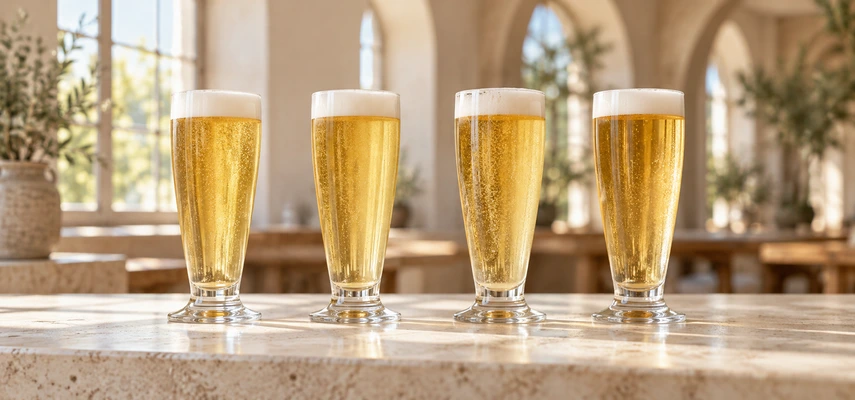

Four glasses arrive, all clear, pale and neatly capped with white foam. If pale lagers were one flavor, choosing between them would be easy. In practice, one may feel especially lean, another gently grainy, and another rounder and more bread-like. Their similarities make the differences worth studying.
The Level 2 group here contains American lager, international pale lager, light lager and Munich helles. The official specification places them among malt-driven styles. Pale describes appearance; malt-driven describes the main sensory emphasis. Neither term requires the beer to be dark, heavy or intensely sweet.
Pale lagers share a foundation, not one recipe
These beers typically combine light-colored brewing material with lager fermentation and a restrained overall expression. Their clarity and relatively delicate flavor leave little room to hide unwanted fermentation or storage character. Producing something subtle can demand considerable control even when the finished beer is easy to drink.
Hop bitterness provides balance, but intense contemporary hop aroma is not usually the defining feature of this group. Malt and other grain expression can range from very light to clearly bready. Carbonation, attenuation and starting extract influence how the beer feels alongside those aromas.
The useful comparison is therefore multi-dimensional. Look at grain intensity, hop expression, perceived sweetness, body and strength together. Do not try to identify the style from a single pale-gold observation, and do not infer that the mildest aroma automatically belongs to the lowest-quality beer.
American lager: restrained and refreshing
American lager typically appears very clear and pale straw to gold, with white foam. Aroma is restrained: light grain, possible corn-like sweetness and little prominent hop character. The palate is crisp, with low bitterness and a relatively neutral fermentation profile rather than obvious banana, clove or intense fruit.
Body is light, carbonation is lively, and the finish commonly feels dry to balanced. Alcohol is modest in sensory impact rather than warming or dominant. Barley malt with maize or rice adjuncts is common, although exact recipes vary. Adjunct use can help create a lighter grain impression; it is not a synonym for careless production.
Compared with Munich helles, the grain profile is generally less richly bready. Compared with light lager, it often offers a little more substance and strength. Those are useful tendencies, not a promise that every commercial example lies neatly between every other example on a tasting table.
International pale lager: broad commercial territory
International pale lager is usually clear, pale straw to gold and white-headed. It commonly presents restrained grain or malt with low hop aroma and a clean lager-fermentation impression. Bitterness can be more noticeable than in a very mild American lager while remaining far from a modern strongly hopped lager.
The body is typically light to medium, with moderate-to-high carbonation and a relatively crisp finish. Malt may suggest grain, light bread or a little sweetness, balanced by hops. Alcohol normally supports an everyday lager presentation rather than announcing itself through pronounced warmth. Malt-only and adjunct-containing recipes can both occur.
International is a descriptive style category, not a protected geographical guarantee or a single worldwide recipe. Compared with American lager, this territory can show more malt or bitter presence. Compared with helles, it usually lacks the same deliberate emphasis on rounded fresh-bread malt. Commercial boundaries overlap, so describe the beer before arguing about its passport.
Light lager: reduced weight, not simply pale color
The light lager in this study context is represented by the American light lager style reference. It is very pale and clear with a white head, restrained grain aroma and little hop aroma. Bitterness is low, body is very light and carbonation can feel prominent against the delicate flavor.
Its production aims for a reduced-strength, reduced-calorie or lighter presentation relative to standard counterparts, depending on the product. A relatively low starting extract and a highly fermentable wort are among relevant production choices. Adjuncts can help create the intended lean profile. Final sweetness is generally low, with no strong alcohol warmth expected.
Do not confuse light with the German word helles. Helles concerns a pale lager style with a particular malt profile, while light lager here concerns a leaner product category. Legal labeling claims also vary by market; this sensory lesson does not establish one universal legal definition for every bottle displaying light.
Munich helles: pale beer with a malt center
Munich helles is generally clear and pale yellow to gold with a white head. Its defining impression is soft, rounded pale malt, often suggesting fresh bread or grain. Traditional herbal, floral or spicy hop notes can provide background detail without overtaking that center.
The palate tends toward malty balance with restrained bitterness, medium body and moderate carbonation. Malt sweetness should remain integrated with a clean, drinkable finish rather than becoming syrupy. Alcohol is generally moderate and unobtrusive. Pale base malt, measured hopping and well-managed lager fermentation help establish the profile.
Compared with a German pilsner, helles is usually less bitter and less hop-led. Compared with a very lean light lager, it has more rounded malt presence and body. Pale color therefore tells you almost nothing about which sensory component dominates: two similarly golden beers can occupy different positions in the course’s style families.
Why grain choices change the impression
Pale base malt can supply delicate bread or cracker character without deep color. A recipe that foregrounds that material can feel malt-driven even with little caramel or roast. Those darker associations are only part of the enormous range of grain-derived flavors.
Replacing some malt contribution with suitable rice or maize can shift flavor and the mix of brewing material. The effect depends on product, proportion and process. An adjunct-containing lager is not automatically sweeter merely because the original ingredient contains starch that will become sugar.
Fermentation matters to that last point. Much of the available fermentable material becomes alcohol and carbon dioxide, so the finished sweetness is not the sweetness of the wort. When comparing recipes, ask what remains after yeast has worked, not just what went into the mash.
Fermentation makes subtle differences easier to notice
Lager production commonly pursues restrained fruity expression in this group. The brewer manages strain, temperature and maturation so unintended buttery, green-apple or excessive sulfur character does not mask the intended grain-and-hop balance. None of that makes fermentation flavorless; it means its expression is controlled.
Because the beers are delicate, a small unwanted note may seem more obvious than it would in a stronger or more aromatic beer. This is one reason easy drinking should not be mistaken for easy production. There may be fewer bold flavors available to distract the taster.
Do not diagnose the entire process from one aroma, however. A little sulfur-related character needs context, and a stored sample may have changed after leaving the brewery. Style comparison and fault evaluation are related skills with different evidence requirements.
Use a comparison grid without forcing the answer
Start with appearance, then compare aroma, bitterness, sweetness, body and carbonation. Put alcohol impression in its own column. You may find four nearly identical color descriptions and four different explanations of balance. That is progress, not a failed tasting exercise.
Next, connect each difference to a plausible production choice. Reduced starting extract can explain lower strength potential; recipe fermentability can influence dryness; pale malt emphasis can explain bread-like character; hop decisions influence bitterness and aroma. Mark possibilities as possibilities until reliable recipe information supports them.
This method also works without drinking. Use verified descriptions from an educator or producer and remove the names first. Group the evidence, propose a style, then explain which observation matters most. The reasoning step is more valuable than guessing a familiar brand correctly.
Avoid three tempting shortcuts
First, all pale lager is not pilsner. Pilsner comparisons belong in Article #17, where hop-driven lager profiles become the focus. Here, the delicate malt or grain center matters even when bitterness is present.
Second, low intensity is not the same as poor quality. Balance, cleanliness of expression and appropriate presentation matter within the intended style. A subtle lager should not be graded down simply for declining to behave like a double IPA.
Third, light, pale and dry are different claims. Color is visual, light lager is a contextual style or product term, and dryness is a sensory impression influenced by residual composition and balance. Keep them separate and many plausible-looking examination distractors lose their appeal.
Optional tasting and service context
If you choose to taste and are legally eligible, compare small samples in matching clean glasses under similar conditions. Very cold beer can suppress aroma and make differences harder to notice, while uneven serving temperatures can create misleading body and aroma contrasts. No alcohol consumption is necessary for theory preparation.
For these relatively delicate beers, freshness and light protection matter. A stale or light-struck sample may tell you more about handling than the style’s intended profile. Record suspected faults separately rather than building an entire style definition around a damaged bottle.
One-page revision summary
American lager is generally restrained, light-bodied and low in bitterness. International pale lager occupies broader territory with possible extra malt or bitter presence. Light lager emphasizes a leaner, often lower-strength presentation. Munich helles gives rounded pale malt a clearer central role.
All four can be pale, clear and lager-fermented without tasting identical. Use recipe composition, starting extract, fermentability, hop decisions and maturation to explain the differences. The most useful observation is not that the beers look similar, but how many decisions can sit behind that shared appearance.
Continue your beer studies
Explore the related lessons on malt explained alongside brewing adjuncts to extend the ingredient, process or sensory reasoning in this article.
Knowledge check: 10 original practice questions
Independent TFE questions, not official WSET examination items. Choose one answer per question; explanations follow separately.
1. Why can Munich helles be malt-driven despite pale color?
- Only black malt can taste malty
- Pale malt can provide a central bready character
- All helles is unhopped
- Color measures fermentation yeast
2. Which style generally emphasizes the leanest body in this comparison?
- Munich helles
- Imperial stout
- Light lager
- Doppelbock
3. Which ingredient choice is common in American lager production?
- Barley malt with rice or maize adjuncts
- Mandatory smoked malt only
- Mandatory cherries and Brett
- Only roasted barley without conversion support
4. How does Munich helles generally compare with German pilsner?
- It is always darker than dunkel
- It has mandatory sourness
- It has no fermentation
- It is usually less bitter and more centered on pale malt
5. What does international pale lager imply here?
- A broad style category rather than one protected worldwide recipe
- Exactly the same grist at every brewery
- Mandatory high alcohol
- A legal guarantee of international ingredients
6. Why might high carbonation seem prominent in light lager?
- It means the beer contains more roast
- The delicate flavor and body leave the gas sensation more exposed
- It proves spontaneous fermentation
- It requires oak ageing
7. Which observation alone proves a beer is Munich helles?
- Clear gold color
- A white foam head
- None of these observations alone
- The use of a clean glass
8. Why does adjunct use not automatically mean sweet finished beer?
- Adjuncts contain no brewing material
- All adjuncts are bitter
- Sweetness is determined only by color
- Fermentation can consume the sugars produced from adjunct material
9. Which statement distinguishes helles from light lager correctly?
- Helles is a pale lager style with rounded malt; light lager here describes a leaner category
- Helles means alcohol-free worldwide
- Both terms have identical universal legal meanings
- Light lager must be darker
10. Why can damaged storage complicate a pale-lager comparison?
- Storage cannot affect these beers
- Staling or light strike may mask the intended delicate profile
- All lager is meant to age indefinitely
- A fault automatically defines the style
Answers and explanations
1. B — Pale malt can provide a central bready character. Malt character includes pale grain and bread as well as darker toast or roast. Malt-driven describes sensory emphasis, not required darkness. Mapping: LO3 AC1/AC2.
2. C — Light lager. The prescribed light-lager territory emphasizes a very light, restrained presentation. The other listed styles do not share that central aim. Mapping: LO3 AC1.
3. A — Barley malt with rice or maize adjuncts. Rice or maize adjuncts commonly help create a lighter grain profile in American lager, although actual recipes vary. Mapping: LO3 AC2.
4. D — It is usually less bitter and more centered on pale malt. The useful contrast is malt-centered helles versus more hop-led German pilsner. Similar pale appearance does not establish identical balance. Mapping: LO3 AC1/AC3.
5. A — A broad style category rather than one protected worldwide recipe. International pale lager organizes a family of sensory and production tendencies. It does not prescribe one recipe or protected ingredient origin. Mapping: LO3 AC1.
6. B — The delicate flavor and body leave the gas sensation more exposed. Carbonation is experienced in relation to the beer’s other properties. Lively gas can be particularly noticeable in a very light-bodied beer. Mapping: LO3 AC1/AC3.
7. C — None of these observations alone. Multiple pale lager styles share clarity, color and foam. Identification needs the combined sensory profile and reliable production or label context. Mapping: LO3 AC1.
8. D — Fermentation can consume the sugars produced from adjunct material. Starch-derived fermentable sugars can become alcohol and carbon dioxide. The original ingredient’s role does not guarantee residual sweetness. Mapping: LO3 AC2/AC3.
9. A — Helles is a pale lager style with rounded malt; light lager here describes a leaner category. The names organize different concepts. Helles should not be translated into a claim that it is the same style as American-style light lager. Mapping: LO3 AC1.
10. B — Staling or light strike may mask the intended delicate profile. Relatively restrained grain and hop profiles can be obscured by handling-related damage. Describe the intended style separately from suspected faults. Mapping: LO3 AC1/LO4 AC1.












