










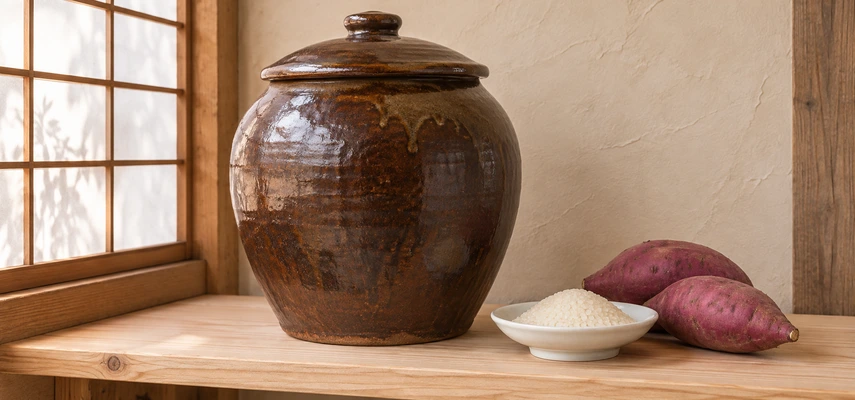

Shōchū rewards a small change in perspective. Instead of starting with a familiar whisky mash and asking what is different, start with two separate jobs: making fermentable sugar and turning that sugar into alcohol. In the characteristic honkaku shōchū process, koji provides enzymes for the first job, while yeast performs the second. Distillation then selects from the resulting mixture.
The broader name also includes a continuous-distilled tradition with a different production goal. Awamori supplies another important variation within the pot-distilled family. For Level 3 these are Learning Outcome 3 topics, so the exercises here use multiple-choice questions rather than inventing written-exam requirements for this additional spirit category.
Shōchū includes different distillation routes
The National Research Institute of Brewing’s introduction distinguishes pot-distilled and continuous-distilled shōchū. Honkaku shōchū and awamori belong to the pot-distilled group. Continuous-distilled shōchū, often called kōrui, generally follows a more highly rectified route and retains less of the original material’s character.
This is not a comparison between distilled and undistilled beverages. Both routes involve fermentation and distillation. Nor should shōchū be confused with sake, a brewed drink without the same distillation step, or with Korean soju merely because the names sound related. Production identity is more informative than a resemblance between words.
The term honkaku is often translated as authentic, but the translation should not become a shortcut for deciding every quality question. It identifies a traditional production family. To describe a particular spirit, still consider the actual base material, koji, fermentation, distillation conditions and storage rather than relying on the positive implications of an English adjective.
Koji is a cultured material, not another name for yeast
Koji is material on which a selected mold has been grown. Its enzymes break starch into smaller carbohydrates that yeast can ferment. The organisms have different roles: mold growth develops the enzyme source, while alcoholic fermentation is the yeast’s work. Calling both organisms yeast makes the process harder to understand and can produce incorrect exam answers.
JSS explains koji’s several production functions. Besides starch-converting enzymes, black and white koji are important for citric acid production, helping maintain an acidic mash that discourages unwanted microbial growth. Koji treatment also affects flavor precursors, so it contributes more than a convenient supply of sugar.
Black, white and yellow koji are not interchangeable color descriptions for the finished spirit. They refer to mold traditions used in production. Black and white are particularly important in shōchū; yellow is also used for some expressions. Their contributions and management differ, so avoid assuming every koji choice leads to exactly the same fermentation environment.
Growing koji happens before the main alcoholic fermentation
For rice koji, the producer prepares the grain by washing, soaking and steaming, then cools it before inoculation. The mold grows under controlled temperature and humidity conditions. This is a managed culture stage, not a matter of leaving grain unattended until a visible growth appears. Preparation provides an appropriate substrate and environment for the selected organism.
During growth the producer manages conditions to support the desired enzyme and acid contribution. That controlled preparation distinguishes koji from an accidental contamination. It also separates this route from malting, where germination of the grain itself develops the enzyme system. Both can provide starch-conversion capability, but they do so through different biological processes.
Do not assume the material used for koji is always the same as the main named ingredient. A sweet-potato shōchū may use rice koji. The rice supplies a cultured enzyme source while the added sweet potatoes make a separate contribution to the mash and spirit. A main-ingredient description is not necessarily a complete ingredient list.
Honkaku commonly uses a two-stage mash
In the typical sequence described by JSS’s production guide, koji, water and yeast form the first moromi, or starter mash. This establishes a population of yeast in an appropriate acidic environment. The main prepared ingredient and more water are then added for the second moromi.
Starch conversion and fermentation can proceed together in that main mash. Enzymes release sugars while yeast consumes fermentable material and produces alcohol and other compounds. This differs from imagining that every starch molecule must be converted in a completely separate vessel before fermentation begins. Keep the simultaneous activities distinct even though they share a vessel.
The two additions are not two complete distillations, and they do not mean the finished spirit is necessarily a blend of two independently made liquors. They describe preparation and fermentation stages. Once the fermented mash is ready, pot distillation provides the next selection step in the characteristic honkaku route.
Raw material choices create a broad family
Rice, barley and sweet potato are important examples, with other permitted materials supplying further styles. Their composition and preparation influence what is available during koji treatment, fermentation and distillation. A cereal, a starchy root and a sugar-containing material do not all begin in the same physical or chemical state.
Rice-based profiles can show restrained cereal, fruit or floral character, while barley can contribute cereal and toasty associations. Sweet-potato expressions can show earthy, floral or fruity detail depending on material and process. These are useful comparison points, not a rule that every bottle must display a fixed list of aromas.
JSS’s flavor-profile discussion emphasizes material, koji and distillation together. That prevents a common error: identifying a sensory effect with the raw material alone when processing also changes its expression. A light barley shōchū and a fuller barley expression need not contradict each other.
Pot distillation can use atmospheric or reduced pressure
Honkaku shōchū is characteristically distilled once in a pot still. Atmospheric operation and reduced-pressure operation offer different conditions. Reducing pressure lowers the temperature at which the mixture boils, changing the thermal environment and the collected composition. A single distillation does not mean all producers use an identical still or temperature regime.
JSS’s distillation guide associates atmospheric operation with fuller raw-material expression and reduced-pressure operation with lighter, more floral styles. Treat these as tendencies within the category. Material, fermentation and collection choices still matter, and lighter is not automatically better or less complex.
Pressure knowledge belongs to the prescribed descriptive toolkit here. Its technical interest does not turn this LO3 topic into an explain-type written-examination requirement. In revision, first identify which category and learning outcome a question addresses, then use the appropriate level of detail and form of answer.
Column-distilled shōchū follows a different goal
JSS’s overview distinguishes kōrui as a column-distilled spirit that can use cereals or molasses and retains relatively little starting-material flavor. Repeated separation produces a more highly rectified base, which is subsequently reduced to its intended strength. Do not assume the pot-distilled two-moromi account describes every continuous producer.
This restrained profile suits a different role from a spirit designed to emphasize its main ingredient. Comparing the two routes helps organize the category without treating one as unfinished or defective. The producer’s target and the resulting composition remain more useful than a simple opposition between industrial and traditional imagery.
Legal limits distinguish the two groups
Japan’s Liquor Tax Act, Article 3, defines continuous-distilled shōchū below 36% ABV and single-distilled shōchū at no more than 45% ABV. These are category-strength boundaries, not instructions that every producer must bottle exactly at the boundary. Familiar strengths such as 20% or 25% are not the only possible bottlings.
The definitions also exclude specified neighboring production routes: germinated cereals and fruit, subject to statutory exceptions, designated birch-charcoal filtration, and extracting other materials into the emerging alcohol during distillation. Sugar-containing materials have additional conditions and exceptions. These boundaries help separate shōchū from whisky, brandy, vodka-like and botanical-distillation routes; they should not be simplified into a ban on every imaginable grain or sugar use.
For the single-distilled family, the act lists permitted ingredient pathways involving grains or potatoes and koji, all-grain-koji mashes, sake lees, and specified sugar with rice koji, among others. Honkaku terminology adds its own production identity. Avoid an unsupported claim that the wider statutory single-distilled category permits absolutely no additions under any circumstances.
Awamori makes the koji distinction especially clear
Awamori traditionally uses indica rice and black koji. Instead of the typical honkaku pattern of adding a separate main ingredient to an established first moromi, its all-koji rice mash follows a single main fermentation arrangement. The rice is both the main material and the substrate on which the koji was prepared.
Pot distillation retains a distinctive mixture that can develop during storage. Okinawa is central to the tradition, while the protected geographical identity Ryukyu Awamori carries its specific origin requirements. Keep the general production type and the protected geographical name distinct rather than assuming every similar rice spirit automatically earns the GI.
Storage can develop character without compulsory oak color
Resting and maturation can occur in suitable vessels including tanks and traditional jars; wood use is another choice requiring its own context. Changes during storage do not need to resemble whisky’s extraction from an oak cask. A spirit can remain clear while developing a different aromatic relationship over time.
The JSS guide to honkaku shōchū and awamori identifies kusu as awamori wholly matured for at least three years. Traditional shitsugi replenishes older stocks from younger ones in a managed sequence. It does not turn every component into the age of the oldest jar or remove the need to follow applicable age-label rules.
What to remember
Separate enzyme-making koji, alcohol-making yeast and the still’s selection step. Compare two-stage honkaku preparation with awamori’s all-koji rice approach, then distinguish pot distillation from the more highly rectified continuous route. Keep the below-36 and at-most-45 boundaries attached to their correct groups, and describe storage through what actually happens rather than expecting oak color.
Knowledge check: 12 original practice questions
Independent TFE questions, not official WSET examination items. Choose one answer per question; explanations follow separately.
1. What is the single-distilled category strength ceiling?
2. Which organism performs alcoholic fermentation in the described mash?
3. What is koji?
4. What distinguishes this lesson assessment scope?
5. Can sweet-potato shōchū use rice koji?
6. What is the continuous-distilled category boundary cited here?
7. Which route is associated with kōrui shōchū?
8. What does kusu require in the cited current description?
9. What characterizes awamori preparation?
10. What is the first moromi in the typical honkaku sequence?
11. Does clear appearance prove that no storage development occurred?
12. How does reduced pressure affect the boiling environment?
Answers and explanations
- B — 45% ABV. The statutory single-distilled ceiling differs from the continuous-distilled boundary. Mapping: LO3.
- D — Yeast. Yeast uses fermentable sugars and produces ethanol and other compounds. Mapping: LO3.
- B — Material cultured with a selected mold. The culture supplies enzymes and other contributions before and during mash processing. Mapping: LO3.
- C — LO3 multiple-choice preparation. The prescribed category is taught without inventing written-examination eligibility. Mapping: LO3.
- C — Yes. The koji substrate can differ from the named main ingredient. Mapping: LO3.
- A — Below 36% ABV. The category boundary must not be confused with distillation strength or a typical bottle strength. Mapping: LO3.
- D — Continuous column distillation. The column route produces a more highly rectified profile. Mapping: LO3.
- B — All the awamori matured for at least three years. The whole-product condition prevents the oldest component from standing in for all of the blend. Mapping: LO3.
- B — An all-koji rice mash using black koji. The traditional rice and black-koji combination differs from the typical two-stage honkaku pattern. Mapping: LO3.
- A — A starter mash of koji water and yeast. It establishes the starter before the main ingredient addition. Mapping: LO3.
- B — No. Development during storage need not involve extraction of visible oak color. Mapping: LO3.
- A — It permits boiling at lower temperature. The changed temperature environment helps distinguish the described distillation styles. Mapping: LO3.
Continue exploring this series
3. Alcoholic Fermentation Explained: Yeast, Nutrients, and Flavor Compounds
4. Fermentation Methods Explained: Liquid, Solid-State, Sequential, and Parallel Fermentation
7. Column and Hybrid Stills Explained: Plates, Reflux, and Continuous Distillation
8. How Distillers Manage Flavor: Sulfur, Esterification, Pressure, and Distillation Choices
11. How Grains Become Whisky: Malting, Mashing, Enzymes, and Starch Conversion
26. Vodka Explained: Neutral Spirits, Raw Materials, and Production Choices
31. Irish, Canadian, and Japanese Whisky Explained: Production, Laws, and Styles
33. Baijiu Explained: Qu, Solid-State Fermentation, and China’s Major Styles
34. Soju Explained: Korean Distilled and Diluted Spirits
50. WSET Level 3 Spirits Exam: Complete Revision Guide and Practice Examinations












