










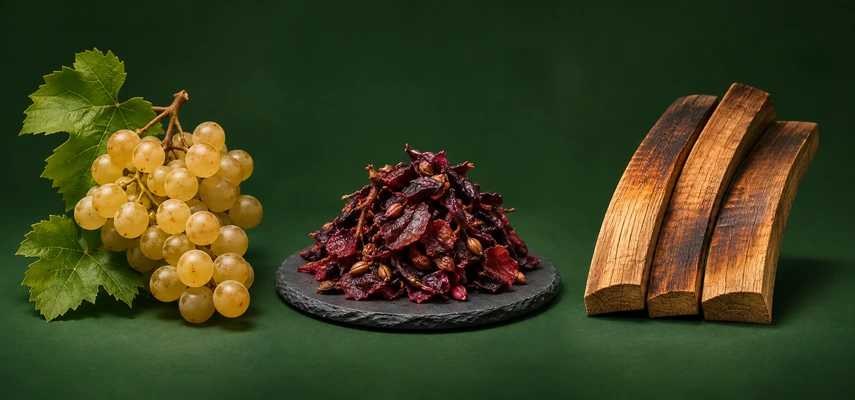

Pisco, Grappa and Brandy de Jerez all begin with grapes, but they do not begin with the same distilling material or finish with the same treatment. One comparison follows freshly fermented grape must, another uses the skins left after winemaking, and another gives wine spirit a distinctive relationship with sherry-seasoned casks. The shared fruit is the beginning of the story.
For Level 3, organize these traditions around grapes, fermentation, distillation and post-distillation operations, then attach each legal identity to the correct place. These are Learning Outcome 3 subjects, assessed through multiple-choice knowledge rather than the written-exam explanation tasks used for principal categories elsewhere in the course.
Pisco needs two national frameworks
Peru and Chile both produce grape spirits called Pisco under different national frameworks. A rule from one cannot simply be transferred to the other. Discuss the actual production and label identity rather than trying to settle the naming dispute through an invented universal recipe. The practical comparison is technically interesting without requiring a verdict on national origin claims.
Grape selection matters in both settings. Aromatic varieties can contribute floral and fruit character, while less overtly aromatic grapes offer another starting profile. Fermentation and separation determine how those contributions reach the spirit. Aromatic describes a grape’s character, not an automatic guarantee of greater sensory complexity or quality.
Peru specifies grapes and production geography
The Peruvian denomination regulations identify eight varieties: Quebranta, Negra Criolla, Mollar, Uvina, Italia, Moscatel, Albilla and Torontel. The last four form the aromatic group in that framework; Uvina has additional locality restrictions. Production geography includes coastal areas of Lima, Ica, Arequipa and Moquegua, plus specified valleys in Tacna.
The distinction between aromatic and non-aromatic does not mean the latter are literally odorless. It is an organizing category for grape character. A less overtly perfumed variety still supplies a fermented mixture capable of producing a distinctive spirit. In a tasting, describe what is present rather than repeating the grape-group term as if it were the whole note.
Peruvian Pisco keeps selection and resting tightly connected
Freshly fermented must is distilled directly and discontinuously, with collection producing spirit in the prescribed 38–48% ABV range. Added water and sugar are prohibited. The resulting spirit rests for at least three months in a suitable vessel that does not alter its characteristic composition or appearance before bottling and sale.
That is a different task from making a high-strength spirit and later reducing it with water. The selected distillate must suit the intended finished strength and profile. Inert resting also differs from extracting oak character. A clear Peruvian Pisco should not be described as necessarily unstored simply because it has no visible barrel color.
The official Pisco Spirit of Peru material reinforces the importance of grape identity, direct distillation and resting. These are related choices: the producer works to preserve an appropriate grape-derived expression within the permitted route, rather than rebuilding it through an unrelated post-distillation flavor recipe.
Puro, mosto verde and acholado describe different decisions
Puro uses one permitted grape variety. Mosto verde comes from fresh must whose fermentation has been interrupted before completion; verde does not mean that the grapes must be picked unripe. Acholado involves an allowed combination of grape varieties or their products at the permitted stages. These terms organize material and processing choices, not three compulsory age categories.
Incomplete fermentation leaves some sugar in the distilling material, but that does not mean the spirit is simply a sweetened wine. Distillation selects a new mixture, and sugar does not transfer like ethanol and volatile aroma components. Learn the actual mosto-verde production decision rather than interpreting the term as proof of an added-sugar recipe.
Chile gives Pisco another range of options
Chile’s consolidated Decree 521 places the protected production zone in Atacama and Coquimbo and specifies permitted grape varieties. Important examples include Muscat-family grapes such as Moscatel de Alejandría and Moscatel Rosada, alongside other authorized varieties. The starting wine and its distillation are governed by that Chilean framework.
Chilean producers can reduce spirit with water and use permitted wood treatments, creating clear through yellow or amber presentations. The official ProChile guide illustrates that breadth. Where a promotional summary simplifies a legal figure, the consolidated regulation remains the better authority for the number.
The strength categories distinguish Corriente or Tradicional at a 30% minimum, Especial at 35%, Reservado at 40% and Gran Pisco at 43%. These should not be confused with a mandatory age ladder. A category’s bottling minimum describes strength; it does not independently state the exact distillation strength, wood history or quality of every product.
Grappa starts with pomace rather than finished wine
Pomace, also called marc, is the solid material remaining after grapes are pressed in winemaking, particularly skins and seeds. Poli’s account of the raw material makes that distinction central. Grappa is not merely wine brandy with an Italian-sounding name; its grape-pomace identity changes the material being prepared and distilled.
The fermentation history depends on the wine process. Red-grape skins have commonly spent time fermenting with the juice, while white grapes pressed before fermentation leave unfermented pomace that needs further preparation and fermentation. Semi-fermented material requires its own handling. The distiller needs alcohol in the material, not simply a container of dry grape skins.
Freshness and storage matter because the moist material can deteriorate. Careful handling preserves the useful starting composition and limits unwanted developments before distillation. Describing pomace as a by-product does not make its condition irrelevant, just as using a costly whole fruit would not automatically eliminate the need for good processing.
Grappa distillation handles a solid-rich material
Steam can pass through prepared pomace and carry volatile components toward separation and condensation. Other equipment arrangements use water baths or continuous systems. Poli describes its steam route, while the Hello Grappa production guide compares batch and continuous operation. These demonstrate alternatives, not a single compulsory pot-still silhouette.
Loading and contact matter because the vapor must pass effectively through a solid-rich material. The retained distillate is then selected for its intended composition. Equipment choice and collection are connected, so it is unhelpful to claim that every batch system is inherently superior or that continuous equipment necessarily removes all individuality.
The Grappa geographical identity is Italian and includes requirements concerning the grapes, vinification and production location. Its minimum commercial strength is 37.5% ABV. Do not extend the name automatically to every pomace spirit made elsewhere or assume that one regional Grappa specification describes every Italian product in all its additional details.
Young and wood-aged Grappa offer different expressions
A young Grappa can be rested in a suitable non-wood vessel and remain clear, emphasizing the relationship among grape material, fermentation and distillation. Wood-aged expressions acquire another set of contributions through extraction and other maturation changes. The starting spirit still matters even when barrel character becomes noticeable.
Poli’s producer FAQ is useful for separating its own equipment and product choices from the general identity. An aromatic grape association does not prove added botanicals, and a clear appearance does not prove an absence of resting. Ask what the distiller actually did before attaching a familiar style story to the glass.
Brandy de Jerez begins with suitable wine spirit
Airén is particularly important for the base wine, with Palomino also used. The grape-growing source of the wine should not be confused with the protected maturation area around Jerez de la Frontera, El Puerto de Santa María and Sanlúcar de Barrameda. A brandy’s maturation identity does not mean every grape must have grown beside the aging bodega.
The regulatory board describes pot and column distillation and spirits with differing concentrations. Lower-strength wine spirits traditionally called holandas retain a different composition from more highly rectified wine distillates. Selecting and combining those components helps establish the style that subsequently enters maturation.
Sherry-seasoned vessels and fractional aging shape the style
The board’s cask discussion describes the importance of vessels that previously contained sherry. Their previous use and contents influence the brandy’s development. Fino-seasoned and richer oxidative-wine-seasoned casks need not give identical results, so sherry cask is a family of production histories rather than one flavor.
In the familiar criaderas y solera system, a portion is withdrawn from the final scale and replenished from a younger scale, with corresponding movements through the system. This combines maturation and continuing blending. The solera’s founding date is not the age of every drop bottled, and average age should not be replaced by the oldest component’s age.
Current Jerez rules include an exceptional static route
The January 2026 EU amendment describes Solera, Solera Reserva and Solera Gran Reserva as averaging more than six months, one year and three years respectively. Minimum strength is 36% ABV. It also provides for exceptional añada brandy aged statically for more than twelve years, rather than blending different-aged batches through the usual fractional system.
The update includes qualified-age categories with specific controls and labeling restrictions. They should not be presented as unrestricted permission to print any average-age number on a label. For the core comparison, remember that fractional aging remains characteristic while the current framework also recognizes a controlled static exception.
What to remember
Peru and Chile give Pisco distinct national rules; Grappa makes pomace the defining material; Brandy de Jerez gives wine spirit a particular maturation setting and cask relationship. Compare grape selection, fermented material, distillation and final treatment in that order. The differences explain much more than the fact that all three traditions began in a vineyard.
Knowledge check: 12 original practice questions
Independent TFE questions, not official WSET examination items. Choose one answer per question; explanations follow separately.
1. What does Peruvian Pisco puro specify?
2. What does mosto verde describe?
3. Which Chilean category minimum is 43% ABV?
4. Why must Peruvian and Chilean Pisco be studied separately?
5. What is the defining Grappa distilling material?
6. Which grapes are especially relevant to the Jerez base-wine discussion?
7. What is the Peruvian Pisco resting minimum cited here?
8. What current exception prevents saying all Brandy de Jerez is fractionally solera-aged?
9. What does a steam route do in pomace distillation?
10. Why can white-wine pomace need fermentation before distillation?
11. Which Chilean regions form the protected Pisco zone?
12. What does a solera founding date establish?
Answers and explanations
- C — One permitted grape variety. Puro organizes grape identity rather than a compulsory wood-aging level. Mapping: LO3.
- A — Distillation before the must has completed fermentation. The defining decision concerns fermentation completion rather than grape skin color or an added pigment. Mapping: LO3.
- B — Gran Pisco. The consolidated Chilean regulation supplies the 43% minimum rather than a promotional 45% shorthand. Mapping: LO3.
- D — They operate under different national production frameworks. Rules on strength, treatment and location must stay attached to the correct national framework. Mapping: LO3.
- A — Grape pomace. Pomace distinguishes the spirit from wine-distilled brandy routes. Mapping: LO3.
- B — Airén and Palomino. Base-wine selection should be kept separate from the protected maturation geography. Mapping: LO3.
- B — Three months in a suitable non-altering vessel. Resting is required without imposing an oak extraction profile. Mapping: LO3.
- B — The controlled añada static-aging route. The 2026 framework recognizes a static route subject to its specific conditions and controls. Mapping: LO3.
- A — Passes steam through prepared material and recovers volatile components. The solid-rich material requires an appropriate contact and vapor-recovery arrangement. Mapping: LO3.
- D — It may have been pressed before fermentation. The material has to develop alcohol rather than relying on the presence of skins alone. Mapping: LO3.
- B — Atacama and Coquimbo. The Chilean zone is distinct from Peru geography and other grape-spirit identities. Mapping: LO3.
- A — The history of the system rather than the age of every bottled drop. Fractional withdrawals and replenishments make the system history different from individual component age. Mapping: LO3.
Continue exploring this series
5. Distillation Science Explained: Volatility, Congeners, Reflux, and Rectification
6. Pot Still Distillation Explained: Design, Heating, Cuts, and Flavor
9. Oak Maturation Explained: Barrels, Oxygen, Evaporation, and Flavor Development
10. Spirits Finishing Explained: Blending, Filtration, Sweetening, Coloring, and Packaging
16. How Fruit Spirits Are Made: Grapes, Wine, Pomace, and Fermentation
17. Cognac Explained: Grapes, Double Distillation, Oak, and Quality
19. Armagnac Explained: Grapes, Column Distillation, and Regional Styles
20. Cognac vs. Armagnac: How Production Decisions Shape Two Great Brandies
37. Calvados, South African Brandy, and European Fruit Spirits Explained
35. Other American Whiskeys Explained: Wheat, Malt, Corn, and Labeling Terms
50. WSET Level 3 Spirits Exam: Complete Revision Guide and Practice Examinations











